Tuesday, 10 November 2015

Bermuda’s Floating Dry Dock 1869

RMS Cedric - a giant in 1901
One of the more attractive aspects of the Victorian Age was the willingness to take on large and often unprecedented engineering challenges. This was perhaps never more so than at sea where, in the course of less than a century the definition of what constituted “a large vessel” changed by a factor of over 600%. In 1805, at the time of the Battle of Trafalgar, HMS Victory, of 3500 tons and 220 feet long, wind-powered and of wooden construction, was almost certainly larger than any merchant ship afloat. By 1901 the largest type of ship, the ocean liner, was typified  by the “Big Four” built for the White Star Line – Celtic, Cedric, Baltic and Adriatic – of over 21000 tons and 720 feet long, driven at 17 knots by steam-power and built of steel.

For the world’s navies the process had taken off in the 1860s, with the arrival of the sea-going ironclad, typified by the Royal Navy’s innovative HMS Warrior of 9200 tons and 420 feet long. Yet larger ironclads were to follow in quick succession. Maintenance of such huge vessels, especially exterior access to their hull-plating below normal water level, posed new challenges. The mechanics of corrosion caused by galvanic action was still imperfectly understood and so demanded regular inspection – and if necessary renewal – of plating. As a global mercantile power, dependent on naval protection in time of war, it was essential that Britain should have necessary repair facilities at its major bases scattered through the world. The most important facility available at any such location was a drydock which would allow full access to all parts of a hull exterior.

HMS Warrior - on display in Portsmoouth today
During the 19th Century the British island-possession of Bermuda, in the western part of the North Atlantic, was an important Royal Navy base. It was well placed for support of operations not just in the Atlantic but in the Caribbean as well and as such it replaced Halifax, Nova Scotia, in 1818 as the headquarters for the North America and West Indies Station. It was well defended with fortifications and coastal artillery batteries and a repair-dockyard was an essential requirement. Such a facility was accordingly constructed at Ireland Island on the west side of the Bermuda group. Much of the work was accomplished by convict labour, which was only finally withdrawn in 1863.

Bermuda dockyard in 1848 - note three hulks at right centre for accommodation of convicts
Construction of a conventional drydock – a basin which could be open to the sea and into which a ship could be floated, and which could be closed off by watertight gates and pumped dry – proved however to be challenging in the extreme. The problem was that the sandstone which constituted Ireland Island was porous, so that pumping out of any flooded excavation was negated by constant influx of water. The solution finally decided upon in the late 1860s was therefore to build a floating drydock. Such items were ship-length constructions of U-shaped cross section. When compartment’s in their bottoms were opened to flooding, they could sink until only the tops of the U’s arms remained above the surface.
Sequential operation of floating drydock (l to r) - as illustrated in an 1870 book on the Bermuda project
A ship could then be manoeuvred between the sides and when the bottom compartments were once more pumped dry the dock would rise, carrying the ship with it. An additional advantage of such docks is that they are mobile and can be built at a shipyard and towed thereafter to another location, or even succession of locations.

The Bermuda drydock nearing completion, Woolwich, 1868
By the 1860s the floating dock concept was known and proven but the growth in ship size demanded that what was needed for Bermuda would be the biggest such unit yet built. It was to take ships of up to 10000 tons – including Britain’s new ironclads – but its location in Bermudan waters, where marine growth was likely to foul it underwater valves and piping, would demand the facility to allow regular “careening” – cleaning by scraping. The design that resulted was 380 feet long and 120 feet separation between its vertical sides. It could accommodate vessels longer than its own length and its own displacement was 8400 tons.

The dock being careened during its working life, rolled over by flooding to expose the bottom
Construction started at the Campbell and Johnstone shipyard on the river Thames, near Woolwich, in 1866 – in this period, and up to the beginning of the 20teh Century, London was still a major ship-building centre. Construction was of iron – use of steel was still a decade or more in the future – and some 1400 men were involved in the work. It was launched, after one failed attempt, in September 1868 and was taken downriver to Sheerness, where it was submerged to wait out winter storms until the following year.  
The dry dock under tow, as seen from HMS Warriot - HMS Terrible can be glimpsed astern
and linked to it to facilitate manoeuvring.
 A tow of this magnitude and length – allowing for course alterations this was to amount to just under 4000 nautical miles – had not been attempted previously. Timing was essential so as to minimise the chance of encountering story weather. The start of the towing operation was accordingly postponed until June 1869.The specialist ocean-going tug concept had not yet been developed and two of Britain’s largest ironclads, Agincourt and Northumberland – were therefor tasked with the first leg of the tow, from Britain to Madeira.  This proceeded without incident, as did the second leg, from Madeira to Bermuda, the task now passing to HMS Warrior and her sister Black Prince. The average speed for the entire tow was a very respectable 4.8 knots, with 6 knots being exceeded on two occasions. Progress was helped by the open ends of the dock being closed off with pointed “cutwaters” to reduce drag, and when following winds were encountered a sail was rigged within the dock to take advantage of it. Manoeuvring was assisted by the veteran paddle-slop HMS Terrible being linked to the dock’s stern (see illustration above).

Triumphant progress, Warrior and Black Prince towing, Terrible astern of drydock
After its successful arrival in Bermuda the floating drydock was to provide over three decades of service until replaced by a new, steel, unit, in 1906. It was sold for scrap thereafter to a German company but while being towed away broke loosed and grounded on a reef. Her remains are still visible off Spanish Point, Bermuda.

Small cruiser HMS Psyche in the floatign dock, circa 1900
 A wonder in its time, one cannot but speculate how many of our greatest engineering achievements today will be forgotten like the Bermuda dry dock as century and a half from now. Sic transit gloria mundi.


A personal update from Antoine Vanner

The last 10 days have been very busy indeed. During it I approved the cover for the fourth Dawlish Chronicles novel, based on a painting commissioned from the talented artist Sara Lee Paterson and I also submitted the final manuscript for publication – more details will be provided here shortly. Today I received the proof copy and this is currently under intensive scrutiny!

The new book will be available in both paperback and Kindle formats next month. I’m also about 25% of the way into the first draft of the next Dawlish novel (in addition to another which had gone through three drafts and is ready for the final one).  

What has been for me the most novel experience this week has been approving, after “proof-listening”, the audio-book version of “Britannia’s Wolf”, the first of the Dawlish novels. It has been read by the American actor David Doersch and we intend to have it available before the holiday season. It’s been an amazing experience hearing my own words brought to life by a talented narrator. As an actor and director, David has worked at some of the leading Shakespeare Festivals in the United States most recently playing Nick Bottom in A Midsummer Night's Dream at the Virginia Shakespeare Festival. He is also an accomplished Fight Director, which is work that has taken him to 5 continents. Currently, he works as the Casting Director and Fight Coordinator for the live touring arena stunt spectacular, “Marvel Universe LIVE!” He literally gets to train superheroes for a living! I’ll be providing more details of the audio-book in the near future – it too will be available before Christmas. 


I was also flattered in the last week to be asked to be a speaker at the Weymouth Leviathan Maritime Literary Festival in March next year, where I’ll also be running a workshop on plot-developments for aspiring writers. I'll be delighted to be able to meet fans who can attend and to discuss my books and my approach to research and writing, with them.  It promises to be a fascinating occasion. I'll be providing updates as details are firmed up but on the meantime, if you're in the UK in 12th-13th March period next year please consider reserving a slot in your diary.  For further information click here.

Friday, 6 November 2015

First Blood 1778: Belle Poule and HMS Arethusa

In reading about the classic Age of Fighting Sail – roughly 1700 to 1830 – one is struck by the fact that encounters between the British and French navies had an almost monotonous aspect in that the British almost invariable won and the French almost invariably lost. This applied to single-ship actions and small-scale operations, no less than to fleet actions. In this period the French were to score one significant triumph – albeit one which had enormous strategic and historical implications. This was the Battle of the Virginia Capes in 1781 which led to the British Surrender to American and French forces at Yorktown and secured the independence of the United States. A much smaller action, which occurred at the very outset of Franco-British confrontation in this war, was also to be a French triumph, and one that aroused enormous enthusiasm at the time.

The amazing M. de Beaumarchais
(What did he NOT do in his life?)
Covert French involvement in the American War was important almost from the very outset and it focussed on supply of arms and munitions to the rebel colonists. ( A key figure in this was the playwright Beaumarchais, the author of “The Marriage of Figaro”, soon to be turned into an opera by Mozart). It was only however in February 1778 that France and the United States signed a Treaty of Alliance.  Britain declared war on France on 17th March but hostilities were surprisingly slow in commencing. Not until June would the first battle take place and this was at sea.

In the run-up to the treaty signing  a confrontation had occurred which, if handled with less tact on both sides, might have led to fighting starting earlier than actually happened. This was in January 1778 when a French Frigate, the Belle Poule, was carrying an American envoy back from France to America to report on progress of negotiations. This was Simeon Deane, brother of Silas Deane, one of the American commissioners in Paris. Two larger Royal Navy ships stopped the Belle Poule and  demanded to inspect her. Though he would be outnumbered and outgunned were it to come to a fight the French captain, Charles de Bernard de Marigny, answered: “I am the Belle Poule, frigate of the King of France; I sail from sea and I sail to sea. Vessels of the King, my master, never allow inspections”. The British apologised and the frigate was allowed to proceed, though she had later to turn back due to adverse weather. The Belle Poule was to meet the Royal Navy again and would fight in first Franco-British naval engagement of the war.

French frigate Machault (1757)
Belle Poule was generally similar
Entering service in  1767, the Belle Poule was notable for being the first French ship to receive copper plating on her hull to deter the marine growths which would reduce a ship's speed appreciably. Thus equipped she was well suited to hydrographic missions, which occupied her from 1772 to 1776. Of 1150 tons at full load, and 141-feet in length, she was a typical 30-gun frigate of the time, carrying twenty-six 12-pounder long guns and four 6-pounders. It is notable that at this stage the short-range but high-firepower carronade, which was in the near future to increase the offensive capability of frigates so dramatically, had not yet made its appearance.

In June 1778 a major British force was sent to watch the French base at Brest, in Britany, thus initiating the long series of blockades that would continue with few interruptions in the wars that would occupy most of the years from 1778 to 1815. A major concern in 1778, as so often later, was to prevent a junction between the French Atlantic and Mediterranean Fleets. With 21 ships of the line, three frigates, and a characteristically aggressive orientation, Admiral Augustus Keppel (1725 – 1786), was well resourced for this mission. On 17th June a small French reconnaissance force, consisting of the Belle Poule, a similar frigate named the Licorne, and two smaller vessels, encountered the British force north of Brest. Keppel, unwilling to have his squadron’s exact whereabouts reported, ordered the French ships to be run down and captured. The Licorne was captured during the following night after a brief combat.

Belle Poule and Arethusa - the action begins
The Belle Poule, accompanied by a cutter named Le Courier, found herself meanwhile chased by the British frigate Arethusa, which was also in company with a cutter, in this case HMS Alert. The Arethusa was herself originally a French vessel which had entered service in 1758 and had been captured by the Royal Navy the following year. The Belle Poule’s captain, Jean de la Clocheterie (1741–1782), refused a British order to submit to Arethusa and was greeted by a shot across his bows. He responded with a full broadside. de la Clocheterie’s objective was however escape rather than capture of his opponent and – as was to be so characteristic of French commanders in the coming decades – concentrated his fire on the British ship’s masts, yards and rigging. 

Belle Poule's sails in tatters (r) and Arethusa (l) dismasted
The two-hour battle that followed was a slogging match and the Arethusa had the worst of it. She lost her mainmast overboard and was unable to close again after a small wind-increase allowed the Belle Poule to escape despite her shot-rent sails. She had suffered 30 killed and de la Clocheterie was among the 72 wounded. The Arethusa had endured a worse pounding, with 44 of her 198-man crew dead or injured. The arrival of Keppel’s force was her salvation however. She managed to cut away her wreckage, to rig a jury mast and to crawl away with Keppel’s squadron to fight another day.

The battle as painted by August-Louis de Rossel de Cercy
Arethusa on the left, Belle Poule still pounding her

As this was the first naval action of the war the Belle Poule’s stalwart performance was greeted with delight in France – not least, once suspects unkindly, since French victories at sea were so infrequent. King Louis XVI promoted de la Clocheterie, whose formal rank had bene Lieutenant, to Captain and received him at court. Here he was to play a hand of the card game piquet with Louis and was surprised when the King remarked during it that he was “unfaithful to his ship.” Louis then explained that "You are sure to abandon the Belle Poule to be captain of a ship with 64 guns" and in this way de la Clocheterie learned that he was being given command of the newly constructed Triton.

A bizarre aspect of the admiration of the action against Arethusa was that ladies appeared at court functions with their hair dressed in a style known as “Belle Poule”. This involved mounting a small model of the ship at the top of a complicated coiffure. One wonders indeed how often, or by how many, this creation was actually worn. The writer of this article, Antoine Vanner, does however remember being amazed as a boy when a court lady was shown wearing it in the spectacular 1935 Ronald Colman film of “A Tale of Two Cities” which was re-issued around 1957. Even with Hollywood’s resources this coiffure must have taken hours to construct, and scarcely less to remove – an indication of the insane levels of hedonistic expenditure in the near-bankrupt France that was already sliding headlong towards Revolution.

de la Clocheterie’s later career was a short one. He performed well at two further engagements but was killed, commanding L'Hercule, at the Battle of the Saintes, in April 1782, the major British naval victory of the war, but a useless one, as the outcome of the conflict had already been settled by the French victory at the Virginia Capes eight months earlier.

And the Belle Poule herself? Like the Arethusa before her she was captured by the Royal Navy in 1780 and saw active service under British colours until the end of the war. She was broken up in 1796.

---------------------------------------------


Download a free copy of Britannia’s Eventide 


To thank subscribers to the Dawlish Chronicles mailing list, a free, downloadable, copy of a new short story, Britannia's Eventide has been sent to them as an e-mail attachment.

If you have not already subscribed to the mailing list, you can do so by clicking here.  You will then receive a copy of the story by e-mail.

Tuesday, 3 November 2015

Loss of Hospital Ship Anglia 17th November 1915

It has been very noticeable over the last year that though commemoration of the First World War opened with a fanfare – and in Britain at least focussed on the Western Front to the exclusion of all else – it is notable that its profile in the media has dwindled steadily ever since. Throughout these months there have however been a number of 100th anniversaries of losses and tragedies which provoked shock and anger at the time, but which are now remembered, if at all, only by the families of the victims. It is with one such case that this article deals, for though all shipwrecks are terrible an extra degree of horror is involved when the vessel in question is a hospital ship.

SS Anglia - seen in peacetime service in 1904
Away from the Western Front 1915 was not only the year of Gallipoli, but also of the first German unrestricted U-boat campaign. From February to August commercial shipping was especially targeted and two incidents in particular, the sinking of the liner RMS Lusitania in May and of the SS Arabic in August, both involving loss of American citizens, came close to drawing the United States into the war. It was to avoid this that in September orders were given that the German High Seas U-Boat flotillas be withdrawn from the commerce war. This did not mean the end of the killing however and merchant ships and fishing vessels continued to be vulnerable should they be considered to be contributing to the Allied war effort. In the month of November 1915 some 60 non-naval ships were sunk by U-boat action, either by torpedoes, by shelling, by explosive charges placed by boarding parties, or by laying of mines in coastal waters. This last was a role for which the submarine was particularly suited.

Le Calvados - she took 470 lives with her 04.11.1915
The vast majority of these craft were sunk in the North Sea, in the English Channel and Western Approaches, and in the Mediterranean. In addition two major troopships were torpedoed off the North African coast by the submarine U-30, the French Le Calvados on 4th November, with the loss of 740 lives and the Italian Ancona, sunk four days later with some 200 lost. The most terrible loss of all, smaller in number of casualties but even more dreadful in detail, was the sinking of HMSS Anglia. The 100th anniversary of this tragedy will be on 17th November this year.

The Anglia as hospital ship. Her white hull and markings identified herself as such
to enemy vessels, and bought immunity, but mines could take no account of that
Built in 1900, this 1862-ton, 362-foot passenger ferry had served in peacetime on routes across the Irish Sea from Liverpool and Holyhead to Dublin. Her extensive public spaces and high speed – 21 knots – suited her for conversion into an auxiliary hospital ship in mid-1915. Serving on routes across the English Channel, she was an ideal vessel for carrying wounded back to Britain from France. She was sufficiently well thought of that when King George V, visiting France to review troops, suffered a riding accident it was on the Anglia that he was brought back to Britain.

UC-5 after capture by Royal Navy later in war -
small but very deadly. Note mine on deck.
Considering the vast numbers of troops who were carried across the English Channel in the war years, it is surprising that so few hospital or troop ships were sunk. This is the more so since German capture of most of the Belgian coast allowed U-boat flotillas to be based in the ports of Ostende and Zeebrugge. Nets and minefields offered some, but not impenetrable, defence against U-boats passing through the Straits of Dover, and the majority that managed to do so were focussed on raiding or mine-laying further west.  The success of the mixed force known as “The Dover Patrol” in securing the safety of troop movements to and from France was to be one of the great, and now largely forgotten, epics of the First World War.

The Anglia was to be one of the victims of a U-boat which did pass safely through the British defences. This was UC-5, a small 168-ton minelayer submarine which entered service in mid-1915. In a career lasting just one year the mines she planted accounted for no less than 28 ships, including the British submarine E-6, as well as damaging several more.

In the morning of17th November 1915, the Anglia left Boulogne harbour and headed for Britain – a passage of a few hours only. On board she carried some 366 wounded men, of whom 166 were “cot cases” accommodated on beds or stretchers.  She headed for a gap in the British sub-surface defences known as “The Folkestone Gate”, reaching it just after noon. Close to it she struck a mine, the explosion being sufficiently powerful to rupture a hole on the port side, just ahead of the bridge. She immediately began to settle by the bows, listing heavily to port as she did. The bridge had been wrecked, though the captain, Lionel John Manning, had survived. He immediately tried to have a radio-SOS transmitted but the set was damaged and the operator was injured.

Photograph taken from rescue ship - Anglia is down by the bows, Ure standing close by
The scene on deck as visualised by the
Illustrated London News
All now depended on the Anglia’s escort, the River-class destroyer HMS Ure, and other vessels in the vicinity. The Anglia had begun to settle so quickly that two of its hospital wards were flooded almost immediately and it appears that few escaped from them. Other wards became quickly awash and crew, nurses and the less badly-wounded patients now attempted to get the more severely injured cases to safety. Due to the listing only one lifeboat could be got away – this was on the port side and could take no more than 50 people. Despite this order was maintained and the behaviour of all involved appears to have been beyond praise as regards selfless courage and discipline. Stories abounded of nurses staying by the wounded as the ship settled and of amputees finding the strength to struggle on deck or even to swim.

HMS Ure (l) and Anglia (r), sinking
 The Ure drew close to take off as many as she could, transferring them to a nearby collier, the SS Lusitania (a namesake of the liner torpedoed earlier in the year) and to HMS Hazard, an 1894-vintage Dryad Class torpedo-gunboat that had been converted for use as a submarine depot ship. By now the Anglia’s stern had risen so high that her propellers were uncovered, still rotating. The Lusitania had been just to the west as the mine exploded and she had immediately put about and launched two boats. Despite the hazard represented by the propellers these boats pulled in under the Anglia’s stern and allowed some 40 men to jump into them. As the Anglia’s head dipped further the Ure’s captain placed her across the sunken bows and managed to get yet more survivors away. The last off appears to have been a fourteen-year old assistant steward called Herbert Scott.

Artist's impression of Anglia's final plunge. Note the inaccuracies - HMS Ure is shown too large (r)
while the Lusitania, sinking in right background, went down later. Good propaganda but bad history!
The Anglia went down some twenty minutes after the explosion, and settled on the shallow seabed, her masts rising above the water’s surface. The tragedy was not yet over however.

The actuality - the Anglia's final plunge caught on camera

The Lusitania’s survivor-laden boats had just drawn alongside her when she too touched off a mine. As she settled, and rolled over, her boats managed to get her crew off. She floated for some time, keel up. By now however other ships had arrived on the scene and the survivors were quickly transferred to them.

Given the short time between explosion and sinking, and the incapacity and vulnerability of the passengers the Anglia carried, the casualty list could have been much longer had not such discipline prevailed. The 164 dead were made up of one nursing sister, nine Royal Army Medical Corps staff, and 129 wounded men. 25 of the Anglia’s own crew died.

UC-5 on display in Central Park, New York, after the US entered the war
And the UC-5? Her fate was a bizarre one. She ran aground off the British coast in April 1916. She was recovered and put on display in the Thames in London and afterwards, then the United States entered the war, in New York’s Central Park. Few who saw her there could have imagined the horror she had unleashed on the Anglia – yet dreadful as it had been it was just one more tragedy in a month of tragedies.

Britannia’s Reach


In 1880, on a broad river deep in the heart of South America, a flotilla of paddle steamers thrashes slowly upstream. It is laden with troops, horses and artillery, intent on conquest and revenge.  Ahead lies a commercial empire that was wrested from a British consortium in a bloody revolution. Now the investors are determined to recoup their losses and are funding a vicious war to do so.

But as brutal land and river battles mark its progress upriver, and as both sides inflict and endure ever greater suffering, stalemate threatens.

And Nicholas Dawlish, the ambitious British naval officer, first introduced in Britannia’s Wolf, finds himself forced to make a terrible ethical choice if he is to return to Britain with some shreds of integrity remaining…


Friday, 30 October 2015

Crimean War 1854 - Action at the Danube Mouth

The war fought by Britain, France, Turkey and Piedmont in 1854-56 is normally referred to as the “Crimean War” since it was in the Crimea, on the northern shores of the Black Sea, where most of the combat took place. The Allied forces concentrated on besieging the great Russian naval base at Sevastopol and on destroying the fleet bottled up there and the siege, imagined initially as likely to be of short duration only, was to drag on for a year and a half, causing vast suffering to both sides. The first British action in the Black Sea involved  bombardment and blockade of  Odessa. Attacks were also made  in peripheral and far-flung theatres far from the main theatre of war (See links at the end of this article to earlier blogs about these campaigns). 


Thereafter, the Royal Navy’s main contribution to war in the Black Sea was support of the siege of Sevastopol by large scale but mainly ineffective bombardment as well as by escorting shipping bringing supplies northwards from Constantinople/Istanbul.

A major role for the Royal Navy - securing supply lines by sea
Here is British shipping in Balaclava Harbour, near Sevastopol
Some limited harrying of the extensive Russian coastline was also undertaken since, with the Allies having control of the Black Sea, the possibility always existed of them landing troops at some other point. We know in retrospect that the Allies were too stretched to do this but this has the benefit of hindsight. The danger could not be discounted at the time and each pinprick attack on the Russian coast demanded diversion of Russian forces that might otherwise been valuable in helping raise the Sevastopol siege.

Sevastopol under bombardment from the sea as well as from land
An early instance of such action was at Sulina, at the mouth of the Danube, and it took place in June 1854, even before Allied troops were landed near Sevastopol. The town of Sulina was of importance in peacetime as it was the export point for the vast grain production in the provinces of Wallachia and Moldavia. The channel had not yet been dredged – as it later was – to allow large ships to move upriver. Grain accordingly came downriver to Sulina in small boats and was transhipped there into sea-going vessels.

Sulina - seen here pre-war
Two Royal Navy paddle sloops, HMS Firebrand, commanded by Captain Hyde Parker, and HMS Vesuvius, commanded by a Captain Powell, were tasked with closure of the Danube. (Readers of this blog may remember Firebrand being in action against  Argentinian forces in 1845 – see link at end).  The initial action was on 22nd June when boats from both ships, supported by a Turkish gunboat, carried landing parties to attack a guard-house and signal-station some twenty miles north of Sulina. As they approached, signals rippled along the coast from station to station, to summon aid. Close to the landing point a body of Cossack cavalry was posted but it pulled back as it came under fire from the vessels close inshore. Sheltered by this fire, the seamen and marines landed from their boats, formed up on the beach and advanced in skirmishing order towards the Cossacks, who retreated on horseback.  The station was immediately burnt, the signal-staff destroyed, and the landing parties returned to their ships in good order and – one must assume – high good spirits.

Russian Military Post on the Danube
In the following days several other stations were destroyed in the same way  and on the night of the 27th June, Captain Parker raided the garrison of Sulina itself, though his force withdrew afterward and the town was not held. Among the prisoners taken was the Russian commander. The operations so far had been exemplary – minimal force for maximum effect – and they were upkeeping the tradition of aggressive small boats raids and cuttings-out of which the Royal Navy had made such deadly use of in the Napoleonic period.

Firebrand and Vesuvius now maintained a strict blockade of the Danube and landing parties continued to operate with impunity.  Parker did however come to suspect that Russian forces had reoccupied a “Gabion” battery  (essentially an earthwork) on the quarantine ground close to Sulina –
the location where crews suffering from  infectious diseases would normally be confined. On  6th July therefore boats from both ships carried parties to investigate and, if required, to storm the position. Parker himself took command.  

There was no sign of Russian presence until Parker’s own boat was close to the position. A single rifle-shot then flashed in the darkness and a volley followed, rounds thudding into the boat, one grazing Parker’s elbow, and another severely wounding one of the men. Parker immediately  ordered the boat to pull round, and, as she retreated, he shot his own rifle back towards the enemy, which by now were pouring in a galling and heavy fire on all the boats. One of these, a pinnace grounded within fifty yards of the battery, putting its occupants at high risk.

Night attack on the Russian gabion battery - note high trajectory use of Congreve rocket
Parker now decided – probably unwisely, since surprise was lost – that landing was now his best option. The boats headed shorewards and he seems to have been the first to leap from his craft, shouting in the best tradition “We must storm — follow me, my men!”  He and his followers rushed towards a line of high canes growing parallel with the river, and about fifteen yards from it. He advanced along this, firing, and knocking down a Cossack who confronted him. He paused to reload and in doing so was killed by a burst of Russian fire, one round of which took him in the heart. He fell into the arms of his coxswain and command devolved to his deputy, a Commander Powell. This officer seems to have been less precipitate and more cautious, since before advancing further he directed the boats to open fire on the battery with the light cannon mounted in their bows and with the Congreve rockets that some carried. The rockets, though difficult to aim and range with accuracy, were especially valuable since, like mortar shells, they could drop on targets not vulnerable to direct gunfire. This barrage gave sufficient support  for  the marines and seamen to storm the position and drive the Russians back into a marsh beyond where, wisely, they were not followed.

The final onshore action was a week later. On 13th July a paddle gunboat, HMS Spitfire – of shallower draught than either Firebrand or Vesuvius – towed the latter’s boats across the bar at the Danube mouth. She opened fire on Sulina directly, driving off the Russians who had reoccupied it after the previous raid. This time there was no holding back. The marines and bluejackets who landed burned the town to the ground.

Parker’s death aside, these operations can only be regarded as text-book examples of economic use of  resources, but which by their very aggressiveness secured a moral superiority that forced the enemy to divert resources that could be better employed elsewhere. In their way they were forerunners of successful commando ”hit and run” raids in WW2.

Links to other articles related to the above:


                              The First Victoria Cross Winner 

----------------------------------

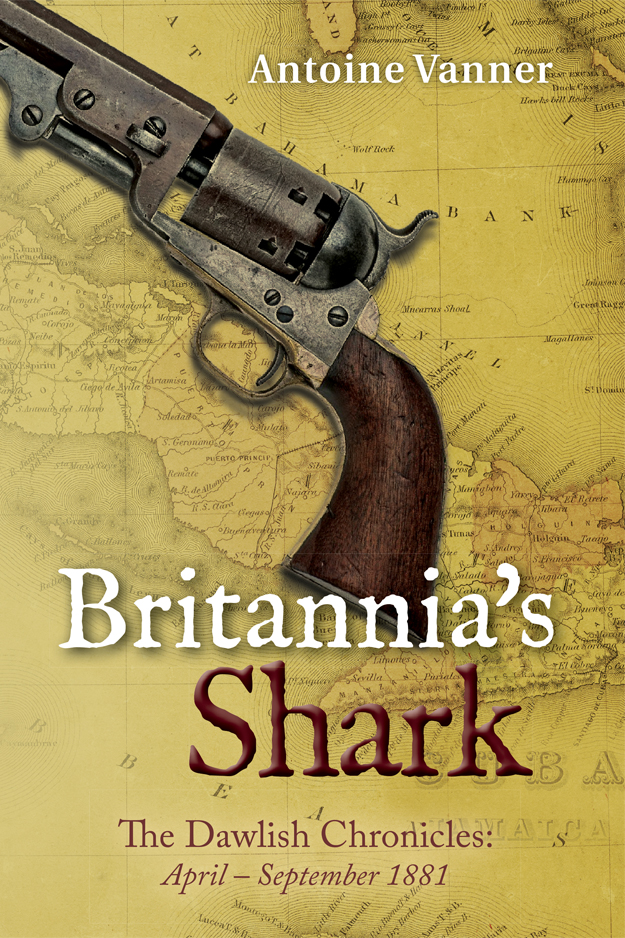
Britannia’s Shark

1881 and the British Empire’s power seems unchallengeable.

But now a group of revolutionaries threaten that power’s economic basis. Their weapon is the invention of a naïve genius, their sense of grievance is implacable and their leader is already proven in the crucible of war. Protected by powerful political and business interests, conventional British military and naval power cannot touch them…


 A daring act of piracy drags the ambitious British naval officer, Nicholas Dawlish, into this deadly maelstrom.  Drawn in too is his wife Florence, for whom a glimpse of a half-forgotten face evokes memories of earlier tragedy. For both a nightmare lies ahead, amid the wealth and squalor of America’s Gilded Age, and on a fever-ridden island ruled by savage tyranny …


Tuesday, 27 October 2015

Two Wasps - glory and tragedy in the War of 1812

The name Wasp is one of the oldest and most illustrious names given to ships in the United States Navy. The earliest,  a schooner purchased by the Continental Navy in late 1775, was one of the first ships in American government service and since then ten more vessels have carried the name. The latest of these is the current Wasp, a 40500-ton amphibious assault ship launched in 1989 and currently in service. Two Wasps were aircraft carriers which saw extensive service in World War 2, the first of these being lost during the Guadalcanal Campaign and her successor, launched in 1943, remaining active until the early 1970s.

The Wasp  of 1807 (r) lying across the bows of HMS Frolic - painting by Thomas Birch
In the 1807-1814 period, four Wasps were commissioned and two of these were to come to eerily similar ends. The earliest of these was a sloop-of-war which entered service in 1807. She was a compact and powerful vessel, carrying no less than  sixteen 32-pounder carronades – murderously efficient weapons at close quarters – as well as two 12-pounder long guns on her 450-tons and 105-ft length. Her 140-man crew was small but this was most likely an advantage for welding it together as a well-trained and cohesive force. She remained in home waters until war broke out with Britain in June 1812 and she continued thereafter to operate off the American coast. In 14th October she sighted a British convoy off the Delaware River. On investigation this proved to consist of six-merchant ships, escorted by a 22-gun sloop-of-war, HMS Frolic. The Wasp drew close during the night and at mid-morning on 15th October the two sloops opened fire on each other in strong wind and unfavourable sea conditions. 

As Frolic, like Wasp, had carronades as her main armament, the range was necessarily close. Unusually for the Royal Navy (though it was apparently common practice for the French) Frolic concentrated her fire on Wasp’s rigging, while the latter directed her own cannonade on the Frolic’s hull. Wasp suffered badly – the upper parts of her mast were shot away and many of her braces severed. Now unmanageable, she drifted slightly ahead and the Frolic collided with her. The initiative of the American commander, Jacob Jones, could not be praised too highly for he took immediate advantage of this situation. He delivered a single raking broadside – devastating at this range when carronades were involved – and then launched boarders. Frolic struck her colours. The action had taken twenty-two minutes and every British officer and half her crew – some 90 men in all – were either dead or wounded.
Contemporary illustration - a real morale-booster for the United States
Had the affair ended there it would have been a resounding triumph. Unfortunately however, the Frolic’s masts collapsed soon after the surrender and Wasp herself also needed extensive repairs. Neither ship was in a fit state to escape when a British “74”, the ship-of-the-line HMS Poictiers, arrived, en route to join the fleet blockading the American coast. Outgunned, and with two crippled ships on his hands, Captain Jacob Jones had no option but to surrender both Wasp and Frolic. They were taken to Bermuda for repair, after which the Wasp became was taken into service in as HMS Loup Cervier the Royal Navy, her name being again changed to HMS Peacock two years later. Under these names she saw significant service and captured several mercantile prizes. The changes of name brought her no luck and she disappeared without trace, with all hands, somewhere off the Virginia Capes, in July 1814.

The next Wasp was a schooner which went to sea under a privateer’s warrant in July 1812 – this meant that two Wasps were briefly in simultaneous service. She cruised in the West Indies later that year, captured at least one prize, and was lucky to survive a hurricane that cost her both her masts. She made one further, but unsuccessful, cruise as a privateer, her service ending in 1814. Yet another Wasp was by now in service, this one a chartered sloop that operated on  Lake Champlain during the late 1813 and into 1814. Her charter ended without her having been in action.

Contemporary illustration
The fourth Wasp of the period was the replacement for the sloop captured by the British in 1812 and she was specifically constructed as a warship. Though tonnage and armament was comparable she was ship-rigged – i.e. had three masts, making her look like a miniature frigate. Commissioned in early 1814 she set sail in May to carry the war into the Eastern Atlantic and the approaches to Britain itself. She immediately captured four small merchant ships as well as a Royal Navy brig. Except for one vessel retained for prisoners, all were either burned or scuttled – one assumes that with Wasp’s small crew, some 170 men, and the manning demanded by her twenty 32-pounder carronades and two long 12-pounders, provision of prize crews would have diminished her fighting ability. The decision proved a wise one for on 28th June she encountered the almost identically-armed Cruizer-class sloop Reindeer some 200 miles west of Cornwall
Marines on Wasp (r) repelling boarding attempts from HMS Reindeer
The resulting battle was brief – nineteen minutes – but it once again involved a ferocious exchange of carronade-fire at close range. The Reindeer made several attempts to get a boarding party on to Wasp but they were beaten back each time. It was now Wasp’s turn and her attempt at boarding proved successful. Reindeer struck her colours – her captain was among the 25 dead and there were in addition 42 wounded, a casualty rate of approximately 40%. She was too badly damaged to be taken as a prize and she was accordingly burned. Thereafter Wasp headed for the French port of L’Orient to land her prisoners and to refit, taking two small prizes on the way.

Now repaired, Wasp was back at sea in late August and immediately captured two brigs. On 1st September she encountered a ten-ship British convoy and, even though it was escorted by a “74”, Wasp darted in, captured a brig, took off her crew, burned her and escaped without loss. Later that evening she sighted a solitary sail. It proved to be an 18-gun brig, HMS Avon. Wasp closed with her and in late evening – it would have been dark – opened fire.  Following a merciless battering Avon struck her colours. Three further British warships now arrived on the scene and Wasp, outnumbered, made off, though not without sustaining some damage in a brief exchange of fire.

Johnston Blakely
Wasp’s successes continued through September and on the 21st captured an 8-gun brig, HMS Atalanta. A valuable acquisition, a prize crew was put aboard her under command of a midshipman to sail her to the United States. She arrived in Savannah in early November.
And that was all but the last contact with Wasp. She was spotted by a Swedish merchantman in October, apparently heading for the Carribbean. She was never seen again.

Like her almost-twin and her namesake – later HMS PeacockWasp disappeared without trace, taking all hands with her. In her half-year of active service she had accumulated a list of successes seldom equalled in so short a time and it is ironic that she should ultimately have succumbed to Nature rather than to enemy action. Her commander, Johnston Blakely (1781 - 1814) was promoted posthumously to the rank of Captain. Three American ships have been named in his honour.

The War of 1812 left a proud tradition for later Wasps to live up to – and they did.


-----------------------------------------------

Britannia's Wolf - the first book in the Dawlish Chronicles Series 

1877: Russian forces drive deep into the corrupt Ottoman-Turkish Empire.  In the depths of a savage winter, as the Turks face defeat on all fronts, a British officer is enmeshed and finds himself confronting enemy ironclads, Cossack lances and merciless Kurdish irregulars. And in the midst of this chaos, while he himself is a pawn in the rivalry of the Sultan’s half-brothers for control of the collapsing empire, he is unwillingly and unexpectedly drawn to a woman whom he believes he should not love.


Friday, 23 October 2015

A picture that could inspire half-a-dozen novels

Like everybody who writes novels I’m frequently asked “Where do you get the ideas from?”

There’s no easy answer and I suspect that the process varies considerably between writers. One is usually drawing on a very wide knowledge and interest in a wide range of topics, and frequently the inspiration comes from what may be an all but subconscious asking of “What if…” Given a reasonable familiarity with the events, personalities, beliefs and politics of a given time it’s not too difficult to visualise the scenery within which a story can be set. What brings the story to life however is identification of the main characters and the challenge they must face. What are their strengths, their weaknesses, their drivers, their loyalties, their priorities, their moral compasses? When we meet them at the beginning of a novel they’re already living, breathing personalities, each with his or her own back-story that makes them what they are at this moment. That back-story may be hinted at – and in some cases main events in it may be briefly sketched – but as often as not it does not require extensive detailing in the current story. The reader does not to know all the details, but the writer must. Unless he or she knows what had brought a character to the point of their appearance on Page 1 or Page 25 or Page 100 then they can never be credible.

This train of though was initiated when I recently stumbled across an 1882 drawing from the Illustrated London News from  entitled “Recruits”. It shows a recruiting sergeant with a small group who have just enlisted by “taking the Queen’s shilling”. They’re on their way to the regimental depot – since it’s in London it may be one of the Household Regiments – and they’re leaving their civilian life behind. And so too perhaps memories, histories, responsibilities and failures they might like to put behind them, but which may prove hard to forget.

For me this drawing crystallises so much about some aspects of the Late-Victorian period and it’s easy to imagine a back-story for each of the characters. It could represent “Act 1, Scene1”, the point of departure for a half-dozen linked stories. So let’s look in more detail.

First the setting. It’s London, spring or early summer judging by the clothing. The Houses of Parliament in the background hint at the confidence and power of Empire. A newsvendor has some news about The Queen – we can’t see what it is, but it might or might not be significant for the story that follows. We glimpse the driver of a Hansom cab in the background, and a fashionably dressed man, but the central group have turned away from this normality and are heading for another.

It’s on the group at the centre upon which attention focusses and from the reaction of the lady with the little boy, and of the dog in the foreground, there’s a hint that they’re already men apart who are heading off into the unknowable.  So what could be the backstory of each of them?

The recruiting sergeant is a trusted and proven man – otherwise he would not be in this job. A decade before he might have been like any one of these men, but his whole demeanour tells of an identity that he has adopted fully and that he is proud of. It’s 1882, so there’s a good chance he may have served in the Ashanti and Zulu Wars, and perhaps has seen action on India’s North-West Frontier with Afghanistan. Whatever his story was when he enlisted he’s now at ease with his military identity and he has the confidence to draw others with him into the same path.

There are five recruits behind him.

On the extreme left is a “gentleman”, certainly from a “good family” and well educated. But he’s a waster – his financial and moral credit has run out through drink or women or gambling, or perhaps all three. He’s deep in debt and close to penniless. His parents are dead and his brothers and brothers-in-law, all solid and respected professionals, have finally given up on him. He has the choice between a leap off a bridge over the Thames and enlistment in the Army. He’ll give the Army a try - at least he won't starve. As a “gentleman ranker” he’s going to find it hard, not just the discipline but the company of the barrack room. In a year or two’s time he may put a muzzle in his mouth and push a trigger with his toe. But there’s another chance, a slim one, but not impossible. He may make the best of it, may distinguish himself in action – and there’s always plenty of it around in this period - and he may be given the choice between a medal and an officer’s commission. There’s hope, but he doesn’t see to at this moment. It’s interesting that his eyes are cast down, perhaps in shame. But it’s perhaps also to avoid the gaze of the lady who is hurrying past and pulling a little boy with her. She may have recognised him as her brother or her husband.

An agricultural labourer in a smock and gaiters also follows the sergeant, somebody straight from the pages of Thomas Hardy. He looks pensive and realises the full enormity of what he’s doing, but he’s accepting it manfully. But what is he escaping? It seems more likely to be poverty rather than family responsibilities, but how did he find himself in Central London rather than enlisting at some Wessex market town? There’s a mystery there. He’s likely to be good soldier. The life he’s heading to may well be less harsh than what he has left behind and he’s at least assured of three meals a day and a dry bed in barracks when he’s not on campaign. He’ll accept discipline easily, will prove reliable in all circumstances, may well be an NCO himself in the next decade. He’ll serve in the Sudan, the Boer War, in several minor Indian and African campaigns. He’ll be retired from the Army and working as a trusted warehouse supervisor in 1914 and he’ll return to the colours to help train Kitchener’s “First Hundred Thousand.”   His son – also a regular – will be killed at Mons and his grandson will be a Second Lieutenant at El Alamein and a successful accountant thereafter.

The young man on the right, with cane and pipe, is probably a clerk, somebody from one of H.G.Wells’ turgid novels such as Kipps or Mr. Polly. He’s flashily dressed – more so than he can afford on his thirty-shillings per week. He may have joined up because he’s been embezzling and he knows that his employers are all but on to him. He has almost certainly enlisted under a false name and though he’s putting on an air of swagger he’s deeply worried about what’s to come. The Army will make or break him very quickly. He’ll probably resent the discipline and, at least initially, will be somewhat of a “barrack-room lawyer” until he realises that it will get him nowhere. He may quite soon be involved in misappropriations of some type and he may be cunning enough to carry it off for a long time. And yet there’s a small chance that he’ll take to the life, that he’ll do well in action, that he too could be a recruiting sergeant ten years from now – he’ll be glib enough with the patter that will entice others like him. Given a good NCO to take him in hand, he has possibilities.

The individual behind him in the “scotch bonnet” and half-mast trousers, is possibly a much nastier piece of work. It’s because of him that a policeman is bringing up the rear because if a close eye isn’t kept on him he’ll disappear He’s had numerous runs-in with law before now – nothing big or violent, but sly and underhand – but it’s never been possible to hang anything on him. The magistrates have had enough – they’ve finally got him for something and to save the rate-payer the expense of his incarceration he’s been given to option of joining the Army. He’ll keep his head done initially but he’ll be running a racket of some type as soon as he knows the system. He’ll cheat on cards if he can and he’ll be a regular on the VD list. But he’ll be a survivor, in the short term at least, and when better men are holding their ground to the last he’ll have weaselled some way of avoiding any action at all. He’ll come to an unpleasant end however, not in the line of fire, but from a knife in the ribs from some pimp he has fallen out with.

A good man to have on your side.
It's two years on. Which of the five is it?
And finally, the young man at the back on the left. He’s naïve, has probably read stirring accounts of military life in the popular press. He’s got some basic education – he’s risen from office boy to very junior clerk, but he’s got a romantic streak and he thinks his soul isn’t fettered to an office stool. Girls don’t take him seriously and he’s had more than one disappointment in that line. He’s probably cannon-fodder. In a badly-conceived story he’ll be a type that’s a cliché in movies – the simple but decent young man who’ll be taken under the wing of the country bumpkin and may well die in his arms, probably clutching a picture of his mother. But he too, if given a good NCO to guide him, may well turn out well.  He may end up doing excellent work in transport and supply rather than front-line combat, and he’ll be trustworthy and honest too. But in the meanwhile, while  he’s chatting to the well-meaning policeman, who’s probably sorry for him, he’s giving the shifty type an opportunity to scarper.

So there we have it – one picture worth a lot more than a thousand words and possibly worth a series of novels.  It’s 1882. Britain has very colourful and dramatic decades ahead and the Army will be in the thick of it. The possibilities are endless. Five men – six including the recruiting sergeant – are heading into the future.

Would anybody like to take up the challenge?

--------------------------

Britannia’s Reach

In 1880, on a broad river deep in the heart of South America, a flotilla of paddle steamers thrashes slowly upstream. It is laden with troops, horses and artillery, intent on conquest and revenge.  Ahead lies a commercial empire that was wrested from a British consortium in a bloody revolution. Now the investors are determined to recoup their losses and are funding a vicious war to do so.

But as brutal land and river battles mark its progress upriver, and as both sides inflict and endure ever greater suffering, stalemate threatens.

And Nicholas Dawlish, the ambitious British naval officer, first introduced in Britannia’s Wolf, finds himself forced to make a terrible ethical choice if he is to return to Britain with some shreds of integrity remaining…