Friday, 7 April 2017

Adam Worth: the real-life “Napoleon of Crime”

“He’s a thief,” Topcliffe said. “A most accomplished and successful one. That’s why he’s useful to us.”
“But he seemed…”
“Exactly what he is. A clever, cultured, agreeable American gentleman, whose profession just happens to be larceny.”

Adam Worth in 1892
And this is how Adam Worth, alias Henry Judson Raymond, is described as he makes his appearance in Britannia’s Shark, in which he plays a key role. He is similarly prominent as a character in Britannia's Amazon.  Important though this involvement in the affairs of Empire proved to be however, it was only one episode – unknown to the general public until now – in the career of a real-life professional criminal who was to be described by a senior Scotland Yard official as “The Napoleon of the Criminal World.”  This historical figure was as remarkable for the global span of his activities as for the ease with which he found acceptance at the highest levels of British society, despite very humble beginnings.

Worth was born in Germany in 1844 and was taken by his parents to the United States when he was five years old. The family settled in Cambridge, Massachusetts, where his father worked as a tailor. Worth left home early and by 1860 was in New York City, employed there as a clerk in a  department store – what he apparently described later as “my first and only honest job".  This could have been the start of a life of respectable drudgery but for Worth – as for many others – the outbreak of the Civil War in 1861 was to provide an opportunity if only he could survive it. 

Second Bull Run - where Worth died officially
Worth, now seventeen, enlisted, attracted probably as much by the generous bounty paid to volunteers as by the prospect of adventure.  Showing obvious leadership talents, he was quickly promoted to sergeant in the 34th New York Light Artillery Regiment. When serving at the Second Battle of Bull Run in August 1862 – yet another in a long string of Union defeats – Worth was seriously wounded and shipped back to hospital in Washington D.C. On recovering he found that he had in error been listed as killed in action.

This was Worth’s big opportunity. Officially dead, he was now free to enlist once more and to claim another bounty. Like many others he got a taste for it, taking the money, deserting, re-enlisting again in another unit under another name. (It might be commented in passing that such “bounty- jumpers”, though reprehensible, were no worse than the rich young men who took advantage of their right to pay poor men to serve as substitutes on their behalf once the draft was introduced. The bounty-jumpers at least risked death by firing squad if apprehended. Those who typically paid $300 to a substitute included the banker J.P.Morgan, future president Grover Cleveland and Theodore Roosevelt's father, as well as many other wealthy people. There is much truth in the saying that this was "A Rich Man's War and a Poor Man's Fight").

Worth evaded retribution for his bounty-jumping and at the end of the Civil War saw opportunities in the New York criminal underworld, that merciless society so memorably depicted in the Martin Scorcese movie “Gangs of New York”. Working in his favour was the fact that he was abstemious by nature and that he had a marked talent for planning and financing criminal enterprises. His luck did however run out, landing him in Sing Sing prison. He escaped within weeks. 

Marm Maddelbaum
- not to be underestimated!
With his appearance now altered by magnificent mutton-chop whiskers, he established a profitable relationship with a fence and criminal financier called Frederika Mandelbaum, known to her friends as "Marm" - obviously a lady to be approached with caution. By 1869 Worth had masterminded a serious of big robberies and was sufficiently respected to be contracted to spring a robber called Charley Bullard from prison. This successful operation involved bribing of guards and digging of a tunnel. Worth and Bullard now formed a partnership – one of their most notable coups was robbery of a bank in Boston by the same method featured in the Sherlock Holmes story “The Red Headed League”. For this a shop was set up near the bank and from it a tunnel was excavated to gain entrance. Worth and Bullard were now so successful that the Pinkerton Detective Agency was set on their trail. Judging the United States to be too hot for them they set sail for Europe.

A typical dinner party hosted by “Marm” Mandelbaum (R) and her "inner circle".
 From "Recollections of a New York Chief of Police" (1887) by George W. Walling,

Paris in the aftermath of the Franco-Prussian War of 1870 and the Commune that followed in 1871 was the corrupt and hedonistic sink immortalised in the work of Zola, de Maupassant and Toulouse-Lautrec. Worth had now re-invented himself as “"Henry Judson Raymond", an American financier, and had acquired the grace and polish to carry it off. With Bullard he operated a major gambling operation in Paris as well as initiating a series of high-value robberies. In the mid-1870s they moved to Britain and here “Raymond” established himself as a popular member of smart society, an acquaintance of the Prince of Wales and a free spender. He bought a magnificent villa in the London suburb of Clapham and maintained in parallel an apartment in a fashionable area off Piccadilly. 

Worth's Clapham villa today
(with acknowledgements to Wikipedia)
Worth formed a criminal network and organised major robberies and burglaries through intermediaries such that his name was unknown to those who were involved directly.  The focus was on high-value proceeds and Worth established the principle that those working for him did not use violence. William Pinkerton, who was later to have direct dealings with him, wrote that:

In all his criminal career, and all the various crimes he committed, ... he was always proud of the fact that he never committed a robbery where the use of firearms had to be resorted to, nor had he ever escaped, or attempted to escape from custody by force or jeopardizing the life of an official, claiming that a man with brains had no right to carry firearms, that there was always a way, and a better way, by the quick exercise of the brain.

Gainsborough's Duchess of Devonshire
Scotland Yard was aware of Worth’s network but was unable to prove anything. From his London  base the Worth operation now functioned on an international scale, including an ambitious swindle involving forged letters of credit in Turkey and a theft of $500,000 worth (in 1870s money!) of uncut diamonds. To oversee the latter operation Worth travelled to South Africa. It was in this period also the Worth pulled off his most spectacular coup. The Thomas Ganisborough painting of Georgiana, Duchess of Devonshire, had recently been rediscovered and was on display in 1876 at an art dealer’s gallery in London. Worth became fascinated by it – obsessed might be the better word. He organised its successful theft with two associates, thereby triggering an international hue-and-cry in the coming years about its whereabouts.  The expectation was that the unknown thieves would attempt to sell it or ransom it but it was in fact to remain in Worth/Raymond’s London apartment within a mile of the gallery. He appears to have immense pleasure in possessing it.

Worth’s criminal enterprises – and his double life – continued through the 1880s. By the early 1890s however he was losing his touch and was arrested in the course of a botched robbery of a money-transport in Belgium in 1892. Worth refused to talk but the net drew in on him when his photograph and details were circulated to Scotland Yard and the United States’ Pinkertons and NYPD. He was now betrayed by several of his associates and following trial was sentenced to seven years in a Belgian gaol. It appears to have broken him, possibly more for the fall from social respectability and prestige than from the physical conditions – he must have endured worse in the Civil War.

He was released early, for good behaviour, in 1897. He determined to return to the United States, where his two children were living (Worth’s affairs with women would need an article to themselves!) but to do so he needed funds. He got them by robbing £4000 (1897 money!) worth of diamonds from a London dealer.

Karl Marx - Worth's neighbour
in Highgate Cemetery
Worth was at risk of prosecution in the United States for his earlier offences there. He had one card still up his sleeve – the Duchess of Devonshire, whom he had managed to keep hidden for some twenty years. He approached the Pinkertons and agreed to return the painting to the dealers he has stolen it from in return for $25,000 and a guarantee of non-prosecution. The exchange of portrait and payment took place in Chicago.  In funds again, Worth returned to London – again as Henry Judson Raymond – with his children. His son appears at a later stage to have become a career Pinkerton detective. The Duchess of Devonshire’s ransom seems to have slipped as easily through Worth’s fingers as all the other money he had come by over four decades. He died in London in 1902 and was buried, under the name of Raymond, in a pauper’s grave in Highgate Cemetery, close to Karl Marx.

The appellation of “The Napoleon of the Criminal World” was awarded Worth by Sir Robert Anderson, Assistant Commissioner (Crime) of the London Metropolitan Police, from 1888 to 1901. The phrase seems to have inspired Sir Arthur Conan Doyle, the creator of Sherlock Holmes, with the idea of a criminal mastermind, Professor James Moriarity. Holmes described him as follows:

Moriarty - he looks
less fun than Worth!
'He sits motionless, like a spider in the centre of its web, but that web has a thousand radiations, and he knows well every quiver of each of them. He does little himself. He only plans. But his agents are numerous and splendidly organised… the agent may be caught. In that case money is found for his bail or his defence. But the central power which uses the agent is never caught - never so much as suspected”

And Holmes summed him up as:

“…the Napoleon of crime. He is the organizer of half that is evil and nearly all that is undetected in this great city.  He is a genius, a philosopher, an abstract thinker.  He has a brain of the first order.'

Adam Worth would have been flattered!

Adam Worth's role in the Dawlish Chronicles...


1881: It is in Britannia's Shark that Nicholas Dawlish encounters Adam Worth, a.k.a. Henry Judson Raymond for the first time. To all appearances a rich and cultured Americn who had chosen to live in Britain and move in the highest levels of society, Raymond also has the contacts that Dawlish needs across the Atlantic if a threat to British naval supremacy is to be overcome. Urbane, ruthless and very, very effective, Raymond is an ally worth having...


Click here to read the opening chapters of Britannia's Shark


1882: In Britannia's Amazon, Florence Dawlish is facing months of separation when her husband Nicholas sails with his cruiser to the Far East ( as told in Britannia's Shark). Florence expects them to be quiet months which she plans to fill with welfare work for seamen's families in Portsmouth. But her witnessing of a brutal abduction on the street plunges her into a maelstrom of corruption, violence, blackmail and intrigue. The enemies she faces are merciless an vicious, their identities protected by guile, power and influence.  Henry Judson Raymond might jut be the person to assist her... but can she trust him?


Click here to read the opening chapters of Britannia's Amazon


Download a free copy of Britannia’s Eventide 


To thank subscribers to the Dawlish Chronicles mailing list, a free, downloadable, copy of a new short story, Britannia's Eventide has been sent to them as an e-mail attachment.

If you have not already subscribed to the mailing list, you can do so by clicking here or on the banner image above

Tuesday, 4 April 2017

Disaster off Punta Arenas 1881

Chile’s Punta Arenas, on the Brunswick Peninsula, to the northern side of the Strait of Magellan, is probably the most southerly city in the world. It was originally established as a penal colony by the Chilean government in 1848 to assert sovereignty over the Strait – at the expense of Argentina, which had similar ambitions. The Chilean claim was finally accepted in a treaty between the two countries in 1881. Through the nineteenth century, and up to the opening of the Panama Canal in 1914, this waterway was of the highest importance as it allowed passage from the South Atlantic to the Pacific while bypassing Cape Horn. Developments on the Pacific coasts of both North America and South America led to very high levels of traffic through the strait and as such the area assumed greater geopolitical importance than it possesses today.
Punta Arenas today (courtesy of Wikipedia)
It was at Punta Arenas that one of the Royal Navy’s most significant peace-time disasters occurred in 1881 when the steam sloop, HMS Dotterel, was destroyed there by internal explosion. The significance of this event was that it was possibly the first in a long series of internal explosions that were to destroy warships in many navies in the next forty years.  Many of the ships involved were very large units. France was to lose two battleships – Iena and Liberté – in the years before World War 1 and during this conflict Britain was to lose several major units – including a modern battleship, HMS Vanguard. Japan was also to lose two capital ships to explosions during the war, as did Italy, which lost the modern battleship Leonardo di Vinci. One explosion – that which destroyed the USS Maine in Havana harbour in 1898 – was to have a major influence on world history. Wrongly blamed on a mine laid by the Spanish authorities, this accident was a trigger for the Spanish-American War, which was decisive in setting the United States on the path to global superpower status.
HMS Doterel, as completed
Though the exact causes of the explosions remained uncertain in many cases – not least because the massive loss of life usually incurred meant there were few surviving witnesses – the majority were due a low perception of the risks involved in handling and storing modern ammunition. The victims were almost invariably moored in harbour when the accident happened and in many cases ammunition loading and stowage was in progress. Unstable explosives were not the only cause –a dust explosion during coal loading was a possibility in at least one case. Careless handling of flammable substances also led to accidents. Many of these explosions were regarded as mysteries for many years – in the case of the Maine for decades. In its immediate aftermath the loss of HMS Doterel was also seen as unexplained.

HMS Doterel was one of fourteen sloops of the Osprey/Doterel-class sloops launched by the Royal Navy from 1876 to 1880. They were of “composite construction”, which meant wooden planking over an iron frame. Cheap, slow and well-armed, they were not intended for fleet employment but rather for support and power projection, often on a single ship basis, on distant stations. Of 1130 tons and 170 ft length they carried a barque rig to supplement their 1100 hp single-screw engines. Under power they struggled to make much over 11 knots but the provision of sails reduced their dependency on coal supplies – a major concern on remote stations – as well as increasing their operational range. They were heavily armed for their size – two 7 in on pivoting mounts and four 64-pounders, all muzzle loaders. Though obsolescent, these weapons were simple to operate and more than adequate for the type of shore bombardment needed for dealing with local emergencies or petty uprisings.
HMS Miranda, a sister of HMS Doterel
HMS Doterel was a new ship, launched the previous year, when she was sent in early 1881 to join the Pacific Station, which included the western coasts of North and South America as well as China and Japan. Under her captain, Commander Richard Evans, she arrived at Punta Arenas at 09:00 on 26 April 1881. Less than an hour later an explosion occurred in her forward magazine. Eyewitnesses described wreckage being thrown into the air, followed by a huge column of smoke. Broken into two sections, the ship sank instantly. Boats from several vessels in the immediate vicinity, and from shore, rushed to find survivors but out of a crew of 155 only twelve were found, one of them Commander Evans. The force of the explosion had stripped all his clothing away and was indeed so violent that only three complete bodies were subsequently recovered, as well as some body parts. The horror of the situation is illustrated by the fact that these remains were loaded into boxes and buried at sea in the same afternoon. An Anglican missionary working in the area, a Reverend Thomas Bridges, subsequently presided over the mass memorial service.
Funeral service held above the site of Doterel's wreck
In the immediate aftermath several theories were advanced as causes. A boiler explosion, triggering a magazine detonation,  was perhaps the most obvious possibility. Another involved sabotage by Fenians – Irish Republicans – an idea not as bizarre as it might sound since a successful mission had been mounted five years previously to rescue six Fenian prisoners from a penal colony in Western Australia. The key role in this rescue was played by a chartered American whaler, the Catalpa. Another theory considered that the explosion had been caused by a Whitehead torpedo lost by HMS Shah when she has been in the area three years before.
Salvage operations - note the diver being lowered from the boat on the right
Two Royal Navy cruisers, HMS Garnet and HMS Turquoise, were sent to Punta Arenas to conduct salvage and investigation operations. Extensive use was made of divers and this received much coverage in illustrated papers since the “Standard Diving Dress” then represented cutting edge technology. The possibility of a boiler explosion was definitively proven to be false when the boilers were found in perfect condition. The investigations showed that Doterel’s hull had been blown apart, leaving two separate sections, fore and aft. The ship's guns, screw and other valuable fittings were salvaged. Insights gained provided evidence for formal enquiry at Portsmouth by a scientific committee. This decided in September 1881 that the disaster had been caused by detonation of coal gas in Doterel’s bunkers, and that no crew members were at fault.
Another view of salvage operations
 Shortly afterwards, in November 1881, another explosion occurred on a Royal Navy warship, once again in Chilean waters. This was on board HMS Triumph, a broadside ironclad en route to the Pacific Station, as had been the Doterel. Though three men were killed and seven were wounded the ship herself survived. It was determined that the explosion had been caused by a volatile substance called xerotine siccative which was mixed in paint to accelerate drying.

HMS Gannet
It was not until 1883 that the cause of the Doterel explosion was settled. A surviving crew member, upon later smelling xerotine siccative while on another ship, stated that he had smelled it before the 1881 explosion. He explained that a jar of the liquid had cracked while being moved below deck. Two men were ordered to throw the jar overboard. While cleaning the leaking explosive liquid from beneath the forward magazine, the men may have broken the rule of not having an open flame below decks. The xerotine siccative exploded first, letting off the huge explosion in the forward magazine.

A lesson had been learned the hard way. The Admiralty ordered the compound to be withdrawn from use and demanded better ventilation below decks. One source of disaster had been eliminated, but more remained and numerous other ship losses lay in the future. But that’s another story…

Though the Doterel's career was a short one, a sister of hers, HMS Gannet, is still in existence. She has been restored beautifully and is now on view at Chatham Historic Dockyard in England. She is well worth a visit and provides as splendid insight to life in the Victorian Royal Navy.

The photograph on the left shows Gannet in 2005 and is reproduced with all thanks to Paul Englefield and Wikipedia.


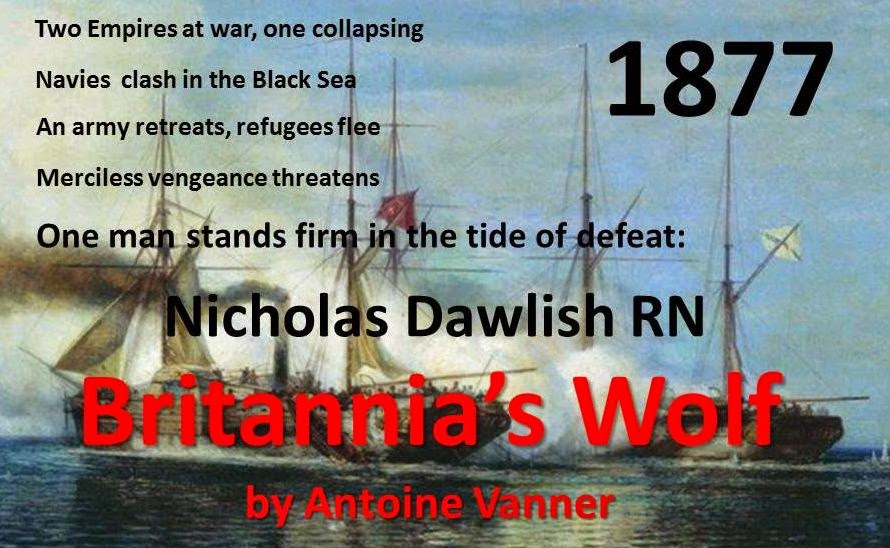
If you want to read about adventure in the age of transition from sail to steam,  then try The Dawlish Chronicles, which so far stretch to five volumes. Start the adventure with "Britannia's Wolf" which features ironclads in combat, desperate land action in the depths of a savage winter, and murderous political intrigue. You can get it in Kindle or paperback format. Click on the image below for details.


Download a free copy of Britannia’s Eventide 


To thank subscribers to the Dawlish Chronicles mailing list, a free, downloadable, copy of a new short story, Britannia's Eventide has been sent to them as an e-mail attachment.

If you have not already subscribed to the mailing list, you can do so by clicking here or on the banner image above


Tuesday, 28 March 2017

The Death of the Adder 1882

It is well known that the USS Monitor, which can be argued to be the first modern warship, and which gave its name to a type of ship which would see service until the end of WW2, was lost off Cape Hatteras in late 1862. This resulted from a very low-freeboard vessel being exposed to heavy seas – conditions such ships were never intended for since they were designed as mobile and heavily-armoured batteries for service in sheltered waters such as river estuaries.  Sixteen men died when the Monitor sank but the scale of the tragedy was dwarfed by the much heavier loss of a later, more sophisticated, vessel of the same type in 1882, the Adder of the Royal Netherlands Navy.

The monitor concept proved to be a very attractive one for the Dutch Navy, tasked as it was in home waters with defence of the approaches to its two largest cities, Amsterdam and Rotterdam. The Netherlands coast in the mid-19th looked significantly different to what it does today. The Zuiderzee, the huge and shallow sea inlet to the north-east of Amsterdam would not be closed off by an enormous dyke until 1932, and much of the area within it reclaimed. The Delta area in the south of the country, where the rivers Rhine, Maas and Schelde enter the sea, was a labyrinth of individual channels, some giving access to Rotterdam, and would remain so until the vast “Delta Works” were undertaken in the 1950s and 60s to close them off.

Longitudinal section of three types of Dutch monitor
Cerberus (1870, Adder (1875) and Luipard (1877)
With increasing sizes and draughts of ships in the 1860s and 70s access to Amsterdam and Rotterdam through the Zuider Zee and the Delta proved increasingly difficult. The solution was to build two large-scale ship canals, both running due west from these cities to new openings on the Netherlands West Coast. Opening in the 1870s, and engineering marvels of their time, both waterways have been regularly increased in dimensions and capacity in the years since. The two new waterways changed the pattern of sea-borne mercantile access to the Netherlands, and given their single points of access to the sea were easily defensible by shore batteries. In the event of war however – even though the Netherlands was not liable to any significant threat from other European powers in this period – the possibility of enemy access to the country’s heartland through the Zuiderzee and the Delta could not be ignored. Shallow-draught monitors represented an ideal mobile defence for these areas. Speed and sea-worthiness were not major requirements since the vessels would be required to operate over short-distances in largely land-locked conditions but heavy armouring and heavy weapons would make them formidable opponents to any invading force.

Between 1868 and 1878 thirteen monitors were completed for the Royal Netherlands Navy, substantial ships of around 1500 tons and when fully manned demanding a crew of some 115 men. Since a design requirement can be deduced as being not to exceed a draught of 3 meters (9.75 ft) very limited accommodation was provided, or indeed required, since the crews could be housed in barracks ashore when the vessels were not exercising. Long, narrow upperworks abaft the single turret seem to have been mainly designed to provide light and ventilation to the spaces below, as will be seen from the contemporary illustration above that shows three of these ships in profile.

Plan view of Luipard and cross-sections of her, Adder and other Dutch monitors
The Adder gave her name to a class of six vessels which was completed between 1870 and 1876. All fitted with ram bows as ramming was still regarded as a viable tactic, especially in confined waters. 192 ft. long and of 1555 tons, these vessels were heavily armoured with iron – 5.5” on the hull sides and between 8” and 11” on the turret. Two 9” muzzle-loading rifles were carried in the turret. Speed as low – maximum 7 to 8 knots and horsepower varied from ship to ship in the range 560 – 740 IHP.
By the nature of their design, and of their likely tactical use, such vessels spent little time in the open sea, their greatest exposure to such conditions being apparently when they moved parallel to the Netherlands coast when transferring from Ijmuiden or Den Helder in the north, to the base at Hellevoetsluis in the Delta region. 

It was on such a voyage south, a short one, that the Adder set off from Ijmuiden on the morning of 5th July 1882. The stretch of coast involved consisted almost entirely of long open beaches. A difficult passage was expected as the vessel did not perform well with wind on the beam and in even moderately heavy waves the decks would be awash. By early afternoon a strong south-westerly was blowing on the starboard beam and the monitor was sighted close inshore, off the fishing village of Scheveningen, a suburb of the Hague and which did not then have a harbour which could have offered shelter. (The present harbour dates from 1904). 

Artist's impression: Adder at sea
Though the seas might have provided problems for the Adder they were not bad enough as to interrupt the activities of Scheveningen fishermen. At 1800 hrs a fishing skipper, Abraham Westerduin, sighted the Adder – seas were washing across her up as high the funnel – and he judged the situation to be sufficiently serious as to decide to stand by to render assistance if possible. Around 2030 the monitor, now obviously in desperate straits, began to shoot off red, white and green rockets. Some 40 minutes later there was one last flash – a large one – and a cloud of smoke, or perhaps steam, and then nothing more was to be seen of the monitor. She had disappeared with all 66 men on board at the time.

In the following days several bodies wearing life-belts were recovered. A note found in an officer’s pocket indicated that a decision had been taken at 1800 hrs to turn back to Ijmuiden, the nearest harbour, but the monitor proved incapable of responding to the helm in the conditions prevailing. This was confirmed when the wreck was examined by a diver two weeks later – it lay just over a mile to the north-west of the Scheveningen lighthouse (still in existence today) and in 60 ft of water depth. The bows were pointed southwards, and not north towards Ijmuiden. A flag signal calling for tug-assistance was also found but it does not appear to have been sighted from shore. The boiler was intact and but the cause of the loss appeared to be large volumes of water spilling down into the engine room through deck openings.

The inevitable enquiry followed. Not unexpectedly the unsuitability of monitors for exposure to open-sea conditions was a major issue but the final responsibility was laid on the Adder’s officers. The vessel’s captain appears not to have had previous experience or training in handling monitors but the responsibility for assigning him – which must have been higher up in the naval hierarchy – appears to have been skated over.

The Reinier Claeszen - the Netherlands' last, and unlovely, monitor
The Adder disaster evoked an outpouring of sympathy throughout the nation and a fund was set up to support the crew’s widows and orphans. A further consequence was the spontaneous decision by a group of naval officers to set up the Royal Association of Naval Officers, which still exists today and is the oldest professional association in the Netherlands. The monitors continued in service, but one assumes in conditions that took account of the Adder experience, and only one further one was built for the Netherlands Navy, the Reinier Claeszen of 1891. The Wikipedia entry (in Dutch) on this vessel describes her as “not fully seaworthy: she steered badly and encountered serious maintenance problems.” This seems perhaps an appropriate epitaph for all these unfortunate vessels.

Britannia's Amazon

Mystery, Vice and Scandal in Victorian London


In Britannia's Spartan Captain Nichols Dawlish headed to unexpected dangers in the Far East in the cruiser HMS Leonidas. He left behind in Britain his indomitable wife Florence, who was determined to fill the months of separation with welfare efforts to support seamen's families. She expected it to be dull - if worthy - work but a chance encounter was to bring her into brutal contact with the squalid underside of complacent Victorian society. On home ground she faces hazards and betrayals every bit as deadly as her husband does in Korea and the powerful enemies she threatens are prepared to stop at nothing to frustrate her. Britannia's Amazon - strongly linked to actual events - tells her story.

Click here or on the image above to read the opening chapters


Download a free copy of Britannia’s Eventide 


To thank subscribers to the Dawlish Chronicles mailing list, a free, downloadable, copy of a new short story, Britannia's Eventide is sent to them as an e-mail attachment.

If you have not already subscribed to the mailing list, you can do so by clicking here or on the banner image above


Friday, 24 March 2017

The Farfadet Submarine Disaster 1905

Courage of the highest order was demanded of the officers and men of the navies that first employed submarines in the early twentieth centuries. Designs were still experimental and operating experience limited, so that every dive was an adventure. Accidents were frequent – and usually fatal when they did occur – and progress was achieved by learning very hard lessons.

The French navy was one of the first to commit to large-scale submarine construction. It looked to the new weapon, as it had looked to torpedo boats two decades before, as a cheap method of compensating for relative weakness in battleship numbers by comparison with potential rivals. At this stage submarines were primarily seen as suited to coastal and port-defence and the second –and so-far largest – design class, the four Farfadet units, launched between 1901 and 1903 were intended for this purpose.
The Farfadet in service
135-ft. long and of 185/ 202 tons (surface/submerged), the Farfadets craft were propelled by a single electric motor driving a variable-pitch propeller. The latter was an innovative item that dispensed with the need to provide reversing capability for the motor.  Range, determined by the batteries that had to be charged at the operating base, was limited to 115 miles surfaced and 28 submerged, and the maximum speeds attainable were 6.1 knots on the surface and 4.3 knots when submerged. Small as they were, these units packed a potentially powerful punch – four 18-inch torpedoes carried on external drop collars. The potency was proved when one unit of the class, the Korrigan, succeeded in hitting the monitor Tempete, serving as a harbour guard, with a practice torpedo while remaining unobserved. This was possibly the first time a target had been hit by a torpedo launched by a submarine. This considerable feat demanded the Korrigan and her sixteen-man crew remaining submerged for some twelve hours, somewhat of a record.  

A contemporary artist's impression of salvage operations
Shallowness of water is exaggerated
Both Korrigan and Farfadet were towed from La Rochelle, on the French Atlantic coast to the naval base at Bizerte, in Tunisia, in 1904 to provide port-defence. It was here that disaster was to overcome the Farfadet on July 6th of the following year when the vessel was undertaking diving exercises some 500 yards from the arsenal. Commander Cyprien Ratier ordered water to be admitted to the ballast tanks and the craft began to settle very quickly – too quickly, for the hatch was not closed properly. (It will be seen from the photographs that the hatches were a point of vulnerability as they were very close to the waterline when surfaced and there was no tower as such). Ratier, his mate and the quartermaster struggled unsuccessfully to close the hatch. Large volumes of water where now cascading into the boat’s interior and Ratier and his two assistants were blasted out through the hatch by the escaping air. The Farfadet sank, head-foremost, and buried her bows in the mud. Ten men had gone down with her.

Immense public interest
in the salvage
The stricken craft was lying in approximately thirty feet of water and some salvage equipment was immediately available at the base. There were obviously still men alive inside, for they were hammering on the hull. By the following morning divers had managed to get four steel hawsers passed around the hull and a floating crane managed to lift it in the early afternoon so as to lash it to a pontoon.  Sufficient of the hull had been exposed for air-valves to be accessed and air passed in to the survivors. It was now attempted to move the craft into shallow water, so as to ground her. The process was a slow one and in the early hours of the following morning the hawsers parted and the Farfadet dropped again. Further efforts failed to lift her before the victims trapped inside died. No further sounds were heard after July 8th, two days after the disaster. (One notices dreadful similarities to the HMS Thetis disaster in Liverpool Bay in 1939, when the stern of the sunken submarine had been raised above the surface).

Salvage efforts continued, a floating dock being used to lift the Farfadet – once again, the role of divers would have been crucial in passing hawsers under, and around, the hull. On July 9th, the Minister of Marine, Gaston Thomson, arrived from Paris to observe operations. On July 15th, the floating dock and the submarine suspended underneath were towed into a dry dock. The floating dock lowered the Farfadet, was then removed, and the dry dock was pumped out to expose the vessel.
The Farfadet - recovered and lying on her side in the dry dock.
Repatriation of the bodies
The distressing duty of retrieving the bodies was allocated to the crew of the sister submarine Korrigan. Four bodies were discovered in the bow compartment, and two in the centre, all probably killed during the initial inrush of water. Eight men had however managed to seal themselves in the compartment aft. These men – who had been beating for hours on the hull plating – had died dreadfully as seawater had reached the sulphuric acid of the batteries, thereby releasing poisonous chlorine gas. It appeared that the last of the crew had died after being trapped for 32 hours.

The long-drawn out agony of the Farfadet had kept France in horror-stricken fascination, the more so since submarines were a new concept, poorly understood by the general public. There was a massive outpouring of national grief and an imposing funeral service was held in Bizerte and the coffins returned to France thereafter for final burial. The salvaged submarine was towed across the Mediterranean to the naval base at Toulon, was reconditioned, and taken back into service. Cyprien Ratier continued as her commander for another two years.
The Lutin - Farfadet's sister and doomed to follow her in a year
The Farfadet was not the only one of her class to meet disaster. Her sister, the Lutin, was to sink, also near Bizerte, in October 1906. On this occasion structural failure of the hull occurred under external pressure. An expensive lesson was learned about design and an entire crew was lost. She too was salvaged. Already outmoded by the time of these disasters, and having served their purpose in introducing naval personnel to the science of submarine operation, all members of the Farfadet class were taken from service in the following years, to be replaced by more sophisticated and more reliable designs.

The Farfadet was not to be the last peacetime submarine disaster. They have continued up to our own time.

Britannia's Shark


The third of the Dawlish Chronicles series centres on the development - and role - of a prototype submarine. Based on actual events and personalities, Britannia's Shark paints a vivid picture of the skills and courage - bordering on madness - which was needed to operate such craft. Click on the image below to learn more and o read the opening chapters.

Download a free copy of Britannia’s Eventide 


To thank subscribers to the Dawlish Chronicles mailing list, a free, downloadable, copy of a new short story, Britannia's Eventide has been sent to them as an e-mail attachment.

If you have not already subscribed to the mailing list, you can do so by clicking here or on the banner image above

Tuesday, 21 March 2017

HMS Guardian 1789 – an epic battle for survival

In earlier posts I mentioned discovering the wonderful 1895 “Story of the Sea”, edited by “Q” (Sir Arthus Quiller Couch, with contributions from several luminaries of the era and with splendid illustrations. It dates from the period in which the British general public’s fascination with things nautical in general and with the Royal Navy in particular was at its zenith. One of the most impressive stories I found in it, and which I had not previously aware of, was of the survival, in appalling conditions, by HMS Guardian, en route to Australia in 1789. This epic of courage and seamanship is well worth sharing more widely.
The First Fleet entering Port Jackson, 26th January 1788, by E. le Bihan
British settlement of Australia commenced in 1788 when the “First Fleet”, consisting of two naval escorts, six convict transports and three stores ships, arrived from Britain at Port Jackson – Sydney Harbour. This was a vast and ambitious project, all the more impressive in that the ships had to voyage half the way around the world yet arrived safely within two days of each other after a passage lasting some 250 days. There is almost a “science-fiction” air about the project, aimed as it was at establishing a large-scale settlement from the start, albeit one relying on convict labour for its development. The First Fleet landed 1373 people, of whom 754 were convicts (including some 189 women and 22 children, some born at sea). Officials and marines, the latter to preserve order and discipline, amounted to 259 and the remainder were seamen, many of whom were to leave again with the ships.

Further support for the infant colony was provided the following year, 1789, with the despatch of HMS Guardian, a frigate converted to carry stores.  These consisted of seeds, plants, agricultural implements and livestock. She had a crew of 123, under the command of who proved to be the very capable Lieutenant Edward Riou, as well as a further 25 convicts. Her voyage from Britain to Cape Town, where she put in briefly, was uneventful, but twelve days after departure from there, on December 23rd, about 1400 miles south east of the Cape, a large iceberg was sighted.

At this stage Lieutenant Riou was concerned about lack of water for the animals on board – one gets the impression that these needs had been underestimated, the more so since one would have expected water supplies to have been replenished at Cape Town. Hoping to replenish his water by taking on ice from the berg, Riou advanced cautiously towards it. Boats were swung out and the Guardian lay to for the ice to be brought on board.

Guardian aground - Victorian era illustration
The fact that the iceberg extended a large distance under water does not seem to have been suspected, since as the Guardian attempted to stand away her bows struck. She swung around and the bows, though damaged, came free, but the stern now smashed on to the ice. The rudder was sheared away and a serious breach was made in the hull. The ice mountain towering above was estimated as “twice was high as the mainmast of a first-rater” and there were fears of sections of it crashing down. Riou remained calm in all this and managed, by use of his sails, to get the vessel free.

The situation was desperate, with six feet of water already in the hold. It was now a question of “all hands to the pumps” while an attempt was made to patch the hole at the stern by a sail. The labour went on through the night and all through the entire next day, during which the weather deteriorated. Despite this efforts were in progress to lighten the ship, during which Riou’s hand was crushed by a falling cask. Some ground had however been gained against the leak when the starboard pump broke down around midnight on the 24th. By Christmas morning not only was the water depth in the hold increasing once more but the night’s tempest had blown the fore- and top-mainsails to shreds, leaving the vessel at the mercy of the sea.

Some of the crew, exhausted and despairing, left the pumps and hid themselves and it was only by threatening to cast them overboard that they were brought back to work. By now the water had reached the orlop deck and was gaining two feet an hour. Some of the more self-reliant men came to the officers and asked for boats to be made ready. Riou agreed to this and those who wished to leave could do so. Masts, sails, compasses and water casks were placed in each boat.
Contemporary view of the boats leaving the stricken Guardian

Knowing that there was insufficient space in the boats, Riou determined to stay behind. 61 others remained with him. These included the officers and 21 of the convicts – it is unlikely that the latter had any say in the matter.  The five boats launched carried 259 – the overcrowding is almost unimaginable. Clements, the ship’s master, took charge of the launch, the largest boat. Riou handed him a letter which should be forwarded, in the event of Clements’ survival, to the Secretary of the Admiralty. It embodies all that is best of the Royal Navy of the period and is worth quoting in full as an example of calm dignity, honour and resolution in the face of almost certain death:

HMS Guardian, December 25th, 1789

Sir – If any part of the officers or crew of the Guardian should ever survive to get home, I have only to say their conduct after the fatal stroke against an island of ice was admirable and wonderful in everything that related to their duties considered either as private men or on his Majesty's Service.
As there seems no possibility of my remaining many hours in this world, I beg leave to recommend to the consideration of the Admiralty a sister who if my conduct or service should be found deserving any memory their favour might be shown to her together with a widowed mother.

I am Sir remaining with great respect, your ever Obedt & humble servt,
                                                                                                                                         E. Riou

A contemporary depiction of the overcrowding in the boats
(With acknowledgement to the National Portrait Gallery in Canberra, Australia)

With the boats gone, Riou’s efforts to save the ship continued undiminished. Though the Guardian was wholly unmanageable it appeared that she had sunk as far as she would go. This appears to have been due to empty casks in the hold pressing up against the lower deck, the hatchways of which had been firmly secured. In addition, as well as the damage at the stern, there was also a hole in the bows and through this iron and shingle ballast seems to have washed out. The vessel was however wholly unmanageable, and was drifting at the mercy of wind and wave. It was at this time that Riou’s leadership was most impressive. At one stage he had to face down a near mutiny when some of the men constructed a raft of the booms and were readying to leave the ship on it. Quite providentially a favourable breeze sprung up as they were launching it and Riou convinced them to stay with the Guardian.

The ship was to drift for almost two months, until February 22nd 1790, when the flat top of Table Mountain was spotted on the horizon, for by a miracle the Guardian had drifted steadily towards Cape Town. A British ship sighted her and sent boats to tow her into the anchorage. Though Riou had brought his people (including one woman) to safety, his hopes of repairing the Guardian and getting her back to Britain were frustrated and she had to be abandoned.

In the meantime the Guardian’s launch – the only one of the five ship’s boats to survive – had been picked up by a French ship after twelve days at sea. There were only fifteen survivors on board, including Clements, the master, wo could now forward Riou’s letter to the Admiralty.

On arrival in Cape Town Riou now wrote another letter:
Table Bay, February 22nd. 1790

Sir, - I hope this letter will reach you before any account arrives of the loss of His Majesty’s ship Guardian. If it should, I have to beg of your lordships that, on the 23rd of December, the ship struck on an island of ice; and that on the 25th all hope of her survival having vanished, I consented that as many of the officers and people should take the boats as thought proper. But it pleased Almighty God to assist my endeavours, with the remaining part of the crew, to arrive with His Majesty’s ship in this bay yesterday. A Dutch packet is now under sail for Europe, which prevents me from giving any further particulars, especially as at this instant I find it more necessary than ever to exert myself to prevent the ship from sinking at her anchors.

I am, sir, most respectfully

Your ever obedient servant, E. Riou

This letter arrived at the Admiralty on April 28th, five days after Riou’s first letter and in this period Riou and his men had been mourned as dead. News was sent immediately to King George III, “who on reading it, expressed uncommon satisfaction.”

It is pleasing to know that though the 21 surviving convicts were sent on to Australia, 14 of them were pardoned as a result of Riou's report of their good conduct on the Guardian.

Thomas Pitt, 2nd Lord Camelford
- he seems to radiate pugnacity
Among the others who remained with Riou on the Guardian was a young midshipman named Thomas Pitt (1775-1804), son of Lord Camelford, brother of the ex-Prime Minister William Pitt. Undeterred by this experience Pitt, now 16, volunteered for the major exploration expedition due to leave under the command of Captain George Vancouver. With no positions left for officers, Pitt signed on as an able-seaman, a remarkable step for one of his background. His undisciplined behaviour on the voyage resulted however in his being flogged three times (once for consorting with native women on Tahiti, an activity regarded with great suspicion since the Bounty mutiny). While at sea Pitt’s father had died, making him Lord Camelford himself and also – perhaps – the only member of the House of Lords ever to be flogged as a common seaman. Back in Britain, and now commissioned as a lieutenant, Pitt (or Camelford as he now was) initiated a vendetta against Vancouver, going so far as to assault him in the street. His life continued to be violent to an extent to which insanity was suspected – when posted to the West Indies he shot dead a subordinate officer who hesitated to obey orders.  His end was to come after he left the navy when, in a dispute over a mistress, he challenged an ex-friend, a Captain Best, to a duel. Camelford was to die of wounds sustained in the encounter, though, to his credit, his will directed that Best not be prosecuted in the event of his death.
"The Caning in Conduit Street"
James Gilray's cartoon of Camelford attacking Vancouver
And the splendid Edward Riou, the hero of the Guardian, what became of him? 

It is sad to record that he was to die at the Battle of Copenhagen in 1801. As captain of HMS Amazon, Riou was entrusted with command of the frigate squadron, which he brought in close to the Danish forts.  Undeterred by a splinter-inflicted head wound, and surrounded by dead and dying, he was still encouraging his men when he was killed by a roundshot while– a death he himself might have wished for. Nelson, on learning of Riou's death, called the loss 'irreparable'.

 Had Riou survived there is little doubt that he would have advanced to the highest levels of command and would be better remembered today. He was a magnificent man.

Britannia's Amazon

Mystery, Vice and Scandal in Victorian London


In Britannia's Spartan Captain Nichols Dawlish headed to unexpected dangers in the Far East in the cruiser HMS Leonidas. He left behind in Britain his indomitable wife Florence, who was determined to fill the months of separation with welfare efforts to support seamen's families. She expected it to be dull - if worthy - work but a chance encounter was to bring her into brutal contact with the squalid underside of complacent Victorian society. On home ground she faces hazards and betrayals every bit as deadly as her husband does in Korea and the powerful enemies she threatens are prepared to stop at nothing to frustrate her. Britannia's Amazon - strongly linked to actual events - tells her story.

Click here or on the image above to read the opening chapters


Download a free copy of Britannia’s Eventide 


To thank subscribers to the Dawlish Chronicles mailing list, a free, downloadable, copy of a new short story, Britannia's Eventide is sent to them as an e-mail attachment.

If you have not already subscribed to the mailing list, you can do so by clicking here or on the banner image above