Friday, 9 May 2014

Pride, Folly and Brilliant Seamanship – Apia 1889

In 1889 United States and German naval units were eyeing each other in an armed confrontation which Britain watched as a neutral but cautious observer.  A false move by any party could well have triggered a shooting war with immeasurable historical consequences. The United States, up to then underestimated as an emerging Great Power, and the newly established German Empire – dating only from 1871 – were both taking their first steps towards projection of military and naval, as well as commercial, influence on a global scale. As new players, both were conscious – perhaps over conscious – of the importance of prestige.
HMS Calliope - the heroine of Apia
The scene of the confrontation was an unlikely one – the harbour of Apia on the northern coast of the Pacific island of East Samoa.

A civil war had been in progress since 1886 – and indeed was to drag on to 1894 – and it involved a struggle between two Samoan factions for control of the Samoan Islands. German trading and plantation companies already had significant commercial interests in copra and cocoa-bean processing, competing in the process with American traders.  Almost inevitably, Germans and Americans found themselves backing different Samoan factions and Britain too, though to a lesser extent, had a business presence.  Tensions heightened in 1887 when a German naval vessel, ostensibly sent to protect German commercial interests, shelled a village in which American-owned property was destroyed –  thereby resulting in despatch of an American naval force to protect American interests. The situation worsened the following year when one Samoan faction  inflicted casualties on a German landing-party and destroyed German-owned plantations.

National pride was now at stake – the more so in view of the growing ambitions of Germany and the United States. German, American and British naval units were despatched to Samoa and by March 1889 were moored in Apia harbour, each waiting for the other to make a move. Suspicion and mistrust were greatest between the Germans and the Americans and the British maintained a position of neutral observers. Annexation by either Germany or the US was a distinct possibility and national prestige was at stake – to what now seems a ludicrous extent. One more incident involving the rival Samoan groups,  an incident likely to be outside the control of the foreign forces, could have been enough to shift the situation from armed confrontation to outright war between the German and American naval units.
SMS Olga - the largest German vessel present at Apia March 1889
And it was at this moment – on 15 March 1889 – that a hitherto unexpected player, Nature itself, dealt the deciding hand. In the process death and disgrace were to be visited on some of those involved while another was to earn universal admiration for a spectacular feat of seamanship.

The German force present at Apia consisted of three ships: the 2,424-ton corvette SMS Olga, the1,040-ton gunboat  SMS Adler and the  760-ton gunboat SMS Eber. Though the Olga was the largest and most powerfully armed of these ships, the commander of the German force was Fregattenkapitän Fritze of the Adler.
The USS Trenton - flagship of the US Pacific Station
The United States was also represented by three units. The flagship was the USS Trenton, A 3,900 frigate, the largest US warship built between the Civil War and the "New Navy"  era that commenced in 1883. She flew the flag of Rear Admiral Lewis Ashfield Kimberly, and was commanded by Captain Norman Von H. Farquhar. The second American  ship was the USS  Vandalia, a 2,033-ton sloop, notable for having carried former President Ulysses S. Grant on a tour of the Mediterranean  in 1877/78. The smallest of the three ships was the USS Nipsic, a 1,375-ton gunboat.
HMS Calliope - superbly designed and brilliantly commanded
The Royal Navy’s single vessel, the  2,770 ton screw corvette HMS Calliope, launched in 1884, though not the largest, was the most modern present, being built of steel.  She and her sister Calypso have been  described as “probably the most successful design of cruising ship” of their time and were intended from the outset for service in Pacific and Australian waters. Like the German and American ships she carried masts and sails to complement her steam-power so as to allow less dependence on sources of fuel on remote stations. 

Calliope was commanded by Captain Henry C. Kane, a 46-year old officer who had already distinguished himself in action on land in Egypt in 1882. His background was interesting – the son of the eminent Irish research chemist, Sir Robert Kane, who was the only Catholic member of the "Irish Relief Commissioners" board that investigated the causes and possible solutions to the Irish Potato Blight in the 1850s. His mother was a noted botanist and author in her own right.

Apia is an exposed harbour, open to the Pacific and unprotected by high ground or an enclosing reef, and vulnerable to storms rolling in from the north.  For several days prior to March 15th there were increasing signs – including falling atmospheric pressure –  that a cyclone was approaching. This was indeed the cyclone season and Apia had been hit by one three years earlier, about which captains of the naval vessels present could learn from the locals. In all cases these commanders had seafaring experience in the Pacific and all saw the approach of potential disaster that could only be avoided by taking their ships from the harbour to ride out the likely 100 mph winds in the open sea. 

And yet, as if they were players in some bizarre game of “Chicken”, no commander ordered such a move. Considerations of “face” were involved and no one was willing to admit, in front of the other nations' navies, that they were afraid of the elements. Worse still, they refused to allow the thirteen merchant ships they were allegedly protecting to move either.

HMS Calliope's escape, cheered from USS Trenton
The cyclone struck in the early hours of March 15th. Samoans onshore had already taken shelter but out in the harbour the ships were exposed to the full fury of wind and wave. The American and German commanders stuck by their decisions to remain at anchor and only Kane of the Calliope had the moral courage to disregard considerations of pride and to head for the open sea. Engines straining, and making less than one knot against the oncoming wind and sea,  Calliope crawled northwards to safety through the narrow approach channel , despite  being less than six feet from a reef at one point. Once at sea she was easily able to ride out the ensuing winds. The achievement represented seamanship of the highest order and reflected credit not only on every officer and man of the Calliope but on her designers, constructors and engine builders.  


Back in the harbour the USS Trenton’s moorings failed in the afternoon and she was flung against the beach, then dragged back into the sea until being finally wrecked on a reef at 10 p.m. that evening. The majority of her crew did however survive unhurt and were able to participate in the ensuing rescue operation. The USS Vandalia was thrown on to the same reef in the early afternoon. Her crew was to spend some 24 hours night clinging to her rigging, losing 43 men before rescue was possible. The gunboat USS Nipsic was thrown high on the beach with the loss of eight men.

A contemporary drawing, showing the USS Trenton dragging her moorings
The German vessels fared even worse. The SMS Olga was thrown high onto the beach but many of her crew escaped higher ground.  The Adler and SMS Eber were smashed together.  The Eber  had touched her propeller the reef in a storm some weeks earlier and the damage had impaired engine capability. Her commander, a Kapitan Wallis, recognising this weakness even before the cyclone hit, he had repeatedly requested permission to leave the harbour. This was refused by his superior, Fritze,  on the Adler. Eber used her engine in short bursts to try to stay off the reef, but she was pounded to pieces, losing 75men from her crew of 80. The Adler also fetched up on the reef and was also a total loss, though with smaller though appreciable loss of life, 20 men.
SMS Adler lying wrecked on the beach
The bow section of  SMS Eber with USS Trenton in the background
The sunken remnant of USS Vandalia is just visible alongside the Trenton
The irony was that though bull-headed pride was the cause of the disaster, only the single captain – Kane of the Calliope – who was not obsessed with it came out of the affair with credit. German and American prestige, far from being enhanced, suffered very badly while Kane’s moral courage, leadership and superb seamanship ensured that the reputation of the Royal Navy was raised to new heights. The events at Apia received attention from all over the world – and were described by the Samoan resident Robert Louis Stevenson In his 1892 book “A Footnote to History, Eight Years of Trouble in Samoa.”  The behaviour of the American and German commanders has provided an illuminating case for psychologists studying aspects of pride, pragmatism and decision-making under extreme pressure.

The Samoan Civil War dragged on for many years more though it never brought the United States and Germany close to war again. The final outcome was the annexation of East Samoa by the United States and of West Samoa to the Germans – which they were to lose to British Empire forces in 1914.

Kane’s subsequent career involved command of one of the largest vessels of the Victorian navy, HMS Inflexible, as well as the prestigious captaincy of HMS Victory. He retired as an admiral in 1907, was knighted in 1911 and died in 1917.

Another player in the drama of the Apia cyclone was to meet a dramatic end a quarter century later. A young midshipman on the Calliope, Horace Lambert Alexander Hood, was to die as a Rear-Admiral on the Inflexible, the first battle cruiser, at the Battle of Jutland in 1916 when she blew up with the loss of all but six of her crew of 1,032 officers and men. 

And HMS Calliope? She was to survive as a moored training ship for Royal Navy Volunteer Reservists until 1951. The painting below, by John Munday, shows her in her final years –a mundane end for a ship that had endured so much.
HMS Calliope in the Tyne, 1950, by John Munday
(with acknowledgement to the National Maritime Museum, Greenwich)


Tuesday, 6 May 2014

MY WRITING PROCESS - BLOG HOP

Sandie Will
One of the pleasures of becoming an author is that one comes in contact with interesting people in different countries and continents whom one would never know in the normal course of events. For me, one such interesting person is Sandie Will, an geologist who is also an aspiring writer. She is also  responsible for two very interesting blogs, one about writing on www.sandiewill.com and one on scientific items on www.rockheadsciences.com. I particularly like the latter as she brings the excitement of the world of the geologist alive, something I can well appreciate given my own background.

As part of a blog-hop Sandie asked me to repeat on my blog an item which I filed previously about my writing process, which she thought could be of interest to other writers who had not seen it previously. If you have seen it before just skip but if not you may find the information of value.

Like other writers on this blog hop I’ve been asked to answer four questions about my writing process and at the end I’ll hand over the baton to another blogger who’ll be filing answers to the same questions on her own blog on Monday 12th May.

Question 1: What are you working on?

I’m currently on the home straight – the last 15% - of the first draft of the fifth Dawlish Chronicles novel. Volumes one and two – Britannia’s Wolf and Britannia’s Reach – have already been published and the third will come out around the end of this year. I’ll say more about my writing process – and why my writing is ahead of my publishing – in response to Question 4 below. In my own mind have a clear overview of the whole life of the series’ protagonist, Nicholas Dawlish (1845-1918) and indeed a sketch of it is provided on my website www.dawlishchronicles.com. Each of the books I write is set in a specific period and they deal with Dawlish’s participation either in actual historic events or in situations closely based on them and consistent with contemporary circumstances. In the first book in the series, Britannia’s Wolf, the reader meets Dawlish at the age of 32 and well established in his profession as a naval officer. This book, and its sequel, Britannia’s Reach, cover Dawlish’s life in the 1877 to 1880 period and involve service in the Ottoman Empire and in South America. By the fifth in the series, now being written, the calendar has advanced to 1882 and Dawlish has gained in experience and advanced in seniority – not that it makes life any easier for him, given the situations he must deal with! Though the main action is set in the period of Dawlish’s late 30’s, there are sections dealing with earlier events in his life, some hints of what might be involved having been given, but left opaque, in earlier books. A challenge for me as a writer – as it is for any creator of a series – is to ensure that the character matures with experience, personal as well as professional. This also applies to other characters carried across from one book into the next.

Question 2: How does your work differ from others of its genre?

The Dawlish Chronicles fall under the general heading of “naval fiction”. This is dominated by novels – usually in series – set in the Age of Fighting Sail, mainly in the Napoleonic Wars. The two acknowledged masters of the genre, C.S.Forester in the Hornblower novels, and Patrick O’Brian in the Aubrey-Maturin series, concentrate on this period. Though I have read widely about naval warfare in this era my major historical interest – political and cultural as well as naval – has been concentrated more on 1860-1945. Of particular interest was the half-century between the American Civil War and the run-up to World War 1 which is fascinating not only in power-politics terms but because of the rapid progress of technology which changed naval warfare as well as much else. Little naval fiction is however set in this period – the “Age of Steam” – despite the fact that complex and shifting great-power relationships provide a rich setting for it. In addition, the era’s cutting-edge technology was in itself a factor in upsetting established balances and relationships.

Bringing together these two elements – the political and the technological – represents the starting point for a series. I then needed a protagonist, ideally one who lived through the entire period, and who needed to cope with rapid change – and to master it – if he wanted to advance his career. Enter therefore Nicholas Dawlish, born in 1845 and in 1859 entering a Royal Navy which was still commanded by veterans of the Nelson era. Like real-life contemporaries such as Admiral Sir John Fisher, later Lord Fisher, who was to serve on into the early years of World War 1, Dawlish must be as familiar with steam power, steel construction, torpedoes and ever-bigger guns as Horatio Hornblower and Jack Aubrey were with sails, rigging, carronades and broadsides.

It’s notable that several agents warned me that “Age of Steam” novels would never sell – one indeed recommended rewriting my novels for a Napoleonic setting – but the response of readers to Britannia’s Wolf and Britannia’s Reach has been uniformly enthusiastic. Perhaps I have indeed identified a gap in the market!

 Question 3: Why do you write what you do?

The short answer is that “I have to” and I guess that this applies to most writers. I’ve got a story in mind and I need to get it out. I’m fascinated by the great-power rivalries and alignment shifts in the six decades up to World War 1 – France remained a major potential enemy to Britain for most of this period and relations with Russia were fraught since massive Russian expansion in Central Asia was seen as a threat to India. Maintenance of the crumbling Ottoman Empire was seen as essential for protecting British interests against Russian ambitions. The Austro-Hungarian Empire (which had an effective navy) was in decline, but that decline was in itself dangerous – as events in 1914 were to prove – and doubts existed whether the new and powerful German Empire should be regarded as a potential British ally or as a growing threat. The Chinese Empire was in the throes of decline and internal conflict while Japan – modernising with almost incredible speed – was positioning itself to establish dominance in the Far East. Add to this the “Scramble for Africa”, in which European powers were competing to secure territory, massive British commercial investment in Latin America and the almost unnoticed advance of the United States to world-power status and the  global complexities can be seen as great as those of our own time.

In this period the “British Empire” was seen as at its apogee. In effect however there were several empires, all different in the nature of their relationship to Britain itself, in accommodation to local power groups and as regards presence – or not – of British settlers. In addition to this “Formal Empire” there was an equally important informal one, based on investment and commercial penetration, and in some cases dominance, in independent nations, as in China and South America. Such investment provides the background to “Britannia’s Reach”.

I want to set stories in this era – believable stories anchored in real events and which are true to contemporary outlooks and values. Much historical fiction consists of “21st Century Characters in Period Costume”, and this I’ve tried to avoid. My protagonist, Nicholas Dawlish, views the world from a standpoint of Victorian values of duty, earnestness, patriotism, honour and class consciousness that borders on snobbery. He’s decent and conscientious, and he’s immensely proud to be an Englishman, but the values he espouses can cause him major personal anguish when he’s confronted with situations in which they may not comfortably support him. In Britannia’s Wolf and Britannia’s Reach his values are tested to the limit when he finds himself allied to forces which have no regard for such ethical concerns. The extent to which he should – or must – compromise is a theme in both books and he will not find it easy in as-yet unpublished work either.

Question 4: How does your writing process work?

Each of my books is placed within an overall understanding of my protagonist’s life from birth to death. One plot flows from the other but each is firmly linked to actual events of the period e.g. the Russo-Turkish War of 1877-78.  Extensive reading about the actual year or years raises possibilities for a plot. How would certain developments have been viewed by the British government? What larger strategic concerns were involved, and what more immediate ones? How did the situation – often a crisis – play out? How could Nicholas Dawlish play a role in the process?

Developing a plot from these elements is linked in a circular process to more detailed research. The plot demands supportive insights if it’s to work, and that demands research, and that in turn opens up further plotting possibilities. There will be several reiterations of this and the process can’t be hurried. I make extensive use of “mind mapping” techniques and I develop an overall contents plan – how many chapters, what happens in each etc. I do this in parallel with the actual writing of another book so that the plot is “simmering on the back burner” for considerable time. I might add that I’m lucky enough to be a member of the London Library – the largest private library in the world, founded in the 1840s by Thomas Carlyle and other luminaries. This gives me access to a vast range of contemporary material, including journals and newspapers.

Once the plot is finalised (and it never is, 100%, as during writing more opportunities for refinement present themselves) it’s necessary to get down to producing the first draft. I aim at writing every day and usually manage about 1000 new words as well as revising the previous day’s work. Trollope’s dictum of Nulla dies sine linea – Not a day without a line – is worth aiming at but not always possible when one has other obligations, as I do. I write in the morning – usually 1000 to 1300 hrs – but if I walk with the dog in the afternoon I tend to be working mentally on refinement of what I’ve written and on what’s coming in the next days. I may put in another hour or two several times a week and I estimate that I’m hitting the keys for about twenty hours a week in total. In my parallel life I’m retired from fulltime employment but I’m an elected representative in local government, as well as a school governor, so my days are very full.

The London Library in the corner of St.James's Square
Once I have the first draft completed I do a quick revision and then set it aside while I start detailed revision of the next book to be published. (This is why I’m currently writing the fifth Dawlish novel while numbers three and four are ready at the first draft stage). Leaving the first draft for several months is essential. It stays on my subconscious “back burner” and when I return to it I will be more critical, better able to spot weaknesses and opportunities, and ready to revise more thoroughly.

“Writing is rewriting” and the first draft, when I return to it, is ruthlessly edited. Entire sections may be cut out and paragraphs or chapters added. Internal consistency and continuity is essential and in the case of a series, must be linked back to other books as well. I’m assisted by one of my daughters, a devotee of military and naval fiction, who reviews as regards such aspects, as well as being ruthless in relation to plotting weaknesses. I may go through three or four further revisions and the last concentrates on proofreading – a nightmare for the independent author.

So that’s it. The process is relatively straightforward but the critical success factor is perseverance. Hanging in there – even sitting in front of a blank screen for several hours when you’re despairing – will get you there in the end!

So that’s it – I’ve shared my secrets and I hope you find them of interest, whether you’re a reader or a writer.


I’m now passing the baton to Jen Ponce, of Nebraska, who writes on wholly different themes to me, as you’ll see from her blog http://jenniferponce.com/skunkblog/. She has a very interesting background and, among much else, is an advocate for victims of domestic violence.

Jen is especially interesting on the mechanics of writing and of publication as an indie author. She’ll be posting in this blog-hop on Monday 12th May.

Monday, 5 May 2014

Our God and soldier we alike adore...

A good review is always excellent for a writer's morale and the following, by Joseph White in the US, is especially interesting, in that it links one of the themes in my novel "Britannia's Wolf" with concerns faced by young officers in the modern US Navy and Army:

" This is far from a normal Horatio Hornblower-knockoff. The main character is one of the first of the steam-navy sailors, and he is continually thrown into situations that (according to the books) he shouldn't have to endure. This first volume of the Dawlish Chronicles dips into the morass of Victorian class differentiation... and that's just a sub-plot!

As Dawlish must adjust and adapt to the changing British Navy of the late Nineteenth Century, I could not help but think of the problems of modern junior officers in the rapidly changing (U.S.) Navy and Army, increasingly treated as mercenaries rather than patriots by those who do not understand the changing nature of war and of service.

I liked this book so well that I immediately bought the second volume, which is the most original slice of "here's our hero in a damned uncomfortable squeeze" that I remember. I hope this series continues, and I hope the author also turns his attention to the modern day. A most original thinker and a good writer."


Mr.White hits on a problem that I guess has been around since the dawn of human history and which applies to the armed forces of many other nations as well as those of the USA today. The concern was very elegantly expressed by Francis Quarles in 1632 :

"Our God and soldier we alike adore. 
Even at the brink of danger; not before; 
After deliverance, both alike requited. 
Our God's forgotten, and our soldiers slighted." 

It's all too easy to forget that in Orwell's phrase "People sleep peacefully in their beds at night only because rough men stand ready to do violence on their behalf" - and today it's women who also bear that burden. The idea is also well expressed in one of Bernard Cornwell's novels in which Richard Sharpe reflects that "a soldier is somebody who defends others who can't defend themselves."

I suspect also that every writer of serious military or naval fiction has this thought in mind that however much thier work must entertain, it must also reflect this reality.

Friday, 25 April 2014

A corner of Hell - the Alzhir Gulag camp for Women

This week's blog is very different in nature to the topics I usually write about. It reflects a very moving personal experience and I've drawn some lessons which are of relevance to us all. I hope you'll read it to the end.

A wall of names, thousands - wives, mothers, sisters, daughters, aunts ...
I’m just back from a visit to Astana, capital of Kazakhstan. It’s an amazing place – a new city dropped down into the middle of an empty steppe - and is memorable for its large number of stunning modern buildings. The discovery and development of vast hydrocarbon reserves have provided the revenues for transformation of this former vassal-state of the old Soviet Union and it is now a very self-consciously independent modern state. I had visited previously and what made the greatest – and most moving – impression on me then was not of the city itself but of the Alzhir women’s Gulag memorial about 30 kms outside. I returned on my latest visit and what follows here is an account of what one finds there.  
Enemies - by family relationship - of the Soviet system
Kazakhstan is a vast country, the ninth largest in the world in terms of area, and much of it, including where Astana is located, consists of thinly-populated steppe terrain, roughly comparable with prairies in the United States and Canada. The Kazakh steppe is a harsh and difficult place to live – freezing in winter, with temperatures below minus 30 deg C. for long periods, with howling winds and driving snow,  but hot and dusty in summer.
More enemies of the Soviet system - some as old as three
These climatic conditions made Kazakhstan an ideal location for the Gulag labour camps of the Soviet era since the geography and climate were efficient barriers to escape. In the Stalinist period,  especially in the period of the purges from 1936/37 to the death of Stalin in 1953 there were large numbers of such camps, not only for “political prisoners “ – many if not most of whom were convicted on the grounds of suspicion of disloyalty –but for their family members, for returned WW2 prisoners of war (capture by the enemy was regarded as a punishable crime) and for large numbers of Poles deported after the joint Nazi-Soviet invasion of 1939.

The Alzhir memorial site - conical structure is the museum, dark strip behind is the wall of names

The Alzhir memorial is established at a camp for female relations of political prisoners and though the visitor is shocked at what they see it is important to remember that this camp was only one of dozens of such manmade hells in Kazakhstan. Alzhir was however the largest women’s camp in the Soviet Union while it operated from 1937 to 1953 and thousands of women – and their children – passed through it. These people were themselves accused of nothing other than being the wives, mothers, sisters or daughters – even cousins – of people who had been convicted of “betrayal of the Motherland.”  The standard sentence was eight years but for many climatic conditions alone could kill them in less than one.  Even very young children were transported to the camp – those under about the age of three staying with their mothers before being taken to separate state orphanages. Pregnancy at time of arrest was no protection and many babies were born in the camp.  

Fear of “guilt by association” must have been the most powerful single deterrent to internal opposition to Soviet rule. A man or woman alone might be prepared to risk the consequences of punishment for themselves personally, but most would hesitate when knowing that any action of theirs would draw the full might of repression and imprisonment on other family members, direct and indirect.
 
A "Stalin Wagon" - transport for up to 70 women prisoners
As one enters the site – beautiful with planted flower beds when I visited last August, but much more bare now before the spring growth kicks in – one is confronted with a preserved “Stalin Wagon”, the type of railway box car used to transport the women in groups of up to 70 across the vast distances of the Soviet Union, regardless of weather or season.  Bare wooden shelving represented accommodation and heating was by a single iron stove in the centre. Sanitary provision consisted of buckets.

The approach to the museum is flanked by the ‘Arch of Sorrow’, designed in the shape of a traditional Kazakh wedding head dress, and beyond it memorial plaques for victims of from individual Soviet nationalities and from Soviet-ruled countries in Eastern Europe. Two statues, one male, one female, symbolise the two extremes of the Gulag experience. A man looks down, broken in despair but a woman, stares into the future, seeing life beyond current suffering. 

 Beyond lies the circular museum building, and behind it, most terrible of all, are black marble walls inscribed with the names of thousands of prisoners, some of whom died there, some of whom survived.The tour of the museum starts with an emotionally-wrenching video in which ex-prisoners, and their children, tell their stories. They came from every background. Some regarded themselves as loyal Communist Party members – the opening testimony is from the surviving sister of Marshal Mikhail Tukhachevsky, the young military genius who had been so successful in the Russian Civil War, and whom Stalin purged as a potential rival. She also lists relations of other “Old Bolshevik” stalwarts. Most prisoners however were of humbler backgrounds and since every citizen was subject to arbitrary arrest, were their loyalty to Comrade Stalin to be suspect, age, occupation or political views – or absence of them – were no protection. The saddest testimonies of all are from surviving children who ended up either in state-run orphanages or were looked after by relatives, and who, like their mothers, made desperate attempts to remain in contact. They remembered the mother they had seen at time of arrest and often failed to recognise the human wreck who, if she was lucky, survived to be released after serving her sentence.
Door to Interrogation Room

The exhibition about life in the camp starts with a sculpture set around the original door to an interrogation room.  I found the photographs on display to be poignant beyond belief – they show prisoners, a few only , but representing the thousands who suffered there. Most show the women before their arrest – some young, some old, some Russian, others from various Soviet nationalities, some stunningly beautiful, others careworn, but each with her own personality, her own family, her hopes and fears and ambitions, her own right to a decent life. They could be your or my grandmother,  mother, wife, sister, daughter, cousin, aunt. When arrested many were told they were to meet their arrested family members so they wore their best clothes to the prison and some managed to bring a few personal belongings – a cruel joke to mark their descent into hell.

The women came from all walks of life – famous actresses, accomplished doctors and intellectuals, ordinary women from every part of the Soviet Union.  They were “rehabilitated” after serving  their five to eight-year sentences and.  Some never found their way back to their families however - their relatives and children had died either in the Gulag system or in the war and many of them built new lives for themselves in Kazakhstan.  The last remaining Alzhir survivor still lives in Astana. 

Barrack hut - adobe walls, sod roof, one stove, home for several women for eight years
The camp was, and the memorial is, surrounded by a vast open plain, much of it flooded at this time of year, April, after the snows have melted. In 1937 the  first prisoners arrived at an open expanse and had to build their camp from scratch, working up to their waists in water to curt reeds for binding the mud of the adobe bricks used to construct their huts. One such barrack hut has been recreated and inside it is a crude but emotionally powerful diorama showing a 3-year old child being taken from its mother to be sent to an orphanage. The roof consisted of rafters covered by grass sods and there was a single stove. The prisoners slept on rough wooden bunks and during the day many of them worked making uniforms – so much so that the camp received a commendation for its contribution to the Soviet victory in 1945.
Sign at reconstructed barrack hut
A child's letter to its mother
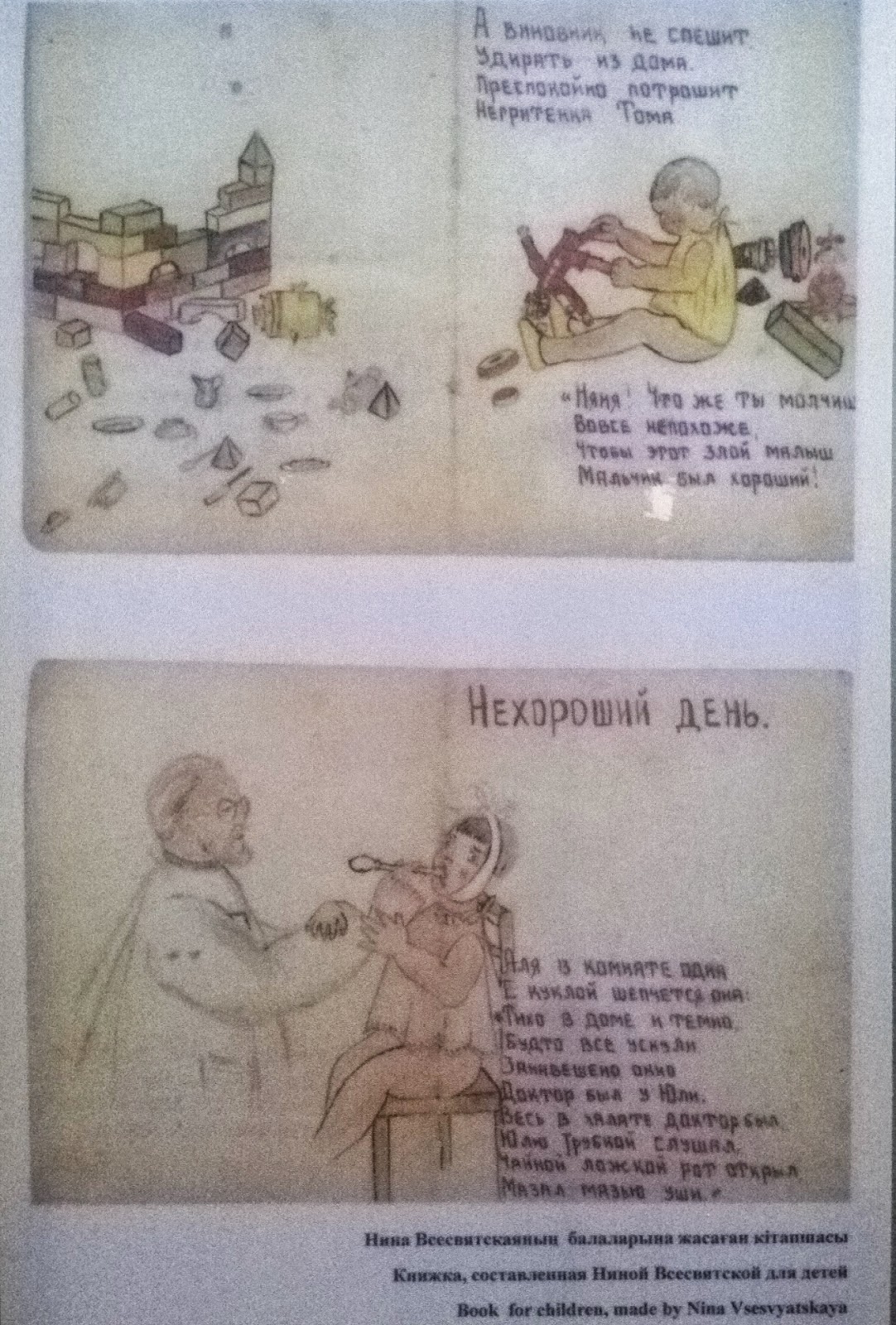
The most heart-breaking display showed letters that the women received from their children and the small items they in turn made for them from scraps and managed to get sent to them. It is impossible to see these without choking with emotion – children’s letters and drawings reassuring their mothers that they were thinking of them, working hard at school, looking forward to their return. One prisoner made a little story book, illustrated by herself.

Several factors helped to make the life of the women more bearable.  The commandant was, by most accounts, if not a gentle man then not a sadist.  The camp was located close to a Kazakh village and the villagers did all they could to help the women – giving them extra food to supplement their meagre camp rations.  The first time this happened the women thought the villagers were throwing stones at them – closer inspection showed the ‘stones’ to be kurt – small hard balls of traditional dried cheese. Helping prisoners in this way was itself a crime that could result in similar incarceration. Despite this however a combination of inadequate food and clothing, cold, despair and overwork killed large numbers.
A letter to a prisoner from her son and daughter
The most terrible feature do the memorial is however the three black marble walls that bear the names of the victims. The number of names run to thousands, each a clearly identified individual – for the Gulag was nothing it not meticulous as regards its records. Each name represents a life ruined – not indeed only a single life, but the lives of so many other family members. The impression of evil having been let loose on earth and to its prevailing for a long period is very strong.
A few names from thousands - each one valuable to so many loved ones
The camp was closed after Stalin’s death.  The memorial complex was opened in 2007 and as a newly-independent nation Kazakhstan has worked hard to acknowledge what happened on its soil in the name of the Soviet Union and to keep the memory alive so that it cannot happen again.  May 31st each year is dedicated to the memory of the victims of political repression.
This lady - first name Fatima - seems to have been a Kazakh. I hope she survived
At the memorial I experienced the same emotions as when I visited the yet more dreadful site of Auschwitz some years ago. I felt extreme sadness, but also limitless reassurance that, no matter what oppression can be inflicted by the forces of evil, all that is good and admirable in humanity will somehow survive. I brought away with me three lessons that should never be forgotten;

·         Freedom is precious and is worth any sacrifice to preserve it

·         There’s nothing more beautiful than a human life, any human life

·         We don’t recognise the infinite value of our happiness in normal times

A child's letter to her mother - no photograph, just her self-portrait
A book made for her children by a prisoner
The three walls of names - thousands of them - are unforgettable
P.S. Many thanks to the very knowledgeable and fluent-Russian speaking “Ersatz Expat” of Astana who accompanied me on this visit to the Alzhir memorial. A link to her own highly-entertaining blog can be found on my blog list in the column to the right.

Friday, 11 April 2014

Blog Hop: Meet My Main Character

In this blog-hop authors are required to answer seven questions about the main character they write about. My submission is below and at the end I’ll be handing over the baton to three other authors, “tagging them” to answer the same questions on their own blogs on April 15th.

I suspect that I myself have been “tagged” by Madame Catherine Gilflurt for today in retaliation for me tagging her for another such hop a fortnight back! Madame is not a lady to be underestimated and is responsible for a splendid 18th century blog entitled “A Covent Garden Gilflurt Guide to Life” http://www.madamegilflurt.com/


So here goes with the Seven Questions about my own writing:

1) What is the name of your character? Is he/she fictional or a historic person?

A brutal initiation - storming
the Taku Forts in 1859
Nicholas Dawlish (1845-1918) is an officer of the Royal Navy who joined the service as a boy in 1859 and who sees varied and challenging action thereafter. For me he’s a real person and I regard preparation for my books as representing research into his life, even if he is strangely absent from official records. This may reflect the fact that some of his assignments involved activities which the government of the day preferred not to be generally known.  I know the exact dates of Dawlish’s birth and death, and much of what happened in between, some of already in detail, other parts in outline only and needing more research. Dawlish’s life parallels the careers of well-known naval officers of similar age such as Lord “Jacky” Fisher (1841-1920) and Lord Charles Beresford (1846-1919). Dawlish’s adventures bring him in to contact with real-life characters such as Sultan Abdul-Hamid II of Turkey and Hobart Pasha, the swashbuckling British head of the Ottoman Turkish navy.

2) When and where is the story set?

The first and second “Dawlish Chronicle” novels, Britannia’s Wolf and Britannia’s Reach, dealt with Dawlish ‘s service in Turkey 1877/78 and in Paraguay 1879/80. He had attained the rank of Commander by this time – his promotion to this rank was early for his age and rewarded services which will be the subject of a “prequel” to be published later – but now, as the 1880s dawn, he’s now hungry for promotion to the rank of captain. The novel due for publication at the end of this year is set in 1881 and Dawlish’s getting his next step in rank will be conditional on completion of a very challenging assignment – one which will demand the support of Florence, his indomitable wife. The setting for the novel’s opening is the Adriatic but the action moves on very quickly from there – but to where will be a surprise.

3) What should we know about him/her?

HMS Warrior 1860 -
the navy Dawlish joins
Dawlish wants to get to the top in the Navy - but he knows he'll have to fight hard to get there since he doesn't have family or influence on his side. He knows that the only things going for him will be energy, professionalism and a mastery of technology that other officers still scorn as beneath their dignity as gentlemen. He is a fundamentally decent man, but one of his own time, not ours. He has many of the Victorian virtues – earnestness, dedication, confidence, pride in his Britishness – but he has many of the shortcomings also, most notably a somewhat unquestioning acceptance of the status quo and a painful
HMS Iron Duke 1912 -
the navy Dawlish helps create
awareness of class differences. He places high value on honour, courage and humanity but can find himself at somewhat of a loss when confronted by less principled players who “play dirty”. His strong sense of right and wrong causes him considerable mental pain when confronted with moral ambiguity. He regrets that entry to the Navy at so young an age has denied him a broader education, which he tries to remedy by private study.


4) What is the main conflict? What messes up his/her life?

Pau in the 1850s 
A happy time for the young Dawlish
His family background is not happy. His mother died when he was a child and his father, a small-town solicitor, comforted himself with a string of working-class women, much to the embarrassment of Nicholas, his brother and his sister. His brother was later killed in a hunting accident and his sister made a loveless marriage that left her worn out by childbearing.  A bright spot was his spending time in the spa town of Pau, in the French Pyrenees, with his mother’s brother, a naval paymaster whom tuberculosis had forced to retire early. Dawlish learned fluent French at this time and received affection he had previously missed from his uncle’s mistress, a respectable widow. The Pau interval was the only really happy part of a childhood cut off by entry to the Royal Navy and his poor experience of family life left him very cautious about personal commitments. There appears to have been a disastrous romantic involvement in Dawlish’s early 20s, one which almost led to an ignominious end to his career.  Research on what actually happened is still in progress.  A happier period in his life commenced – unexpectedly – in 1877, when he met Miss Florence Morton in Turkey. Even then however, concerns about class difference made it difficult for him to admit his true feelings.  

5) What is the personal goal of the character?

The Royal Navy was Britain's
greatest pride in this period
Dawlish hopes to rise to the highest levels in the Royal Navy at a time when the British Empire is reaching its apogee. He recognises that he's living at a time of vast and rapid technological change and that the Navy is changing more quickly than the majority of officers can keep pace with. Steam, enhanced gunnery, electricity, torpedoes, all offer chances that he must grasp. Given his character, he welcomes the opportunities the Navy gives for honourable advancement, for personal achievement, and for adventure. The path proves more difficult than he has anticipated, not only because of physical danger but because of hard ethical dilemmas.

 6) Is there a working title for this novel, and can we read more about it?

The Dawlish Chronicle novels will all be called “Britannia’s X”. In the first two novels “X” has stood for “Wolf” and “Reach” but in line with good algebraic precedent “X” will remain the unknown until the third novel is published. Perhaps I’ll run a competition nearer the time – with a signed copy as prize - to see if anybody can identify “X”

7) When can we expect the book to be published?

I’m aiming for December 2014.

And whom am I tagging to answer the same questions on their blogs on Tuesday April 15th?

Linda Collison: To call Linda a “Renaissance Woman” would be an understatement by a big margin. She says “I  spent more than 13 years as a registered nurse, mostly in Emergency and Critical Care (with a stint in psychiatric nursing and oncology), teaching skydiving on the weekends, pursuing a second degree in History, studying French, traveling whenever possible, and writing for magazines as a sideline.  I’ve also worked as a waitress, shoemaker, film processor, gas station attendant, volunteer firefighter — and I spent two weeks skinning tomatoes with migrant workers in Carroll County Maryland.  Time travel I learned on my own!” Linda’s writing includes naval fiction set in the 18th Century as well as entertaining tongue-in-cheek SF and fiction for young adults. Linda’s “Sea of Words” blog can be found on blog  http://www.lindacollison.com/linda-collison/

Seymour Hamilton: Seymour builds his fantasy fiction on a very firm foundation of experience sailing in the unforgiving waters off Canada’s East Coast. I love his statement thatin“The Astreya Trilogy is science fiction, I guess, although it’s pretty damn real to me” – which I think is the best starting point for writing fiction in any genre. Seymour’s blog is not only unique but one of the most entertaining I know – he describes it as “a ragbag of thoughts, borrowings, discoveries, essays, assays, evaluations, rants, whatever” and it’s well worth following on: http://seymourhamilton.com/


Alison Morton: Alison writes a series of alternative history “what if” thrillers set in Roma Nova, a survival of the Roman Republic which is located in Central Europe and which by the 21st Century women have not just achieved true equality but something approaching dominance. The first two books, INCEPTIO and PERFIDITAS have already been published and the third, SUCCESSIO, is due in mid-2014. Alison’s fiction is fast-moving and well-plotted. The alternative universe she creates is so “just a little different” to our own in a few key aspects, that it is wholly credible. Her blog is: http://alison-morton.com/