Friday, 20 June 2014

The Imperial German Navy 1902 - sketches of life on board ship

My blog this week is based on my recent discovery of a German 1902 publication entitled "Germany's Honour on the World's Oceans" (Deutschlands Ehr im Weltenmeer) by a Vice-Admiral von Werner. The sub-title is "The development of the German Navy and sketches of life on board." It is on the latter aspect I'll concentrate in this blog.

The timing of the book is significant - the German Navy was just starting the expansion which in just over a decade was to bring it from second-class status to the second most powerful one in th world. Enthusiasm for the Navy and naval affairs was high and was fostered by the government, Kaiser Wilhelm II seeing naval strength as essential for his personal prestige no less than for the nation. This is reflected in the book's frontispiece - see above - in which the ridiculously mustachioed kaiser is seen inspecting naval personnel. Prior to this time the German Empire, building on traditions of the Prussian military, and its crushing defeat of France in 1870, had been primarily a land power with only a limited naval tradition. This was to change and the book seems to be part of the shift in cultural mindset. It is notable that it is printed in German Gothic font which is quite difficult to read at first (I hadn't read in it for almost 50 years!), but which one gets quickly used to.
Painting entitled "Squadron at Sea"
Leading ship is a reconstructed central-battery ironclad of the 1874 "Kaiser" class
Much of book's focus is on presenting life in the navy as attractive for young men either as officers or seamen. The text is illustrated not just by photographs of ships, but with drawings - many not just idealised, but indeed sentimentalised - of life on board. There are some very attractive stylised capital letters at the start of each chapter, all incorporating a sketch. I have scanned many of the illustrations and have included them below. They tell as much about aspiration as about reality and as such give what is to me a unique insight to the thinking of the time.
A first step towards a naval career - a worried cadet, aged about 13, prepares to
leave home. Interesting that it is a maid, rather than a family member, who helps him pack
Fun in the gunroom - cadets enjoying themselves on board a training vessel
Boy recruits for the lower deck scrubbing - not too clear what! Clothing or stools?
A nap on deck for an exhausted recruit- hard to imagine this lasting for long!
Note blackened soles of feet!
Instruction by an older seaman
Sunday religious service conducted by a Lutheran chaplain
Young sailors dancing hornpipes - not sure if doing so voluntarily or under orders!
Christmas overseas - note tree in background
The training ship SMS Nixe of 1883 was described in "Conway's All the World's Fighting Ships 1860-1905" as "a hopeless anachronism, with her full rig and wood and copper-sheathed bottom, but useful as a school ship, though she was a bad seaboat and awkward under sail" She served in this capacity to 1901.
Training ship SMS Gneisenau (of Bismarck class of iron flush-decked corvettes),
commissioned 1880 but wrecked in Malaga harbour, Spain, during a storm
in 1900.  The captain and forty others died.

Britannia’s Shark by Antoine Vanner 


1881 and the power of the British Empire seems unchallengeable.

But now a group of revolutionaries threaten the economic basis of that power. Their weapon is the invention of a naïve genius, their sense of grievance is implacable and their leader is already proven in the crucible of war. Protected by powerful political and business interests, conventional British military or naval power cannot touch them. A daring act of piracy draws the ambitious British naval officer, Nicholas Dawlish, and his wife into this deadly maelstrom. Amid the wealth and squalor of America’s Gilded Age, and on a fever-ridden island ruled by savage tyranny success – and survival –will demand making some very strange alliances...
  
Britannia’s Shark brings historic naval fiction into the dawn of the Submarine Age. 


Monday, 16 June 2014

Did Victorians react differently to violence than we do? How to handle this in fiction?

A few months ago one of the first readers of Britannia’s Wolf sent me the question below:

“Today’s readers do not have the same sensibility as Victorians. Is there a compromise in Britannia’s Wolf between the way Dawlish and his contemporaries saw, and to some extent accepted, violence, and the way we respond to it today?”

It’s worth repeating the answer I gave then on my website and which I’ve updated with reference to my second novel, Britannia’s Reach:

The issue of making characters true to their period – in my case the Victorians, is critical. We shouldn’t graft 21st Century sensibilities on to 19th Century people, even sensitive and decent ones. The Victorians had a much more robust attitude to life and death than we do in the West today. Most families would have lost children and death in childbirth was still as common as it is today in Africa. Anesthetics were only in their infancy and people died regularly of complaints that are managed almost routinely today. There was somewhat of a cult of mourning and remembrance in that era (led by Queen Victoria herself - the "Widow of Windsor") whereas today many in the West have never seen a corpse until a parent dies. With us death is hidden – and is perhaps the last undiscussible.
The cult of ostentatious mourning supported a small industry - 1888 advertisement
Public executions continued in Britain until 1868 and were well attended. When they ventured overseas, as Victorians increasingly did as the Empire expanded, they encountered cruelty on a scale and intensity that shocked even them, as happened in China and India and Zululand and elsewhere  – they responded very robustly indeed. There’s a taste of this in Britannia’s Wolf, when Dawlish is confronted with a massacre of innocents and takes a rather tough reprisal against the perpetrators. There was a lot of similarly unofficial rough-justice against concentration-camp guards and other SS thugs in the immediate aftermath of WW2. Britannia’s Wolf is set in the brutal Russo-Turkish War of 1877-78, which was provoked by widespread massacres of Christian villagers in Bulgaria by their Ottoman Turkish overlords and the course of which was marked by horrific atrocities and reprisals in both sides. The situations Dawlish encounters in the novel are, unfortunately, closely modelled on real events.
Bulgarian massacre victims 1877 - eyewitness sketch
And yes – people do get marked, indeed hardened, by such experiences. My own exposure to cruelty and callousness by the powerful in Africa and South America has left me with an abiding contempt for the self-styled elites in such countries and makes me understand, even if I cannot condone, violent retribution when the tables are finally turned. History has taught us that overthrow of one corrupt and tyrannical regime is usually followed by one equally bad, no matter how noble the ideals proclaimed initially might have been.  I addressed this theme in the second Dawlish Chronicles novel, Britannia’s Reach. For a decent person to be caught in such a maelstrom, and to be forced to confront moral ambiguities on every side at a time when “doing nothing” is not an option, is a terrible one. A Mephistophelean bargain of the type portrayed in Britannia’s Reach (which I wrote a blog about on March 18th) is one which we should pray we are never tempted to make.
Western observers view heaps of burned Bulgarian villagers - eyewitness sketch
In writing about violence and atrocity I've tried not to shy away from the horrors inflicted on civilian populations - but one has to be careful. On the one hand there’s writing that blandly draws a veil over such pain and on the other there’s a danger of indulging in an orgy of violence. Finding the mean between these extremes is critical and I hope I do that.
Retribution: Turkish refugees flee before the Russians Winter 1877/78

Thursday, 5 June 2014

Book Launch: Alison Morton’s SUCCESSIO

I had a splendidly enjoyable evening yesterday when I attended the launch in London of Alison Morton’s SUCCESSIO, the third novel in her very entertaining Roma Nova series. Having read and admired Alison’s two earlier books, INCEPTIO and PERFIDITAS, I had been looking forwards the new book and now, having acquired a signed copy, I’m looking forward to getting stuck in.
Alison's oeuvre, set out with justifiable pride
Roma Nova is a fascinating concept - a 21st. Century nation, located in the area between modern Italy and Modern Switzerland. It represents a survival of the Roman Empire and which has, with some very significant deviations, remained true to austere Senatorian ideals and principles. The rest of the world is very like ours - but not quite - and all the modern technologies we are familiar with are in place. This is not an alternate world of the "Steampunk" variety, but one that is wholly credible and which could have come about had history worked out just a little differently.

Alison - on the right - in action, portrait of her lead character, Carina, on the left
During the launch session Alison was interviewed by the well-known BBC presenter Sue Cook. “Interview” was however wholly the word since Alison is such a lively and witty speaker that she her answers amounted to a one-woman show on topics relating to her own novels, her life experiences, her writing techniques and much more besides. Beneath the humour however once sensed the utter dedication, organisation and professionalism that Alison brings to her research (including how much to leave out) and to her writing. She gave what was in many respects an abbreviated master-class in “how to become a novelist”. (Given the fact that Roma Nova is run on matriarchal principles I should perhaps rephrase that as "mistress class"!)

Interviewer Sue Cook (left) with Alison after the interview
Other members of the British historical-novelist community were also present, making it a convivial and memorable occasion. For all of us it was a privilege to hear Alison speak and I can only hope that she’ll be bringing us back for many more visits to Roma Nova. If you haven’t had a trip there already this is the time to start.

(There’s already a link to Alison’s very enjoyable blog to be found in this blog for some time – you’ll find it in the bar to the right and by clicking on it you’ll find out more about the fascinating and internally-consistent alternate world that she has created.)

Friday, 30 May 2014

Britain and France confront Argentina - the Battle of Obligado, 1845

British ships (right) and French ships (left) move up
the Parana river towards Argentinian defences, November 20th 1845
Today, when one thinks of naval combat between British and Argentinian forces the Falklands War of 1982 is the case most likely to come to mind. An equally fierce engagement did however occur 137 years earlier and, though it is largely forgotten in Britain today, is commemorated annually in Argentina by a national holiday on each 20th November.

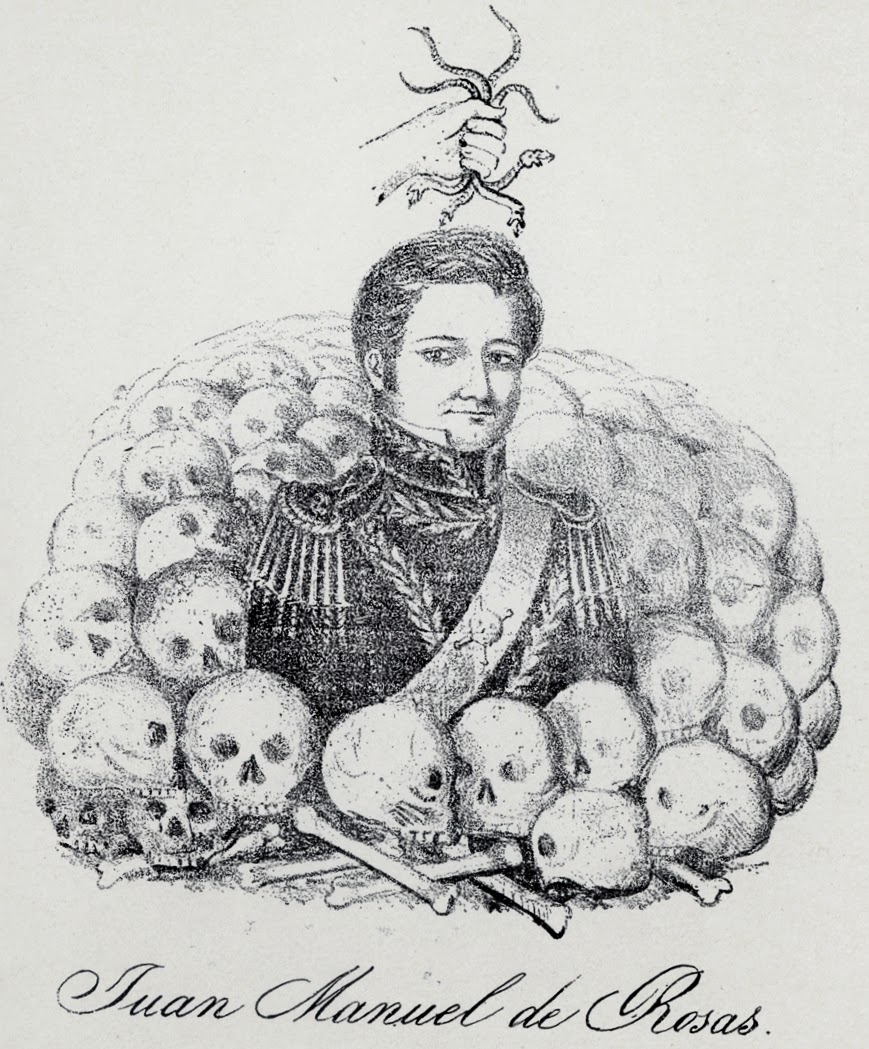
Juan Manuel de Rosas
The Spanish colonies in South America gained their independence in the 1820s through brutal wars of liberation. Much of the rest of the century thereafter was to be occupied by an almost constant warfare between the new nations – and with the Portuguese-speaking Empire of Brazil – to establish national boundaries. Dictators were to abound in this period, many as savage and ruthless as those who were to be seen in Europe and Africa in the 20th Century. Among the most notable – indeed notorious – of these was the tyrant Juan Manuel de Rosas (1793 –1877) ruled Argentina almost uninterruptedly from 1829 to 1852. His government was one of terror, with savage suppression of opposition by a state police called the Mazorca.  Wars with neighbouring states, as well as civil conflict, marked his rule and were barbarous in the extreme – according to one source “prisoners were rarely taken or, if taken, were then killed; fugitives were hunted down, their throats cut, their heads exhibited."  

The political complexities surrounding war between Argentina and Uruguay in the mid-1840s are impossible to sketch in a short article. British and French interest in the situation focussed on protection of commercial interests in Uruguay and on keeping navigation of the Parana River open to commercial traffic. This huge river, navigable by sea-going vessels of the time for much of its length, leads into the very heart of South America.

View of the boom from the Argentinian batteries on the cliff south of the river
In mid-1845 Argentina had closed the river by means of a boom and shore batteries at La Vuelta de Obligado, some 120 mile NNW of Buenos Aires. At this point the river is 700 metres wide and a tight turn (vuelta in Spanish) makes navigation difficult. British merchant shipping was trapped upstream and other ships, 92 in total, carrying manufactured goods, were unable to move upstream. At this period of British commercial dominance the challenge was irresistible, as it also was for the French.

The Argentine boom extended completely across the river and consisted of 24 vessels linked by three strong metal chains. Only three of these vessels were Argentinian naval units and the remainder were requisitioned. Four artillery batteries with 30 cannons in total, a mix of 8, 10, 12 and 20-pounders, were dug in on a cliff that rose from 100 to 600 feet on the southern bank, and supported by some 2,000 entrenched troops. A small brigantine, the Republicano, and two small gunboats, the Restaurador and the Lagos, were also available to protect the boom.

The combined British-French force that moved upriver totalled eleven warships, six of them of the Royal Navy. Eight of the vessels were sailing craft but the most powerful were three steam paddlers: HMS Gorgon, HMS Firebrand and the French Fulton. Steam power in warfare still a novelty and these vessels represented contemporary cutting-edge technology.

HMS Gorgon - by Sir Oswald Walters Brierly
The Gorgon, which had already seen action in the bombardment of Acre in 1840, can be considered representative of the type. Of wooden construction and of 1,610 tons, she was classed as a sloop. Her length was 152 feet along the keel and her 800 hp 2-cylinder direct-acting steam engine drove two enormous 27 foot diameter paddle wheels – and obvious point of vulnerability in battle. Though capable of 9.5 knots under steam considerations of coal supply demanded that she also carry an auxiliary sailing rig. Her armament was impressive for her size – two pivot-mounted 10-inch guns, two 68-pounders and two 42-pounder carronades. In addition the British ships carried Congreave rockets, probably 24-pounders, which, due to their high trajectories, were to prove very useful for attacking the Argentinian positions on the cliffs.

The Argentinian batteries under rocket bombardment
British and French ships approach the boom (on the right)
The battle commenced early on November 20th, with an intense bombardment by the British and French ships of the outgunned Argentinian defences.  The wind was light, making handling of the British and French sailing vessels difficult and they were to suffer under fire of the batteries. The three steamers now came into their own, not only since they were heavily armed, but because  of their manoeuvrability and non-dependence on wind. Heavy casualties — 150 dead, 90 wounded – were inflicted on the Argentinian defenders. The boom remained however intact and heavily defended, and gunfire alone was unlikely to part the chains linking the vessels it consisted of.

Boarding the boom - a heavily romanticised contemporary view
The boom is shown as consisting of ships - in fact there were three only
and the remaining vessels were barges
What followed had much about it of a “cutting out” expedition of the Nelsonian and Napoleonic period. Captain James Hope of HMS Firebrand volunteered to cut the boom. Taking three boats with him, and under heavy fire, he managed to board at the centre of the boom. Armourers accompanied the bluejackets and in some four minutes the chains had been severed, allowing the allied ships to push upriver. They were now in a position to rake the shore batteries with impunity. Disembarked troops overcame the last defenders of the bluff, and 21 cannons were captured. The Argentinian Republicano was blown up by her own commander when he was unable to defend it any longer but the gunboats Restaurador and Lagos disengaged successfully and withdrew up river. The combined British and French force had lost 28 dead and 95 wounded.

Sulivan as admiral
The river was now open to commercial traffic, its safety guaranteed by the allied ships. One of the British vessels, the brig HMS Philomel, advanced to a point 800 miles from the sea, under the command of Commander Bartholomew Sulivan. The voyage was a triumph of skilful seamanship, progress hampered at times by contrary winds, a three or four knot current, and shallow sections with as little as a foot of water beneath the keel. Sulivan, who had served on HMS Beagle during her momentous voyage, was subsequently to emerge as the Royal Navy’s most noted hydrographer and to end his career as an admiral. Captain Hope also achieved flag rank, his promotions culminating in Admiral of the Fleet in 1879.

The Obligado victory did not however end the British and French confrontation with Argentina. A five-year long blockade was to close Buenos Aires to maritime commerce. The stand-off was ended by treaties signed in 1849 by Britain and in 1850 by France and acknowledging the Argentine sovereignty over its rivers.

The Battle of Obligado has achieved iconic status in Argentinian memory as an instance of preservation of national sovereignty and of resistance to foreign intervention. It is commemorated not just by the annual 20th November holiday but by a memorial park at the site of the battle at which the remnants of the boom chains figure prominently

The French took particular pride in their contribution and a Paris Métro station remained named after the battle until 1947.  When Eva Perón came to visit the name was however judged undiplomatic and the station was renamed “Argentine” and has remained so since!


And what became of the dictator, Rosas? He was to rule Argentina for another seven years, finally fleeing into exile after defeat in a war with Brazil. He settled – surprisingly – in England, and appears to have lived quietly thereafter, dying at Southampton in 1877.

Dictators have met worse fates. 

Thursday, 29 May 2014

Comprehensive Review of Britannia's Wolf

I'm always glad to get feedback - whether it's positive or negative - from my readers as it helps me improve future books.  Reviews on Amazon are especially valuable. I was therefore very pleased to see a comprehensive one of Britannia's Wolf by American reader Charles A.Seaver. It not only comments on the book itself but also provides a good summary of the strategic and political context in which it is set. Charles provides an especially valuable piece of advice, which I'll be taking into account in future books (post-Britannia's Reach), and this refers to provision of more maps. Since I use maps from the start when I'm plotting I should perhaps have thought of this before! I quote in full:

"The year is 1877. The world is slowly lurching into the modern age, politically, socially, and technology-wise. Vanner hits all of these themes in the course of the novel, and will doubtless expand upon them in future books. The setting is the Russo-Turkish war of 1877-78. The Ottoman Empire is slowly decaying, and the Russian empire is only a bit behind on the road to history's dustbin. The Turks, however, control the Bosphorus, the narrow strip of water separating the Black Sea from the Mediterranean. In that control they prevent the Russians from access to the open seas and the Suez Canal, Britain's shortest passage to India where they, and the Russians, are engaged in the great game of control of the sub-continent. It is definitely not in Britain's interest that the Russians gain access to open waters, and possibly threaten the canal, in spite of truly wretched behavior on the part of the Turks.

Among other steps the British take is to dispatch Nicholas Dawlish, Commander, RN, to serve in the Turkish navy, put out a bit of stick,stiffen their spines, and raise hell with Russian supply shipping on the Black Sea, and see what else he can do to disrupt Russian efforts. Dawlish has, ahh, "resigned" officially from the RN, in order to maintain the fiction that he is simply looking for better rank (Captain) and more money, in the Ottoman navy. A not unheard of ruse in those days. He takes command of the Turkish (but British built) ironclad Mesrustiyet and it's Turkish crew, and starts working on his assignment. With no small amount of success.

Mesrustiyet is a good example of changing naval technology. The age of sail was over, and the slow transition to the age of iron and steam was underway. Nobody was sure what iron/steam warships should look like, and it took another 20-40 years after the close of this book for the modern battleship to assume final form. Mesrustiyet was heavily armed- 4 12" cannons, and armored, but rather slow, and not what could be called a good sea vessel. She also sported a large iron ram that was something of an anachronism at the time, but Dawlish eventually makes good use of it. This was not a vessel that an age of sail warship could engage with any hope of success. The other major technological advance that figures in the book is the presence of Winchester repeating rifles- used to excellent effect on several occasions.

Trying to explain the political background to the book is simply impossible. There is a reason that the word Byzantine still applies to extremely complex situations. Things do get Byzantine, and Dawlish suffers from it.

There is no small amount of action, both afloat (the above mentioned ramming sequence), and ashore, where the Winchesters get used. Vanner is not at all squeamish about describing the hardships of combat, both on the participants and on the far too many civilians caught in the crossfire of the combatants and their own religious/tribal/political/loyalty conflicts. The final retreat from Ljubimec at the end of the book is particularly harrowing.

Vanner has us in new territory in this series. Patrick O'Brian and others have produced many,many, volumes covering the Napoleonic era of age of sail combat. There has been some fiction dealing with ironclad warfare - most recently James L. Nelson's two volumes on the Confederate Navy during the American Civil War. Vanner has virtually untouched territory to spin his tales involving iron, steam, and the largely small and forgotten wars in the latter third of the 19th century. I think sailing, or steaming, on previously uncharted seas should produce an interesting saga.

My criticisms are mild, and not meant to minimize how much I enjoyed the book. I could really have used some better maps to keep track of where the action was taking place. That could easily just be me, the reader, and not apply to anybody else. One of the two things in the book that struck me as ever so slightly off was the budding romance with Miss Morton. I can't even really put a finger on it, but it was not entirely convincing, at least to me. Maybe I'm too American to really feel the depths of British class prejudice. The other thing that struck me was that Dawlish was very lucky in his Turkish subordinates. To a man they shaped up and did their duty, sometimes from not very auspicious beginnings. Not a rotter or traitor in the crowd?

All in all a wonderful read, and now I have to go buy the other volumes in print. Highly recommended."

Friday, 23 May 2014

World War One Reading List - Part 1

I’ve been fascinated by World War One for most of my life, not least because like many of my generation I knew people who had lived – and fought – through it. I’ve visited the Somme, Ypres, Verdun and Meuse-Argonne battlefields more than once. 

I’m reasonably well read on the period and with the 100th anniversary of the start of the war coming up I thought it might be appropriate to share recommendations of some of the books I have found most enlightening. I’ll extend the list over a number of blog posts and in due course the list will also find a place on the “Antoine Vanner’s Bookshelf” section on my website www.dawlishchronicles.com. Below is the first instalment. It deals with the outbreak and early months of the war and I hope you find it useful.

The Assassination of the Archduke: Greg King and Sue Woolmans. Subtitled “Sarajevo 1914 and the Romance That Changed the World”, this is a very recent book (2013) but deserves to be a classic.  Though the assassination of Archduke Franz Ferdinand and his wife triggered WW1, the couple themselves have remained shadowy figures in most accounts, and have been frequently portrayed unsympathetically. In this account they emerge as rounded – and indeed admirable – personalities who were prepared to endure humiliation at the Austro-Hungarian court as the price of their marriage. The assassins responsible for their murder are equally well portrayed. The account of the couple’s last day is almost unbearably poignant and their personal tragedy foreshadows those of millions of others. It’s very accessible and a good starting point for reading more about the war.

The World Crisis: Winston S. Churchill. Though a colleague said “Winston has written an enormous book about himself, and called it "The World Crisis"”, this six-volume account of the war is, as might be expected from Churchill, idiosyncratic, vigorous, subjective, eloquent and vastly readable. Either in the cabinet as a minister, or in the trenches as a battalion commander, Churchill himself was closely involved in many of the key event and decisions and these he makes live. I’ve found the first volume – dealing with the run-up to the war, of especial interest. In the UK old versions of this work can still be spotted in second-hand bookshops (those that remain) at reasonable prices. If you see them don’t hesitate – buy them! You’ll be dipping in to them for years to come.

The Guns of August (a.k.a. August 1914): Barbara Tuchman. This superb narrative history deals with the first month of the war – the German Invasion of Belgium and France, the battles on the frontiers, the Allied Retreat, the Russian incursion into East Prussia and the Battle of Tannenberg. It ends on the eve of the Battle of the Marne, the event that brought the German onslaught to a halt and ended all hopes of a short war. This is an exciting and fast paced read, and is particularly effective as “Military and Political History” for the non-specialist reader. No matter how well one knows what the outcome in fact was a sense of suspense is maintained to the end. I doubt if this book has ever been out of print since its publication some fifty years ago and it has, deservedly, been recognised as a modern classic.

The Rape of Belgium, The Untold Story of World War I: Larry Zuckerman. Belgium was the first country to suffer invasion and occupation by German forces in WW1. Most books on the subject deal with the military aspect but this book concentrates on the impact on civilians. Within days of the Germans crossing the frontier Belgian civilians were being used as human shields or being shot by the dozen in reprisals for acts of, often-imaginary, defiance. Ancient buildings and libraries – even an entire town – were burned in cold blood and worse was to follow in terms of deportation of forced labour, confiscation of food supplies and looting of industrial plant. In 1914 Belgium was apparently the 6th largest economy in the world and it never recovered this position following the devastation wreaked on it. This carefully researched book from 2004 leaves the reader with no illusions about the reality of German aggression. If you think that WW1 was “futile” then ask yourself if a tyranny that showed its hand like this could ever be tolerated by civilised men and women. The price of Freedom can be very high.

Liaison 1914, a Narrative of the Great Retreat: Edward Spears. A young and very junior British officer in 1914 (he was to be a General in the WW2), Spears found himself, almost by accident, as catapulted into a key role as liaison officer between the French and British high-commands. His English/French bilingualism proved invaluable in facilitating communication between mutually uncomprehending allies at the very moment when the German advance through Belgium into France threatened to be unstoppable. Spears was thus a “witness to history” at the highest levels and his high-drama account in Liaison 1914, originally published in 1930,  offers unrivalled insights into decision-making under crisis conditions. 

Old Soldiers Never Die: Frank Richards. While Spear’s book deals with the challenges of high command in the opening months of the war, Richards’ book, first published in 1933, tells of the same campaign (and of his subsequent service through the war) from the viewpoint of a private soldier, a rank he never rose above. He had already served over a decade, much of it in India, and had left the army in 1912, though he remained a reservist. He was recalled to duty on the outbreak of war in August 1914 and participated in the opening battles and the “Great Retreat”. His story is unvarnished and unpretentious, the solid record of a professional’s job well done under the worst circumstances imaginable. The comrades he writes of bear little resemblance to what are often portrayed, in more recent books on the war, as passive victims herded to slaughter. The come across as heroic (an adjective they wold never have applied to themselves) and indomitable, cheerful but complaining, ribald and irreverent, but decent and generous – indeed probably not much different from the men and women on the front line in Afghanistan today. Richards’ book is gem. Read it!

1914, The Days of Hope: Lyn MacDonald This is one of a series of excellent narrative histories of individual years or campaigns of the war. The focus is almost entirely on the experience – and near total destruction – of the British Expeditionary force between August and December 1914. It draws heavily on individual accounts, doing so in a way that bring to life not only the major events – the Mons and Le Cateau battles, the Great Retreat, the engagement at Néry , the Marne, Aisne and First Ypres battles – but also the experiences of individual participants. One is awed by sheer bloody-minded indomitability and professionalism of this last purely regular force to fight for Britain in the war. The entire series is to be very highly recommended  and this is the volume to start with.


A Military Atlas of the First World War: Arthur Banks. If you are to buy one book only about World War 1, and one only, I would recommend that this is it. Though I’ve seen many other “military atlases” they’ve essentially been complementary to text accounts, and not a substitute for them. The Banks book, which has been around for over 40 years, is unique in that it tells the whole story of the war as a standalone account, not in text, but in a combination of maps, diagrams and tables. It can be enjoyed sequentially, start to finish, or as an invaluable reference thereafter when one reads more about individual campaigns.

More to follow in future blog postings!

Friday, 16 May 2014

HMS Indefatigable vs. Droits de l’Homme

Besides the few major fleet actions, the French Revolutionary and Napoleonic Wars saw many vicious encounters between small numbers of French and British ships which have since provided the inspiration for much naval fiction. One of the most ferocious of these battles was fought in the darkness of a stormy winter night off the coast of Brittany in early 1797 and it established Sir Edward Pellew, later to be Lord Exmouth, as the foremost frigate captain of the era.    
Action off Brittany 13th January 1797
In December 1796, eager to exploit rebellious sentiment in Ireland against British rule, and urged on by Irish exiles, the French Revolutionary Government sent a huge naval and military expedition to open a new theatre of war in Britain’s own backyard. The choice of December may seem a strange one, due to the poor weather that could be expected, but the French relied on this to allow their ships to slip past the blockading Royal Navy squadrons.

The French force left their base at Brest, in Brittany, on December 16th 1796 – seventeen ships-of the-line, thirteen frigates, six corvettes, seven transports, and a store ship. They carried some 20,000 troops under the command of the renowned General Hoche. Overall commander was Admiral Morard de Galles, who had established his reputation as one of the great Admiral Suffren's most successful captains.

Brest was under observation by the Royal Navy’s inshore squadron, under Captain Sir Edward Pellew. It consisted of four frigates, Pellew himself in the Indefatigable, a 44-gun heavy frigate, as well as the Revolutionnaire (a French prize taken into British service), the Phoebe, and the Amazon. When Pellew saw the French emerge he sent off the Revolutionnaire to alert Admiral Sir John Colpoys, who with fifteen of the line would have normally been closer inshore, but who had been blown off station by the same strong easterly winds that facilitated the French departure.

The Revolution had deprived the French Navy of many of its most experienced officers and indiscipline was rampant. Insufficient attention had been paid to training and the presence of strong British forces offshore limited opportunities for building ship-handling experience. The result was that even in the absence of strong Royal Navy forces de Galles’ fleet, badly handled in strong wind, lost cohesion on its first day at sea.

As darkness came on, Pellew edged down among the mob of French ships. When de Galles signalled with guns, rockets, and blue lights, Pellew did the same, with variations of his own, completely confusing the French captains. Amid the general disorder that followed, one of the French 74's, the Seduisant, drove on to a rock and became a total wreck. From 1300 on board only some 600 were saved.

Despite this setback the French evaded Colpoys’ squadron and reached Bantry Bay, in South-West Ireland, in late December. Here storms and fog made landing impossible and the decision was taken to abandon the expedition and return to France. 
A contemporary British view of the failure of the Bantry Bay Expedition
- Cartoon by Gillray
The French straggled home in ones and twos and threes, no longer a fleet. On the January 13th, one of the French 74's, the Droits de l’Homme, commanded by a Captain Raymond de Lacrosse, found herself alone off the Britany coast. Visibility was poor and Lacrosse decided to approach no nearer but to sail southward under easy sail, the wind on his starboard beam. In mid-afternoon two sails were spotted on the lee bow, between the Droits de l'Homme and the land. These proved to be Pellew’s Indefatigable, in company with a 36-gun 18-pounder frigate, the Amazon, commanded by a Captain Reynolds. Pellew immediately signalled to the Amazon to give chase, and steered towards the enemy, sailing considerably faster than his smaller consort in the heavy sea.

On this winter day dusk fell early, about four-thirty and the wind, which had been fresh all day, blew a full gale. As darkness came on the Droits de l'Homme lost her fore and main topmasts in a violent squall. Fearing that there might be yet more British ships about, Lacrosse altered course to eastward, and ran straight before the gale, hoping to reach the channel leading to Brest. It was a dangerous decision, as he cannot have been certain about his exact position, and should he have mistaken his landfall, there would be no chance for a crippled ship on a lee shore in such conditions.

At five-thirty the Indefatigable, in near darkness and under close-reefed topsails, surged across the Droits de l'Homme’s stern and raked her. The French ship had nearly a thousand troops on board and they peppered the Indefatigable with musket fire as she passed.  Pellew's manoeuvre brought the two vessels so close together that the ensign staff of the French ship fouled  the Indefatigable's mizzen rigging  and British seamen dragged the tattered remains of the French tricolour on to their own quarterdeck. Lacrosse now tried to bring his vessel alongside, possibly with a view to boarding, difficult as the high seas running would make it, but Pellew managed to sheer away. The Droits de l'Homme's bowsprit actually grazed Indefatigable's spanker boom, and she in turn suffered raking fire as she turned away.
Indefatigable (on right) engages, mid-afternoon
Amazon seen coming up on the horizon
For the next hour and more the Indefatigable engaged the French ship-of-the-line single-handedly. In her favour was the fact that in the heavy sea that was running Lacrosse hardly dared open his lower deck gun-ports, and thus lost use of his 36-pounders, his most formidable weapons. The Droits de l'Homme carried 18-pounders in her upper tier, while the Indefatigable had an unusually powerful armament for a frigate – 24-pounders on the gun-deck and 42-pounder carronades on the poop and forecastle. In spite of the sea she fought her 24-pounders right through the action. The loss of his topmasts made it impossible for Lacrosse to steady his ship, and she rolled so furiously that her gunners and small-arms men found aiming difficult.

The Amazon arrived out of the darkness shortly before seven o’clock. She blasted a broadside into the Droits de l'Homme but swift action by Lacrosse avoided raking through the stern. The Amazon's manoeuvre had brought both British frigates on the same side of the French ship, masking each other’s fire, so at seven-thirty they both pulled ahead of the enemy. Pellew seems to have been particularly concerned to repair damage to his rigging.

The Droits de l'Homme also needed a respite badly – heavy casualties had been sustained and poor discipline and training had resulted in considerable confusion – but it proved a short one. An hour later Pellew’s two frigates  resumed their attack, stationing themselves one on either bow of the enemy, and manoeuvring so as to rake her alternately. The Droits de l'Homme attempted to yaw first one way and then the other in order to return their fire, but without much success.
The height of the action, night of 13/14th January
Le Droits de l'Homme sandwiched between Pellew's two frigates
It is hard to visualise just how ghastly the scene must have been – the high waves, the screaming wind, the crashing guns, the cries of the injured and dying, the enveloping darkness and choking clouds of smoke illuminated by the deafening gunfire. This continued for over two hours.

At ten-thirty the Droits de l'Homme’s  mizzen-mast went overboard, and the frigates now positioned themselves off her port and starboard quarter, firing grapeshot  so as to hinder any attempt at rigging a jury-mast. Both British ships were rolling so violently that their guns' breechings – their restraining ropes – were parting and iron ring-bolts in the deck, to which they were fastened were being torn free. The brutal pounding march continued through the night, so heavy that by midnight the French vessel’s store of roundshot was exhausted. And still the British ships blasted without let-up.

At four in the morning, long before daylight, a look-out on the Indefatigable reported land directly ahead. Pellew immediately signalled the danger to the Amazon, and hauled his wind southwards, while the Amazon bore away to the north. The Droits de l'Homme, possibly oblivious to the danger, held straight on.

All three ships were now in extreme peril. Attack had proved the best form of defence for the Indefatigable – her crew’s superior gunnery skills has seen to that. Almost miraculously, no one had been killed and fewer than twenty were wounded, half of them only slightly. She had however suffered severe damage aloft – the French were known for aiming for masts, spars and rigging.  The most significant damage was that the shrouds of the maintop-mast had been severed. Should this mast fall then Indefatigable could not hope to beat off a lee shore in strong wind under her fore and mizzen topsails only. The hero of the hour proved to be the seaman who was captain of the maintop. He went aloft and somehow reached the lurching  topmast-head. The end of a hawser was passed up to him and he managed to secure it around the head of the mast. The other end was made fast below and the mast was stabilised. This was perhaps the most heroic exploit of the battle for it was accomplished in darkness, and in a gale, with the swaying topmast threatening to go over at every moment, taking the seaman with it.
All three ships fighting for survival in Audierne Bay
The Indefatigable stood to the south, close-hauled. Then, in the light of dawn, breakers were seen ahead, astern and to starboard. Blindly running before the gale during the night action, all three ships had been entrapped in Brittany’s Audierne Bay.

Pellew wore ship – he “jibed”, a difficult manoeuvre for a square-rigged ship at any time and a daunting one for a damaged one and in the teeth of a gale. Superb professionalism by officers and men alike proved it successful and through the morning Pellew worked towards  the safety of the open sea.

The Amazon was less lucky. She had taken higher casualties - three killed and fifteen badly wounded – and her masts and spars were badly damaged. Her mizzen topmast, gaff, spanker -boom, and main-topsail yard were gone, and her sails were in shreds. She ran on shore and broke up, but not before all but six of her disciplined crew all came safely ashore on rafts. They were immediately surrounded by French troops and marched off into captivity. It is pleasing to learn that they were well treated. Amazon’s Captain Reynolds was later honourably acquitted by a court martial for the loss of his ship, and his two lieutenants were promoted.
The destruction of Le Droits de l'Homme
Indefatigable seen escaping seawards on the left
A worse fate awaited the Droits de l'Homme. She too ran on to rocks but discipline seems to have broken down and officers proved incapable or regaining control.  For the next four days the survivors clung, cold and starving, to the remains of the wreck until a French brig managed to reach them and get them ashore. Among the survivors was General  Jean Joseph Amable Humbert, who the following year was successful in landing a small French army in Ireland. Humbert’s life was a fascinating – and unlikely – one and worthy of a separate blog in the future.   

In the action the Droits de l’Homme lost over 100 killed, and 150 wounded, from the gunfire of Pellew’s frigates. A British naval officer who was a prisoner on board, and survived, though barely, claimed that after she had run on the rocks about 1000 men drowned or died of starvation and exposure. Just over 400 were saved.

Pellew’s reputation and fame, already great, reached new levels after this action which was perhaps the only instance of a ship-of-the-line being destroyed by frigates. The circumstances were however  exceptional and few captains other than Pellew would have dared turn storm and darkness into weapons against the larger ship.

Few more desperate actions were fought in the Age of Sail