Tuesday, 17 May 2016

A Flawed Concept – The Imperial Chinese Navy's doomed "Rendel Cruisers"

In my novel Britannia’s Spartan, set in 1882, an important role is played by a cruiser of the Imperial Chinese Navy, the Fu Ching. She is the fictional sister of two warships the Yang Wei and the Chao Yung, that did indeed serve in that navy. For a short period in the 1880s these vessels carried what was probably the heaviest armament for any ships of their sizes afloat. Built in British yards, their design had been evolved by Sir George Rendel, building on the success of his earlier concept, the “Flatiron Gunboat” which was armed with a single large-calibre weapon. While the latter were intended for use in estuaries and sheltered waters, the new design envisaged a small, cheap cruiser-type vessel suited for service in the open sea and carrying two of the most powerful guns then available. These were Armstrong 10” breech-loaders.  With reasonable speed for the time, and with high mobility, these vessels would be suited, in theory at least, to engage larger and more heavily armoured, but less nimble ships. Despite the superficial attractiveness the concept was turned down by the Royal Navy, due to concerns about seaworthiness in the English Channel and the North Sea. These areas might well become battlegrounds in any future war since France was perceived as Britain’s most likely potential enemy in this period.
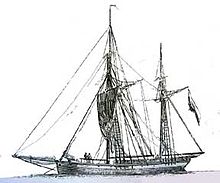
Contemporary drawing - the sailing rig was unlikely to have been used except
during the initial delivery voyage from Britain to China
Overseas customers were now sought and the first ship of the type was laid down for Chile in 1879 as this nation’s war with Peru and Bolivia was commencing. In the event that war ended before the vessel was completed and she was taken over by the Imperial Japanese Navy as the Tsukushi.  She was to serve without distinction in the Sino-Japanese War of 1894-95 and the Russo-Japanese War of 1904-05.Her construction and completion was however overtaken by two generally similar vessels for another Far Eastern customer when an order was placed by China. In the early 1880s the corrupt and floundering Chinese Empire was wakening up to the threats posed by growing Russian and Japanese power on its northern and eastern borders, as well as the pressure from France  the south, from what is now Viet-Nam, and which was to erupt into the Sino-French War of 1885 which ended in a humiliating Chinese defeat. The need for a strong navy to protect China’s long coastline was obvious but corruption and inefficiency was to make progress in this spasmodic and inconsistent. A few ships of limited capacity could be built at the Foochow Dockyard and equipped with imported guns, but the majority were contracted from European sources, German as well as British, resulting in a wide variety of calibres of guns and munitions.
Japanese view of the Battle of the Yalu, 1897
One of the superb woodblock prints made in Japan at the time
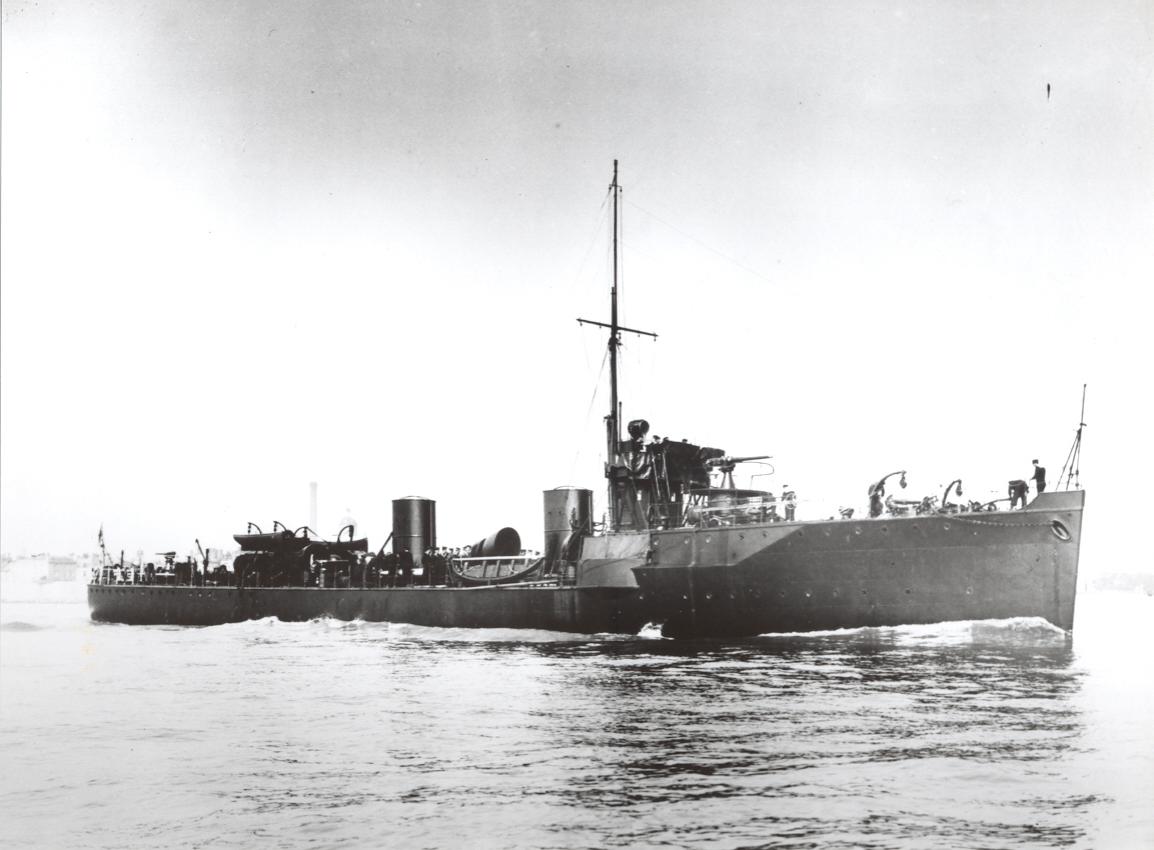
The two Chinese “Rendel cruisers”, named Yang Wei and Chao Yung were of a mere 1350 tons, length 220 feet and beam of 32 feet. Two compound engines, each of 1300 HP, ensured a maximum speed of 16 knots, a respectable speed at a time when the Royal Navy’s HMS Iris, then entering service, was regarded as a marvel for achieving just under 18 knots. Like the Iris, the Chinese cruisers were of all-steel construction, which was also an innovation, but their most remarkable feature was their armament. Each ship carried two 10-inch Armstrong breech-loaders, one forward, one aft. There were mounted so as to pivot inside fixed steel drums, armoured shutters being raised to allow bearing on limited arcs ahead and astern (45 °) and on either side (70 °). In addition each ship carried four 4.7 - inch breech-loaders, two on each broadside, as well as what would have been a fearsome collection of Gatling and Nordenveldt guns’ for protection against torpedo boats. The hulls had only low freeboard fore and aft and had to be built up for the delivery voyage from Britain to China. A simple fore and aft rig was carried to supplement the engines and was probably of most use during delivery. Like Royal Navy ships of the period – notably HMS Inflexible – electricity generation on shipboard represented a major innovation, allowing incandescent light fixtures, including arc searchlights. Hydraulic steering was another innovation – and perhaps a needless complication. 

Chinese ensign, initially triangular, later a rectangle
The Yang Wei and Chao Yung entered service in 1881. Though spasmodic efforts were made to fashion the Chinese Navy into an effective force, the state of unrest, corruption and reluctance to challenge traditional thinking meant that the process was never effective. This was by comparison with the fast-modernising Empire of Japan, which already had ambitions to dominate the Far East and set out to build a powerful navy on the model of the Royal Navy. Japanese naval development was based on coherent planning, with the emphasis not only on the necessary “hardware” – the ships and weapons – but also on “software aspects” – structured organisation, training plans and an ethos of professionalism and pride. By contrast the Chinese navy acquired ships on a random and piecemeal basis, without reference to any single coherent plan. Corruption was rife and the navy was divided into as many as four different “fleets” which at any time might, or might not, cooperate with each other.
  
The Sino-Japanese War of 1894-95 announced Japan’s arrival as a major power on the world stage and resulted in humiliating defeats of Chinese forces by both land and sea.  By the time of the war’s outbreak the Yang Wei and Chao Yung were in a very poor state of maintenance, little more than half their original top speed being achievable and probably several of their weapons being unserviceable. Extensive use of wooden partitioning, overlain with layers of varnish, made them particularly vulnerable to onboard-fire. The concept of the large but slow-loading gun-armament on a small vessel with limited armoured protection was by now overtaken by the development of smaller-calibre quick-loading weapons. In addition, lack of professionalism and corruption so serious that there were rumours of munitions being sold off by officers had made the Chinese Navy a hopeless adversary against the super-efficient Japanese. 
Japanese cruisers in action at the Battle of the Yalu - note Chinese ships burning
 In the key Battle of the Yalu on 17th September 1894 both the Yang Wei and the Chao Yung were placed in the Chinese line of battle. They were subjected to a hail of explosive 6-inch and 4.7-inch shells from the Japanese cruisers involved and both vessels were soon engulfed in flames as the wooden fittings took light. With her steering damaged the Yang Wei collided with the German-built Chinese cruiser Jiyuan and sank in shallow water, as did the Chao Yung, which may have been trying to save herself by beaching. It was a sad end for two vessels which in their time were mistakenly regarded as being at the cutting edge of naval development.
The Yang Wei's and Chao Yung's Nemesis - Japanese 6-inch quick-firers in action


Britannia’s Spartan


Six-inch breech loading guns represented the cutting edge of naval technology in the early 1880s. In my novel Britannia’s Spartan they are seen in use on both British and Japanese ships. The splendid woodcut below shows Japanese crews managing just such a weapon in the war of 1895 against China. Click here for further details – for UK and for US & Rest of World

Friday, 13 May 2016

Privateer Action off Peru 1801

Accounts of the Age of Fighting Sail, whether factual or fictional, are noticeably sparse as regards the activities of privateers, yet they played a vital role in the wars of the period. Essentially commercial ventures, individual or syndicate-owners were granted authorisation by their governments, by means of a “Letter of Marque” to arm vessels and wage war upon the enemy. There were obvious economic advantages for the governments – the financial risks were carried by the owners, who were remunerated from the value of the prizes they captured. With profit as the driving motive, privateers aimed at capture, ideally in an undamaged state, of unarmed or lightly armed enemy commercial vessels and they generally avoided combat with regular naval forces. The typical privateer was a small, lightly-armed vessel, powerful enough to overwhelm its typical targets, but fast enough to escape from any naval craft larger than themselves. The practice emerged in the late 16th Century, when the Dutch “Sea Beggars” were a critical factor in the war of liberation against the Spanish. It was to be widely employed, often on a vast scale, by all maritime nations in the conflicts of the next two and a half centuries. The border between privateering and piracy was often a very blurred one and the practice was all but finally banned by international agreement in the Declaration of Paris in 1856. 
The sort of vessel often used for privateering service
Danish Brig by Antoine Roux (1765-1835)
One outstanding example of a privateer in action in the Napoleonic period occurred in 1801, off Callao, the main port of what was then the Spanish colony of Peru, when Spain was still in alliance with France against Britain. This case was especially notable in that the privateer was prepared not just to dart in and out to capture a prize, but to engage in battle with a much more powerful ship. 
The Chance, commanded by a Captain White and with a crew of 94, was heavily armed for a privateer as she carried 16 guns, most of which appear to have been 12 and 6-pounder carronades. The fact that she was operating off the west coast of South America, far from any British-controlled port, was in itself confirmation of White’s Intrepid spirit. In the Chance’s favour however was that this very fact could lead to complacency by Spanish vessels that an enemy raider was not a likely threat. 
Towards nightfall on 29th August 1801 the Chance approached Callao and encountered a large Spanish trader. Captain White ordered Spanish colours to be run up – a ruse-de-guerre internationally approved as legal until fire would be opened, when British colours must replace them – and he manoeuvred so as to keep the Chance between the trader and Callao itself. By ten o’clock the vessels were within pistol shot and White hailed the Spaniard. Still unsuspecting, and perhaps also with suspicion dulled by the Chance being so much smaller, the Spanish vessel replied that she was the Amiable Maria but apparently did not indicate that she was anything but a trading vessel. White responded by running up British colours and opening fire – a manoeuvre that was calculated to intimidate any innocent trader into immediate surrender. A boat was simultaneously dropped to carry the Chance’s second lieutenant and a boarding party to take possession. 
An action perhaps similar as regards sizes to the Chance and Maria Amiable contest
The Will of Liverpool under attach by a French privateer 1804 - by Robert Salmon (1775-1851)
White had miscalculated – the Amiable Maria was a naval vessel, armed with 18 and 24-pounder weapons – and after the initial shock the Spanish commander brought them into action. White’s stark alternatives were now to fight or to fly, and flight might have been considered the more logical choice. In a straight fire-fight the Chance’s puny armament would be no match for the enemy’s heavier battery and it was likely that she would be pounded to a wreck in short order. The only hope lay in boarding. White accordingly closed with the Amiable Maria in an attempt to run the Chance’s bowsprit over the enemy’s stern to provide a means of crossing. The wind was so light however that the Chance fell away, exposing her stern to an enemy broadside that dismounted several of her guns and killed one of the officers.  Undismayed, White closed again and this time managed to run the bowsprit over the Amiable Maria’s quarter. Men swarmed across and bound the bowsprit to the enemy’s mizzen mast, so locking both ships together. 
At this remove in time it is difficult to imagine just how savage a boarding action could be. In a novel it may occupy a few pages, in a movie some minutes, but the reality of hacking, stabbing and shooting in a small area sometimes lasted for hours. The Chance and the Maria Amiable might be locked together but the Spaniards rallied and drove the boarders back on to the bowsprit. Captain White seems to have been in the thick of the action at this point and he managed, sword in hand, to beat back the defenders and get his own men across to the Spanish poop. They attempted to press forward and every inch was contested by the Maria Amiable’s crew in a struggle that lasted forty-five minutes. The Spanish captain and his men were at last forced back to the forecastle, where they began to drag the bow guns around, loaded with grape and canister, to blast sternwards. Had this succeeded then the Maria Amiable might have been saved but at this critical moment the Spanish captain was disabled. He was carried below and his men rushed after. What must have been the worst part of the action now followed, a murderous close-quarter battle on the lower deck and in the cabins that finally resulted in only 86 of the 220-man Spanish crew surviving when they finally surrendered.  The decks were littered with corpses and wounded and an added horror was the screaming of a Spanish lady who had been a passenger on board, and whose baby had been cut in half by a roundshot, although she herself was uninjured. 
Another battle between unequally-matched ships: East Indiaman Kent under attack by French Confiance 1800
Painting by Ambroise Louis Garneray (1783-1857)
The two ships, still locked together had drifted to within four miles of the port. The Maria Amiable’s shrouds and braces had been badly damaged but the masts were apparently still standing and it was possible, as a breeze sprung up, to take her out to sea. The disparity in casualties seems extreme, if a 19th Century account of the action is to be believed, with the Chance allegedly losing only one officer killed and three officers and two seamen badly wounded.  Surprise and the apparent unpreparedness of the Spanish crew, may have been significant factors in this.  
The action had occurred in sight of the shore and the Spanish Viceroy of Lima was outraged. A small warship, the Limeňo, mounting 18 long 9-pounders and 12 4-pounders, was sent after the Chance with a bounty offered for every man taken, dead or alive. Though the Chance’s crew was reduced to 50 through casualties and provision of a prize-crew for the Maria Amiable, White decided to accept combat. He again closed to pistol shot – at which his carronades were likely to be more effective than the enemy’s long nines and the two ships, more equally matched than in Chance’s earlier action, commenced a running firefight yard-arm to yard-arm. It lasted two and three-quarter hours before the Limeňo surrendered. She had suffered fourteen killed and seven wounded to the Chance’s two killed and one wounded.
We leave Captain White with his battered Chance and two Spanish prizes off the South American coast. What happened afterwards? The 19th Century account I have read makes no further mention of the man or of his ships. One hungers to know more about a man who, had he been a Royal Navy officer, would most certainly have had a stellar career thereafter.

Friday, 6 May 2016

The Convergence of the Twain: English Channel, June 1916

I have always admired – and been somewhat disturbed by – Thomas Hardy’s poem “The Convergence of the Twain” in which he meditated on how the Titanic and the iceberg that was to sink her were brought separately into existence and how they were to meet for one decisive moment only:

                                 And as the smart ship grew
                                 In stature, grace, and hue,
                                In shadowy silent distance grew the Iceberg too. 

                                Alien they seemed to be;
                                No mortal eye could see
                                The intimate welding of their later history, 

                                Or sign that they were bent
                                By paths coincident
                               On being anon twin halves of one august event. 

I was reminded of this poem, and of the terrible image of inexorable, unforgiving destiny which it evokes, when I read recently of the collision of two vessels four years after the Titanic disaster. Collisions at sea occur even in our own day, and did so much more frequently in the days before radar, so at first glance there was nothing unusual about this event. What did strike me however was that the two vessels involved were so dissimilar – one the epitome of luxury, the other’s accommodation so Spartan that its crew was entitled to compensation for their discomfort.

The SS France in her full glory
In the early years of the twentieth century giant ocean liners were as much symbols of national pride as they were means of mass transportation. Ever larger and more luxurious British and German liners competed on the North Atlantic but it was not until 1912 – “Titanic Year” – that France was to provide a worthy competitor. She was named, with obvious pride, the SS France, a 712-foot long vessel capable of carrying 2020 passengers. Driven by four Parsons steam turbines of total 45,000-hp – the first such units installed in a French passenger ship – she was capable of a top speed of 23.5 knots. Like the foreign liners she would compete with, she carried the ultimate status symbol of the era – a dummy fourth funnel. 
Even before the SS France, French liners had an established reputation for comfort and luxury.
The illustrations above refer to an earlier vessel, the SS La Provence of 1905
At 24,666-tons the France was smaller her British and German competitors –  her Cunard contemporary, the Lusitania was of 44,060-tons – but what she lacked in size was more than made up for by the unprecedented luxuriousness of her accommodation. Her first-class interiors, decorated in style Louis Quatorze were perhaps the most opulent on any liner, resulting in the nickname of The Versailles of the Atlantic.
First Class music room on the SS France
Salon on the SS France. Note fireplace and portrait of the "Sun King"
The ship with which the France’s destiny would “converge”, in Hardy’s phrase, could not have been more different. HMS Eden was one of thirty-four destroyers of the “River Class” commissioned into the Royal Navy between 1903 and 1905 (the sheer numbers of vessels in the navy of this period is remarkable by modern standards). One of only three of these ships to be driven by turbines, the Eden’s installed 7000-hp drove her at a maximum of 25.5 knots. On her 550-tons and her 226-foot length she carried four 12-pounder guns and a half-dozen smaller, these being primarily intended for use against other destroyers and torpedo craft. Her two 18-inch torpedo tubes would make her a threat to larger enemy vessels in any fleet action.  Accommodation of her 70 strong crew was by necessity basic – her beam was a mere 24 feet – and like all destroyer crews of the period they were entitled to “Hard Lying Money” as a compensation.
HMS Eden
The Eden’s career was to be spent in home-waters. Even before outbreak of war she was to prove and unlucky ship for in 1910 she broke loose from her moorings in Dover harbour in story weather and sank. She was refloated and returned to service thereafter.
HMS Eden sunken at Dover 1910 
 The France’s career on the North Atlantic was cut short after two years by the commencement of World War 1. She was taken into naval service – initially, and unsuitably due to her high coal consumption, as an armed merchant cruiser and thereafter as a troop carrier.  The Eden meanwhile had been assigned to “The Dover Patrol”, the British naval force tasked with ensuring the safe passage of men and materials between Britain and France across the English Channel. The success of the Dover Patrol in keeping losses to a minimum, despite the presence of German U-boats operating out of bases on the nearby Belgian coast, was one of the Royal Navy’s most remarkable achievements in World War 1.

It was in the early hours of 18th June 1916 that the convergence of this twain was to occur in the English Channel, off the French port of Fécamp on the Normandy coast.  Wartime conditions inevitably meant manoeuvring with limited lighting of ships and collision was a constant danger. The       consequences for the Eden were fatal, her 550 tons no match for the France’s more than 40-times times greater tonnage. The Eden’s commander, Lieutenant A.C.N. Farquhar, and 42 officers and men went down with her and 33 survivors were picked up by the France. Within the larger scale of World War 1, and occurring only three weeks after the Battle of Jutland, the Eden’s tragedy was quickly forgotten by all but the families of those who had perished.
The France in service as a hospital ship in the Mediterranean
Essentially undamaged, the France went on with busy war service. The sinking in late 1915 of Titanic’s sister, the Britannic, which had been converted to a hospital ship, demanded provision of another ship of high capacity. This need was to be met by the France and she was to serve in this role in the Mediterranean until entry of the United States into the war increased the demand for troop transportation. The France once again changed role and as a trooper proved capable of carrying up to 5000 men at a time across the Atlantic, shipping them to Europe in 1918 and back home in 1919. One suspects that the comfort level for these troops was substantially lower than for the 2020 passengers she would carry in peacetime.
Troops of the American 15th Infantry Division being transported by the France
 The France’s civilian career resumed in 1920. Her luxurious accommodation was once again an attraction to the wealthy and in 1924 she was converted to almost total first-class accommodation only, with only 150 third-class berths. She was to continue in service until the early 1930s. By then a dinosaur, the Depression made demand for the comfort she offered less affordable and continued operation was uneconomic. She was scrapped in 1935.

The French presence in the North Atlantic passenger trade was not at an end however and in the year that the France was scrapped the Normandie, arguably the most beautiful liner ever built, entered service. 

But that’s another story.


Britannia’s Reach by Antoine Vanner


"Britannia’s reach is not just political or military alone. What higher interest can there be than consolidation of Britain’s commercial interests?” So says one of the key figures in this novel , which centres on the efforts of a British owned company  to reassert control of its cattle-raising investment in Paraguay, following a revolt by its workers. The story of desperate riverine combat brings historic naval fiction into the age of Fighting Steam. Click on the image below for more details.


Friday, 29 April 2016

The Loss by Fire of the RMS Amazon 1852

Ships are still lost at sea in our own time, frequently as a result of regulations and standards being ignored rather than standards being established in the first place to ensure safe operation. When reading of seafaring in the 19th Century, and the vast numbers of maritime disasters, one is struck by the fact that not only had standards not been established, but that little thought went into recognising inevitable hazards and to identifying measures to mitigate or eliminate them. The most glaring example refers to provision of adequate numbers of lifeboats – a straightforward and obvious measure, the absence of which resulted in heavy loss of life for decades until the Titanic disaster in 1912 finally made action unavoidable. Similar shortcomings applied as regards protection against fire, an especially serious concern when steam-engines were installed in wooden ships. In addition, one is struck, when reading about Victorian-era, by what frequently amounted to an all but wilful blindness to signs of danger. This latter was to be a factor in one of the most horrific of passenger-trade tragedies, the loss by fire of the Royal Mail Steamer (RMS) Amazon, in 1852.

The horror of fire at sea, conveyed by the Victorian painter James Francis Danby (1816-1875)
Constructed in 1850-51, the Amazon, at 2256-tons and 300-feet long, and her four sisters were among the largest wooden-hulled steamers ever built, for by this time iron construction was becoming commonplace. Intended for the mail service between Britain and the West Indies, the 800-horsepower Amazon was paddle-driven and capable, under steam, of a maximum of fifteen knots, though her usual cruising speed would have been closer to eleven. As with almost all steamers of the time she also carried a sailing rig, in her case of three-masted barque configuration. Her crew of 112 reflected the need to operate under sail as well as to feed the furnaces and tend the engine. There was accommodation for 50 passengers.

Commanded by a Captain Symonds, the Amazon left Southampton on her maiden voyage to the West Indies on 2nd January 1852.  According to accounts by survivors of the subsequent tragedy, alarm was felt immediately by many passengers as regards risk of fire. The two engines installed appeared to be overheating and the captain and engineer stopped them several times to allow them to cool. A Mr. Neilson was too worried by this to go below decks and another, a Mr. Glennie, attested that may of the crew were no less concerned. Despite this, Captain Symonds was not prepared to return to Southampton.

The impressive-looking RMS Amazon, as seen before departure on her maiden voyage

Thirty-six hours into her voyage the Amazon ran into a heavy headwind in the Bay of Biscay and soon after midnight fire was seen erupting from just abaft the foremast. The watch-officer sent the quartermaster to rouse the captain, who was sleeping, and as he did alerted the passengers, apparently in a way that encouraged alarm. Even before the captain reached the bridge – which ran across between the paddle-boxes – the fourth engineer, a heroic man names Stone, attempted to go below to stop the engines but was driven back by heat and smoke. Efforts were in progress to drag a fire-hose forward when the blaze reached the oil and tallow store, worsening the inferno. Terrified passengers were now crowding on deck to be confronted with a wall of flame that spanned the deck and was as high as the paddle-boxes, isolating the officers, who were aft, with most of the crew, who were on the forecastle. The only way past the flames was to creep up the curved surface of eh paddle-boxes and slide down the other side, a manoeuvre so dangerous that few attempted it.

By this stage panic was already manifesting itself among passengers and crew alike. An account of the tragedy in an 1877 publication leaves little to the imagination: “It would be needless to tell here of the screams and shrieks of the terrified passenger, mixed with the cried of the animals on board; of the wild anguish with which they saw before them only the choice of deaths, and both almost equally dreadful – the raging flames or the raging sea; and of these fearful moments when all self-control, all presence of mind, appeared to be lost, and no authority was recognised, no command obeyed.”

Every effort was made to prevent the flames extending aft. The Amazon carried nine boats and, remarkably for this period, had in theory sufficient accommodation in them for passengers and crew, but they could not be safely lowered as the unreachable engines were still running and driving the vessel forward at some thirteen knots. The captain hoped that the ship’s movement would finally be arrested by exhaustion of the contents of the boilers but it transpired that when fire was first detected one of the engineers, fearing a boiler explosion, had opened the feed line from the water cistern to maintain a continuous feed. As the ship’s headlong charge continued Captain Symonds ordered all boats to be kept fast until he should order lowering. By the time he did, when the spread of the flames was clearly unstoppable, the forward life-boats were already on fire. According to the 1877 source: “When this was discovered, al order and discipline seemed to disappear immediately, and instead of fortitude and resolution, a selfish desire for preservation entered almost every breast.”

The Amazon ablaze - contemporary illustration. Note boat hanging from davit.

Unfamiliarity with the handling-equipment of the remaining boats now played its role – a sad indication of inadequate crew-training before departure. They were suspended from davits in the usual way but their keels were held in protruding cradles to prevent them swinging but the crew seemed unaware of this. Due to this at least three boats were flipped over as they were lifted and they dumped their occupants into the sea. The captain assisted in lowering the boats and when no more could be done went back to the wheel, took it from the steersman, and apparently perished at his post.  The remaining boats did get away, the first to do so carrying sixteen people, including the Mr. Neilson previously referred to. It rescued a further five from a dinghy that had also got away – it was almost swamped and the occupants were bailing with boots – but the now empty dinghy drove into the stern of the lifeboat and wrecker her rudder.

The gale continued another three hours and all that could be done in the lifeboat was to keep her head to the wind by her oars and save her from swamping. The blazing Amazon was visible in the distance, her masts toppling over in succession as the flames ate them away. A sailing vessel now appeared, heading out from the French coast, and passed within four hundred yards of the lifeboat, which hailed her. An answer was made by signal but she made no attempt to assist and continued on her course. Around dawn an explosion was seen to engulf the Amazon. The funnels toppled over and then she herself disappeared. The lifeboat pulled for the French coast and in mid-morning was picked up by a British brig, the Marsden, which landed the survivors in France.

Burning ship by Ivan Aivazovsky (1817-1900) - it conveys how the Amazon must have looked

The Amazon’s pinnace had also got way although on launching its occupants had been tipped into the sea. A few managed to clamber back on to the ship though a lady clutching an eighteen-month old child, a Mrs. M’Lennan, managed to keep hold of the boat until it was righted. It finally got away with sixteen occupants, including the Mr. Glennie mentioned earlier. An ex-Royal Navy seaman called Berryman (“a fine fellow”) trailed a portion of a spar as a sea anchor to hold the over-loaded boat’s head to. the wind and later, when the sea had calmed, hoisted Mrs. M’Lennan’s shawl between two boat-hooks as a sail. Mr. Glennie noted as he saw the Amazon drew away that “a large hole was burnt out of her side immediately abaft the (port) paddlebox, part of which was also burnt. The hole was nearly down to the water’s edge and through it I could see the machinery.” The pinnace survived into the morning, a leak that threatened to swamp her being stopped by Stone, the heroic engineer, and it steered for the French coast. “the men plying their oars lustily, and Mrs. M’Lennan, as she lay in the sternsheets, cheering them to their work.” Later in the day another vessel was sighted and the lady’s shawl was again put to good use for signalling. It proved to be a galiot, a small Dutch trading vessel called the Gertruda, which picked up the pinnace’s occupants and set her course towards Brest to land them. On the way more survivors were picked up from another boat.

A Dutch galiot
The disaster had occurred on January 4th and it was not until the 15th of the month that it emerged that another thirteen persons had also been saved. They had been rescued by another Dutch vessel, the Hellechina, en route to Leghorn, which transferred them to a British revenue-cutter which took them to Plymouth. These survivors’ experiences were no less horrific than those of the others. The boat had been lowered safely from the Amazon, though a stewardess had fallen out and been drowned in in the process. Command was adopted by a Royal Navy officer, a Lieutenant Grylls, who had been a passenger on the Amazon and who had been active helping fight the fire previously. The boat was however leaking badly – “Fox, a stoker, stopped the hole by taking off his drawers and cramming them into it, keeping them in position for three or four hours by the pressure of his own body; and when seized by violent cramps was relieved by Durdney and Wall.”  Another ship passed between them and the burning Amazon, though without seeing them – though it must have seen the Amazon. One wonders if it was not the same vessel that had acknowledged the lifeboat’s signal but had carried on regardless. Gryll’s boat lacked oars and attempts were made to paddle her with the bottom boards. In the course of the morning it passed over the area where the Amazon had gone down, strewn as it was with wreckage, but with no sign of bodies. Later in the day rescue came in the shape of the Hellechina.

Of the 162 people on the Amazon only 58 survived. The loss was regarded as a national tragedy with Queen Victoria and Prince Albert heading an appeal for support of widows and orphans. A subsequent enquiry was inconclusive as regards the origin of the fire. Though blame was placed by some on the engine bearings running hot – and indeed insufficient testing had been done prior to committing to the maiden voyage – this seems to have been unlikely since the engines continued to operate without seizing until the ship consumed herself. A further consideration was that the crew was freshly raised, knew little of each other and had not exercised together.  The rapid spread of the fire was attributed to the use of much “Danzig Pine” in the construction, a timber known to be particularly inflammable. The single most significant contributory factor was most likely however to be the haste in which the ship had been rushed into service without adequate shakedown of crew and machinery.
The iron-hulled RMS Atrato by William Frederick Mitchell (1845-1918)
And one lesson was most certainly learned. The next Royal Mail ship commissioned, the Atrato, was constructed of iron.

Britannia’s Spartan

Six-inch breech loading guns represented the cutting edge of naval technology in the early 1880s. In my novel Britannia’s Spartan they are seen in use on both British and Japanese ships. The splendid woodcut below shows Japanese crews managing just such a weapon in the war of 1895 against China. Click here for further details – for UK and for US & Rest of World


Friday, 22 April 2016

An Unequal Duel: Trader vs. Privateer 1744

The story of war against maritime trade in the Age of Fighting Sail is usually told, whether in fact or in fiction, from the viewpoint of the naval commerce-raider intent on prize-money. One finds few accounts which view these contests from the side of the victims. I was therefore fascinated by stumbling recently on an account of a furious battle between a civilian trader – armed, as was essential at the time – and a French privateer in 1744, during the War of Austrian Succession.
A trading brig by Joseph Walter,1838 - the Isabella may have looked generally similar.
The Wrightson and Isabella of Sunderland was a merchant ship engaged in trade across the North Sea and commanded by a Captain Richard Avery Hornsby (1699-1751). No details are available of this vessel but given the fact that she was manned by only five men and three boys, besides Hornsby, and that she mounted four carriage guns – which could only have been small ones – and two swivels, she cannot have been of large size, perhaps brig-rigged. On 13th June 1744 Hornsby arrived off the Dutch coast at Scheveningen, the coastal suburb of The Hague, in company with three smaller vessels with which he had sailed in convoy from Norfolk. The Isabella (it’s easier to refer to her as such) was laden with malt and barley. At this period there was no harbour at Scheveningen – one would not be constructed until 1904 – and trading vessels had to lie offshore and transfer cargoes ashore in smaller boats. Fishing boats were drawn up on to the beach (a subject for many painters, including Vincent van Gogh, for many years).

Fishing boats on the beach at Scheveningen, 1882 - by Vincent van Gogh
When the Isabella arrived a large number of fishing boats were lying offshore and among them a French privateer, the Marquis de Brancas, had concealed herself. Commanded by a Captain André, this appears to have been a larger vessel that carried ten carriage guns and eight swivels, plus a crew of 75. She made straight for the Isabella, the other British ships turning away and escaping.
View of Scheveningen 1871 by Johannes Joseph Destree
Note the vessels clustered offshore - among such a grouping the Brancas would have lurked
Given the disparities of armament and crew, resistance by the Isabella must have appeared suicidal.   Hornsby seems however to have had the agreement of his crew to fight it out and he accordingly refused to comply when André of the Brancas called on him to strike his colours. Like any privateer André was naturally focussed on capture of a valuable prize rather than on her destruction and his initial attack on the Isabella was with small-arms fire only. Hornsby ordered his men to shelter and by skilful manoeuvring avoided two French attempts to board on the port quarter. By this stage the Brancas was bringing her guns as well as her small-arms into action and Hornsby was replying with his two port weapons.

This part of the action lasted – amazingly – for upwards of an hour but at two in the afternoon the privateer ran her bowsprit into the main shrouds on Isabella’s port side and held there. Captain André again demanded that Hornsby strike, and was one again rejected. Some twenty French now crossed only to be driven back by a hail of blunderbusses fire. The Brancas now broke free and attacked the Isabella on her starboard side. A new boarding attempt was made – this must have been a nightmare conflict, conducted as it was with hatchets and pole-axes as well as small arms. The two ships were by now lashed together and Hornsby’s men, concentrated at the Isabella’s stern, were somehow holding back the attackers, fresh men crossing from the Brancas to replace dead and wounded boarders. These attackers had taken shelter behind (or rather ahead of) the mainmast when Hornsby fired on them again with his blunderbuss. He had not realised that in the heat of the moment it had been doubly loaded and, as he fired, the weapon burst, throwing him down bruised but still defiant. Boarding proving too costly, Captain André now pulled his men back on board the Brancas and broke away, apparently determined on destruction – and revenge – rather than on capture of a prize.
A Royal Navy brigantine of the18th Century - the Brancas might have looked generally similar
As the French vessel sheered off Captain Hornsby managed to fire his starboard guns into her stern – raking her – and a new yard-arm to yard-arm gunnery battle commenced, a miniature version of the single-ship frigate actions of later decades. Isabella – not surprisingly – had the worst of it, her hull damaged, her sails and rigging torn to shreds and every mast and yard damaged to some extent. The resolve of Hornsby and his crew must have been almost superhuman but it was rewarded by landing a lucky hit on the Brancas “between wind and water” – i.e. along the waterline. This forced the French captain to draw away to plug the leak, thereby giving the Isabella enough respite to haul her fallen ensign up again.

Boarding - the close-quarters horror of the Age of Fighting Sail
The contest was taking place close inshore and crowds had hurried to the beach on foot and by coach to view the spectacle. With her leak stopped the Brancas now returned to deliver the crippled Isabella what must be her coup-de-grace. She crossed under the Isabella’s stern subjecting her to a volley of small-arms fire, one musket ball hitting Hornsby on the temple. He bled profusely but was not otherwise seriously wounded. Brancas now poured three broadsides into the Isabella but was again driven away by another lucky water-line strike. A hasty repair was enough to bring her back into action – another five broadsides were smashed into the Isabella’s hull and André once more called on Hornsby to strike her colours. With his demand once more rejected he ordered his men to bring Brancas alongside to board one more and was answered with a refusal. They had had enough and there was nothing more to be done but for André to break off the fight.
A man-of-war exploding - by the Russian painter Ivan Aivazovsky
The Brancas's detonation would have been smaller, but no less deadly
What happened now was perhaps the most remarkable aspect of the encounter. As the Brancas drew away the Isabella fired on her for the last time. A shot passed through the French vessel’s already badly damaged stern and set off her magazine. The Brancas blew up in a spectacular explosion – so powerful in fact that only three survivors of her crew were picked up by Dutch fishing boats. Isabella herself, a floating wreck, had survived an engagement that had lasted for a seven hours. It would have been a creditable achievement for a warship but an unprecedented one for a civilian vessel.

The courage of Hornsby and his crew were deservedly recognised. Three months later, at Kensington Palace, King George II presented him with a gold medal and chain worth £100 while each of his crew members – who seem all to have survived – were awarded £5 each, though with only £2 for the boys. It is sad to note however that Hornsby lived only another seven years and died at sea “of a lingering illness”.

He and his men deserve to be remembered.


Britannia’s Reach by Antoine Vanner


"Britannia’s reach is not just political or military alone. What higher interest can there be than consolidation of Britain’s commercial interests?” So says one of the key figures in this novel , which centres on the efforts of a British-owned company to reassert control of its cattle-raising investment in Paraguay, following a revolt by its workers. The story of desperate riverine combat brings historic naval fiction into the age of Fighting Steam. Click on the image below for more details.

Tuesday, 19 April 2016

The Iéna and Liberté Disasters, 1907 and 1911

In the late nineteenth and early twentieth centuries all major navies, other than the German, lost large ships through magazine explosions of unstable ammunition. The first of such tragedies was in the US Navy, when the battleship USS Maine blew up in the harbour of Havana, Cuba, in January 1898. The explosion was initially blamed on sabotage by Spanish forces, and was a factor in precipitating the Spanish-American War of the same year (the recruiting slogan being “Remember the Maine!”) but it was only long afterwards when the cause was finally attributed to a magazine explosion.

 Iéna in service in happier times 
The French Navy was to be particularly unlucky in this respect in the years preceding World War 1, two pre-dreadnought battleships being lost while in the naval base at Toulon. The first disaster involved the 11500-ton, 401-feet long Iéna. In service since 1902, this vessel carried an armament – four 12”, eight 6” and many smaller – generally similar to those of her British contemporaries, such as the Formidable class, but on some 3000 tons less displacement.

Contemporary image - Iéna exploding
On 12th March 1907 Iéna was in dry-dock at Toulon for maintenance of her hull and inspection of her rudder shaft (which had provided embarrassing problems on the ship’s first commissioning). The full complement was not therefore on board when a series of explosions erupted in the port-side magazines of the 4” anti- torpedo boat armament. The normal procedure in such cases would have been to flood the magazines, but this was impossible due to the ship being in dry-dock. The quick-thinking captain of the battleship Patrie, which was moored nearby, ordered a shell to be fired into the dock-gates to flood the dock but the shell failed to have any effect. Why it was not attempted to repeat this is not obvious. While this was going on, the violence of the explosions on the Iéna was enough to cause the battleship Suffren, moored close by, to heel over so far as almost to capsize. (The Suffren was an unlucky ship ever since her launching – click here to read more about her). The dock was finally flooded, thanks to the heroism of a young officer, Ensign de Vaisseau Roux, who was killed by fragments soon thereafter. Though the Iéna was damaged beyond repair the death toll – 120 lives – was lower than if the explosions had occurred at sea with her full 700-man crew on board.
Iéna after the disaster 
Investigation traced the origin of the explosion to the instability of the ammunition’s nitrocellulose-based propellant. Known as “Poudre B”, this was known to become unstable with age and to self-ignite. It was estimated that 80% of the contents of the ship's magazines were the suspect at the time of the accident – which could have been far worse had the magazines of the main 12-inch weapons also detonated.  Scandals – known as affairs – were one of the great institutions of the French Third Republic that lasted from 1870 to 1940 and the Iéna disaster was to trigger a choice specimen, referred to as “l'Affaire des Poudres” which resulted in the resignation of the Navy Minister, Gaston Thomson (1848 -1932). Like so many French politicians of the time, involvement in a scandal does not seem to have affected his future career negatively.
Liberté at speed
Lessons from the loss of the Iéna should have been sufficient to avoid similar tragedies in the future but three similar accidents occurred on smaller vessels over the next three years, with no ship lost and a small death-toll. A greater disaster was however to occur, again in Toulon, for years later.  The Liberté, of 14630- tons and 430-feet length, was one of the four ships of the class to which she gave her name and which were the last pre-dreadnoughts to serve in the French Navy. Liberté was obsolete at time of her launch and she entered service in 1908, a year after Britain’s HMS Dreadnought had changed the battleship paradigm. Her four 12-inch cannon represented a puny armament when compared with the Dreadnought’s ten. Liberté did however also mount ten 7.6-inch weapons, six in single turrets and four in casemates.
Liberté exploding - contemporary artist's impression
Liberté was moored in the harbour in Toulon on 25th September 1911 when an explosion erupted in one of the forward magazines of the 7.6-inch guns. The situation was serious, but not yet fatal, and the commander, Captain Louis Jaurès, sent a party forward to flood the magazines to prevent an explosion in the main magazines. A major design fault was now manifested, for the flooding valves were located beneath the magazines. Two heroic attempts were made to reach the valves but were beaten back by fire and smoke. A third attempt was in progress when the main magazine exploded, tearing the ship apart. 
A 40-ton armour plate from the Liberté lodged in the side of the République
The violence of the detonation was sufficient for the pre-dreadnought République, moored over 200 yards away, to be damaged seriously when a 40-ton section of Liberté’s armoured plate was thrown against her side. The death-toll was some 250 and state funerals for these victims were attended by the president and a relief fund for the bereaved families received massive support across the nation.
The wreckage of the Liberté - hardly identifiable as a ship
France had learned the hard way, but other nations were to suffer similar disasters during World War 1. Britain was to lose the pre-dreadnought HMS Bulwark in 1914, the mine-layer HMS Princess Irene in 1915, the armoured-cruiser HMS Natal in 1915 (click here to read an earlier blog about it) and the dreadnought HMS Vanguard in 1917. The Italian Navy was to lose the pre-dreadnought Bendetto Brin in 1915 and the Imperial Russian Navy was to lose the massive new dreadnought Imperatritsa Ekaterina Velikaya at Sevastopol in 1917. Japan’s first dreadnought, the Kawachi, blew up in 1918. In all cases the death toll was horrific.
Improvements in propellant stability ended this string of disasters after 1918 and internal explosions were not to punctuate World War 2, as they had the previous conflict.