Tuesday, 7 March 2017

The Bellona and Courageux action 1761

Devotees of naval history and fiction will know that the “74”, the so-called Third- Rate ships of the line, were the backbone of the fleets of the major European powers in the period 1756-1815. Though the type is primarily thought of as British, the original concept, dating from the 1740s, was French.

Battle of Cape Finisterre 3 May 1747 by Samuel Scott
The Royal Navy captured 4 French ships-of-the-line (including 74s), 2 frigates and 7 merchantmen 

The Royal Navy captured a number of the early French 74-gun ships during the War of the Austrian Succession (1740-48) and was greatly impressed by them compared to their own smallish 70-gun ships. Britain thereafter began to construct its own 74s. The balance of fire-power, sailing qualities, habitability, ability to absorb punishment, plus the endurance that a large store-capacity brought with size, suited the 74 not just to service in the battle line but also for blockade duty and for independent missions on distant stations. As such they were of particular value to the British and French navies, and to a somewhat lesser extent to the Spanish, in view of the global reach of their ambitions. The Russian, Dutch and Danish navies were also to build 74s and the type was to figure in every major action of the period.

The most notable characteristic of the 74 was that it carried its guns on two decks, compared with the three decks of First and Second Rate ships, of which there were far fewer, and which usually served as Admiral’s flagships. HMS Bellona, launched in 1760, was essentially the prototype of the Royal Navy’s 74s and her vital statistics were not significantly departed from in more than 40 generally similar ships which followed. These were:


Two 74s slugging it out off Brest 21st April 1798
The French Hercule (l) and the British Mars. The Hercule was captured.

When Bellona commissioned the Seven Years War – which can be fairly described as “The First World War” since it was fought on a global scale – was already in progress for four years. Her first duty was one that was to become monotonously familiar to herself and to her sisters in the next five and a half decades – blockade of the French coast. Her first blooding – most appropriately since she was carried the name of the Roman Goddess of War – was however to occur off the western coast of Portugal and Spain in 1761. There, off the port of Vigo, Northern Spain, on August 13th, and in company with the 36-gun frigate HMS Brilliant, she was to encounter a close counterpart, the French 74 Courageux. The latter was in company with two frigates, Malicieuse and Ermine. The latter were 36-gun vessels, very similar to Brilliant.

French frigate of the Magicienne class - generally similar to what Brilliant took on two of
In view of the French having the numerical advantage it is surprising that the greater aggression was shown by the British. Captain Loggie of the Brilliant concentrated on drawing off the two enemy frigates so that Captain Faulkner, of Bellona, could concentrate on the Courageux alone. Throughout the following engagement Brilliant withstood the united attacks of both French frigates, until they at last sheered off, both seriously damaged.

Bellona and Courageux were meanwhile involved in a classic single-ship action. They had closed very quickly and the Courageux fired her first broadside when she reached musket-shot range. Faulkner, on Bellona, kept his nerve – and his fire – however, ordering his gun-crews not to fire till they saw the whites of the Frenchmen’s eyes, adding, “Take my word for it, they will never stand the singeing of their whiskers!”

Whether or not the speech recorded in an admiring Victorian history was ever actually delivered by Faulkner it was however an excellent summary of what he intended to do – and did:

“I propose to lead you close on the enemy’s larboard quarter, when we will discharge two broadsides, and then back astern, and range upon the other quarter, and so tell your guns as you pass. I recommend you at all times to point chiefly at the quarters, with your guns slanting fore and aft; this is the principal part of a ship. If you kill the officers, break the rudder, and snap the braces, she is yours, of course; but, for this reason, I desire you may only fire one round of shot and grape above, and two rounds, shot only, below. Take care and send them home with exactness. This is a rich ship; they will render you, in return, their weight in gold.”
 The plan was carried out to the letter and almost every shot took effect. The French returned a very brisk fire, and within nine minutes of the action commencing Bellona’s shrouds and rigging were almost all cut to pieces and the mizzen-mast had fallen over the stern. Faulkner managed nonetheless to wear his ship round; the officers and men flew to their respective opposite guns, and carried on, from the larboard side, a fire even more effective than they had hitherto kept up from the starboard guns. The French colours were hauled down little over ten minutes later.

Courageux (l) and Bellona (r) in close action. Brilliant's separate frigate action to the right
19th Century illustration by H.Fletcher
Faulkner ordered the Bellona to cease firing as soon as the Courageux struck. Many of her crew had come on deck, congratulating each other on their victory – and, no doubt, on their prize money – when gunfire erupted, perhaps accidently, from the Courageux’s lower gun-deck. Fury now overtook the Bellona’s crew and, without waiting for orders, they rushed back to their guns. Two full broadsides were poured into the French vessel before quarter was called for. By the time firing ceased the Courageux was virtually a wreck. Only her foremast and bowsprit still stood, several of gun-ports had been knocked into one, and she had suffered 240 killed and 110 wounded. The Bellona, by contrast, had only six dead and twenty-eight wounded.  The Brilliant which, while outnumbered, had put two similar frigates to flight, had five men killed and 16 wounded.

Victorian-era illustration of Bellona's gunners in action
The Courageux was brought to Lisbon (the Portuguese were Britain’s allies) and after repair was taken into the Royal Navy as HMS Courageux.  She was to serve for three decades until she was wrecked off Gibraltar in 1791. Her French captain, Dugue L'Ambert, had been wounded in the neck at the start of the action. He died, at Lisbon and it is pleasing to record that his funeral was attended by the Bellona's officers and the surviving officers of the Courageux.

The Bellona was to serve until 1814, and to play honourable roles in numerous actions, including the Battle of Copenhagen in 1801. It was however the Courageux action for which she is most remembered. By it she had established a British reputation for almost unvarying victory in single-ship actions which was to last until the encounters with the United States Navy from 1812 onwards. But that’s a another story!

Britannia's Reach

Click here or on the image below to plunge yourself into a world of danger, betrayal and merciless conflict in which neither side has clean hands and one man battles to maintain his integrity. One click gives you access to the opening chapters...


Download a free copy of Britannia’s Eventide 


To thank subscribers to the Dawlish Chronicles mailing list, a free, downloadable, copy of a new short story, Britannia's Eventide has been sent to them as an e-mail attachment.

If you have not already subscribed to the mailing list, you can do so by clicking here or on the banner image above


Friday, 3 March 2017

The Discovery of Franz Josef Land 1873

Franz Josef in 1910 -
an old man for whom so many young ones died
The Emperor Franz Josef (1830 - 1916) of the Austro-Hungarian Empire reigned for an amazing 68 years and is probably best remembered today for his complicity in starting World War 1. Conscientious, unimaginative, hardworking, pig-headed, but essentially stupid, his tenure was to be marked by military defeat, political decline and personal tragedy. His wife was murdered, his son died in a suicide pact, his brother – the so-called Emperor of Mexico – was shot by a firing squad and his nephew’s assassination triggered disaster in 1914. His domains lay in Central and Southern Europe and it is therefore all the more surprising that the archipelago named after him – Franz Josef Land – should be located in the Arctic Ocean and be today a Russian possession of considerable strategic value.

In an earlier blog (30 September 2016 – accessible through sidebar on right) I described Austro-Hungary’s Novara scientific expedition of 1857-59. In this period, such expeditions were matters of international prestige comparable to space exploration in our own day and Austro-Hungary, which had only acquired a navy in the aftermath of the Napoleonic Wars, was keen not to be left out. The resulting Novara expedition was to be a triumph that included oceanographic and geomagnetic surveys as well as onshore botany and geology of lands visited and it provided material for what would become Vienna’s Naturhistorisches Museum in such volume that some of it is still under examination today. 

The Novara model in Vienna's
Naturhistorisches Museum
My wife and I spent two days in the museum last year and we could have spent an entire week there with no less pleasure and were impressed by two splendid models of ships which had participated in important scientific expeditions. The first was the previously mentioned Novara, but the second was of the later Tegetthoff, which was responsible for the discovery of Franz Josef Land.

By the 1870s the Arctic had become a major focus of exploration activity (see blog of 27.12.16).  It was not surprising therefore that when a major Austro-Hungarian scientific and exploration effort be launched in the early 1870s the focus was to be on the Arctic Ocean and investigation of a possible route to the North Pole. Financed by two noblemen, the exploration was to concentrate on the area north-west of Novaya Zemlya. It was under command of a Captain Karl Weyprecht, who had himself served under the famous Admiral Tegetthoff, for whom the vessel was named. The crew was small – 24 in number, including scientific staff.

The Tegetthoff model in Vienna's
Naturhistorisches Museum
The Tegetthoff departed from Tromsø, in Norway, in July 1872. A month later she found herself locked in pack ice north of Novaya Zemlya. The phenomenon of ice-drift in the Arctic ocean was not yet known much less understood, and the ship was in the same nightmare situation as the American Jeanette expedition of 1878-81 (see blog of 27.12.16).  

Forecastle details
Deck Details

Tegetthoff fast in the ice
Though there was continued expectation that the ice would ultimately release its hold and give access to open water, the Tegetthoff was now drifting into the unknown. The ship was to remain locked during the winter of 1872-73, through the summer that followed, and through another winter, 1873-74. Hope, discipline and morale remained high however and when an obvious land mass was sighted a sledge expedition was despatched, under one of the expedition leaders, Julius von Payer, to investigate.  The land discovered proved to be an archipelago, now known to consist of 191 islands, and one of the most barren places on earth, and then wholly uninhabited. It was duly named after Emperor Franz Josef.   

Location of Franz Josef Land - with thanks to Google Earth
It seems to have emerged later that this may not however have bene the first sighting the archipelago, since a Norwegian sealing vessel may have done so in 1865. Anxious however to keep secret what could be a fertile area for sealing and whaling, and to ensure that other vessels would not come to exploit it, no announcement was made by the captain responsible. The Tegetthoff Expedition’s objective was however less mercenary and the credit for the discovery is therefore due to it.  One cannot be impressed by the cool-efficiency with which sledging parties were sent out throughout 1873, even though the prospects for release of the ship from the ice became more grim by the day. On one of these sledge journeys von Payer reached 81° 50′ North, the highest latitude achieved up to that time.
The Franz Josef archipelago - with thanks to Google Earth
When spring arrived in May 1874 the expectation that the ice might free the ship was proved vain. The decision was accordingly taken to abandon the Tegetthoff and to strike out for the open sea, dragging the ship’s boats. The journey involved must have been a nightmare and it lasted almost three months, but on 14 August 1874 open water was reached. The boats carried the crew to  Novaya Zemlya, from where a Russian fishing boat carried them to Northern Norway. Weyprecht, von Payer and their men were accorded a well-deserved hero’s welcome at each stage of their returned to Austria through Norway, Sweden and Germany. Their entry to Vienna was greeted by a crowd numbered at over a hundred thousand. For all that the Tegettoff herself had been lost, her scientific contribution had been enormous. 

The empire that Franz Josef had ruled lasted only two years after his death and is now a distant memory. It is ironic therefore that in the wastes of the Arctic, where he himself never set foot, his name should be preserved.

r

Britannia’s Reach 


Click image for details
It’s 1880. On a broad river deep in the heart of South America, a flotilla of paddle steamers thrashes slowly upstream. Laden with troops, horses and artillery, intent on conquest and revenge. 

Ahead lies a commercial empire that was wrested from a British consortium in a bloody revolution. Now the investors are determined to recoup their losses and are funding a vicious war to do so.

Nicholas Dawlish, an ambitious British naval officer, is playing a leading role in the expedition.  But as brutal land and river battles mark its progress upriver, and as both sides inflict and endure ever greater suffering, stalemate threatens.

And Dawlish finds himself forced to make a terrible ethical choice if he is to return to Britain with some shreds of integrity remaining…

 opening

Download a free copy of Britannia’s Eventide 


To thank subscribers to the Dawlish Chronicles mailing list, a free, downloadable, copy of a new short story, Britannia's Eventide has been sent to them as an e-mail attachment.

If you have not already subscribed to the mailing list, you can do so by clicking here or on the banner image above

Friday, 24 February 2017

From Rebel to Samurai – the epic career of the Ironclad Stonewall/ Kōtetsu: Part 1

When thinking of the ocean-going navy of the Southern Confederacy in the American Civil War the image immediately comes to mind of fast, largely unarmoured vessels such as the Alabama and the Florida, general similar in construction terms to commercial vessels, albeit strengthened to carry heavy armament. The corresponding image of a Confederate ironclad is, by contrast, an armoured, improvised, steam-propelled raft intended for service in rivers and coastal waters. It is therefore somewhat of a surprise to learn that the Confederacy’s last “Blue-Water” naval vessel was a heavily-armed ironclad, well capable of sinking any major Union warship she encountered. Completed late in the Civil War, only the end of the conflict brought her potentially devastating career in Confederate service to an end only just as it was starting. This was however to be just the prelude to spectacular battle-service in a newly created navy on the other side of the world.

CSS Stonewall
The ship that was to become the CSS Stonewall was one of two ironclads constructed in France, personal approval for the project being given in 1863 by the Emperor Napoleon III, who was sympathetic to the Confederate cause. The objection that French neutrality would be compromised by delivery of warships to either the Union or to the Confederacy was neatly side-stepped by circulation of the rumour that they were intended for delivery to the Khedive of Egypt – the appropriate names of Sphynx and Cheops were allocated to them. A further element of confusion was added by ensuring that the armament would come from Britain. The seagoing ironclad concept was a new and revolutionary one at the time – France’s Gloire and Britain’s HMS Warrior, the first of the type, had been launched in 1859 and 1860 respectively – so the Confederacy was betting on acquiring cutting-edge naval technology.

Armouring of Cheops and Sphynx - note waterline belts and armoured redoubts for and aft
Sphynx and Cheops were of 1358 tons and some 190 feet long. Their 1200-hp steam engines, driving two screws, gave a top speed of over 10-knots. Twin rudders made for very tight turning circles – a decided advantage at a time when combat was likely to be at very close range. They also carried an auxiliary sail rig – especially valuable for conservation of coal when operating over long distances. The most notable feature was however the heavy armour protection – a waterline belt with thickness ranging from 3-5 to 5-inches or iron, as well as some 5-inches on the redoubts fore and aft in which the armament was housed. These latter structures were not rotating turrets, but rather protective casemates from which the guns fired through ports. As such they could be regarded as precursors of the later “central battery” type of ironclads, as compared with the traditional broadside arrangement of the earlier Gloire and Warrior.  Sphynx and Cheops each carried a single 300-pounder muzzle-loading Armstrong forward, firing over the pronounced ram-bow, with two 68-pounder weapons in the after redoubt. As such they were built to absorb tremendous punishment as well as to deal it out.
Sail Plan of Cheops and Sphynx - note armouring above ram.
Note also how the weapons are carried high behind thick armour,
The vessels were constructed in Bordeaux, on France’s Atlantic coast, and were launched early in 1864. Human greed is however a major obstacle to keeping a project of this sort secret. In this case the subterfuge about purchase by Egypt was exposed by a clerk at the shipyard who supplied information on the deal – and hard evidence, in the form of documentation – to the United States ambassador in Paris.  With a diplomatic crisis about neutrality brewing, the French Government had no option but to block the sale. A new customer was immediately available however. Prussia’s “Iron Chancellor”, Otto von Bismarck, supported by the Austro-Hungarians, had precipitated war with Denmark. Heavily outnumbered, the Danish resistance was fierce, heroic and doomed. The bright spot for Denmark was the performance of its navy, both in support of land operations and on the open sea. (My blog of 8th January 2016 regarding the Battle of Heligoland refers. It can be found via the sidebar). It was accordingly inevitable that both the Danes and their enemies should be looking to purchase more warships. Sphynx and Cheops would fit the bill to perfection. In a cynical deal in which a sale to one side was balanced by a sale to the other, the Sphynx was sold to Denmark – and renamed Stærkodder – while the Cheops was purchased by Prussia and called Prinz Adalbert. Thus were neutrality concerns elegantly sidestepped!
Denmark's day of glory - the Nils Juel at Heligoland, 9th May 1864
A Danish crew arrived in Bordeaux in June 1864 to start acceptance trials and take her to Denmark thereafter. (One wonders if there were any embarrassing encounters with a Prussian crew arriving to take over Prinz Adalbert!). The war was however winding down – with Denmark comprehensively beaten – and by 1st August a preliminary peace treaty had been signed. By the time Stærkodder arrived in Copenhagen all was over and she was by now essentially surplus to the requirements of the vanquished nation.

Confederate agents had however followed the Sphynx/ Stærkodder affair with interest and were still determined to acquire her. Negotiations – which must have required a high degree of secrecy – resulted in a sale by Denmark and in early January 1865 a Confederate crew commanded by Captain Thomas Jefferson Page (1808 – 1899) took delivery. The ship was commissioned at sea as the CSS Stonewall.

These events had not gone unnoticed by Union agents and diplomats and once intelligence was obtained of the Stonewall’s “breakout” from the Baltic to the North Sea, and on to the Atlantic, powerful Union Navy units were despatched to find and sink her. There are strong parallels with the breakout of Germany’s battleship  Bismarck in 1941 and her hunting by Royal Navy forces. Among the Union ships deployed were the steam-sloop USS Kearsarge – recently the victor of her duel with the CSS Alabama off the French coast – and her sister USS Sacramento, supported later by the steam-frigate USS Niagara. Though Kearsarge had been partly protected by improvised chain-armour, all these ships would have been at a decided – and perhaps fatal – disadvantage in any duel with the heavily-armoured Stonewall.
Gun exposed on an open deck during the Kearsarge - Alabama duel
It is clear that such ships would be at a disadvantage when facing a heavily armoured
 vessel like the Stonewall with its weapons sheltered behind 5-inches of iron plate.
Once at sea the Stonewall developed a leak – it is notable that her now-Prussian sister Prinz Adalbert deteriorated so rapidly that she was taken from service in 1871 – and she put in at Quiberon, on France’s Brittany coast, where repair possibilities see to have been limited, and to take on supplies and further crew members. It is likely that many of these recruits were not American, as was the case also with other Confederate raiders, but men of other nationalities who were attracted by pay and by the opportunity for adventure. Stonewall now pressed on to Ferrol, in North-West Spain, where she could undertake repairs. She remained there for almost two months. Word of her presence spread and the USS Sacramento and USS Niagara took up station outside. (One is reminded of HMS Shannon lying off Boston in 1813, daring the USS Chesapeake to come out).

Portuguese battery at Belem fort firing warning shots
to restrain USS Niagara. Common sense prevailed a
and the situation was defused
When the Stonewall did finally emerge from Ferrol on 24th March, the Union warships waiting for him declined to engage – wisely, in view of the disparity in armament and armour.  Captain Page now headed for Lisbon, Portugal, to take on coal prior to a dash across the Atlantic to attack Port Royal in South Carolina, the supply base for the Union General Sherman's army. The Stonewall was followed into port by the Sacramento and Niagara – which under neutrality rules could only glower at each other in enmity. An attempt by the Niagara to shift her berth was interpreted by the Portuguese authorities as a potentially hostile move against the Confederate vessel and warning shots from cannon on the castle of Belem put an end to the manoeuvre. Formal neutrality rules – demanding that enemy ships could not leave harbour simultaneously – were strictly applied and the Stonewall slipped away unmolested.

Time was running out for the Confederacy however. On 9th April Lee surrendered the Army of Northern Virginia to Grant and on 26th April the only other major Confederate force was surrendered by Johnson to Sherman. By the time that Page and the Stonewall put in at Nassau, in the British possession of the Bahamas, on 6th May the epic conflict was at an end. The ironclad and her crew were now orphans.

Page now decided to take his ship to Havana, in Cuba, then still a Spanish possession. He handed her over to the government authorities there against a payment of $16,000 and paid off her crew. The Spanish in turn handed the Stonewall to the United States in return for a similar payment.

The triumphant Union now possessed one of the most powerful warships afloat, but in the aftermath of the Civil War there was little appetite for retention of a large navy – the concern was indeed to run down one which had grown to gigantic levels during the conflict. The Stonewall lay decommissioned at the Washington Navy Yard for some two years until it was decided to sell her.

And the buyer?

Opened up to foreign contact only thirteen years before, the Empire of Japan was engaged on a furious, and historically-unprecedented, campaign of modernisation. Its ambitions were all but boundless and acquisition of an effective navy was of the highest priority. The ex-Confederate ironclad would be ideal for their purposes.

The Stonewall would be heading east, and under a new name -  Kōtetsu - would embark on the most active part of her career.

I’ll tell about that in the second part of this article, which will appear soon. Watch out for it! 

Japan’s rapid creation of a superbly efficient modern navy is one of the most remarkable stories in Maritime History. This achievement is a major theme in my Dawlish Chronicles novel Britannia’s Spartan. Click on the image below to learn more.


Download a free copy of Britannia’s Eventide 


To thank subscribers to the Dawlish Chronicles mailing list, a free, downloadable, copy of a new short story, Britannia's Eventide has been sent to them as an e-mail attachment.

If you have not already subscribed to the mailing list, you can do so by clicking here or on the banner image above

Friday, 17 February 2017

Protected Cruisers in the Pre-Dreadnought Era

It is always gratifying to an author to received feedback from readers, particularly when detailed research to support a story is recognised and appreciated. I was therefore delighted to be contacted recently by an American reader, Douglas R. Smith, who was intrigued by the central role played in my novel Britannia’s Spartan by HMS Leonidas, a fictional member of the innovative and real-life Leander class of “protected cruiser” which entered service with the Royal Navy in the 1880s. I’m proud therefore to welcome Douglas as a guest blogger today. I’ve no doubt you’ll enjoy his article.

PROTECTED CRUISERS IN 
THE PRE-DREADNOUGHT ERA 
by Douglas R. Smith

The British Empire was vast and overextended in the late 1800s, and dependent upon vulnerable sea lanes. To compensate it had a Navy equal to the next two contenders combined. British bankers and businessmen built a network of intercontinental telegraph lines, reaching all of the way to New Zealand by 1876, with London at the center. The role of protected cruisers was for protecting commerce, and raiding that of the enemy, often operating distantly and independently around the globe.
1891 Telegraph Map 

Telegraph Connections (Telegraphen Verbindungen), 1891 Stielers Hand-Atlas, Plate No. 5, Weltkarte in Mercators Projection. Uploaded to en:Wikipedia on 03:53, 16 February 2006 by w:User:Flux.books == Licensing == {{PD-
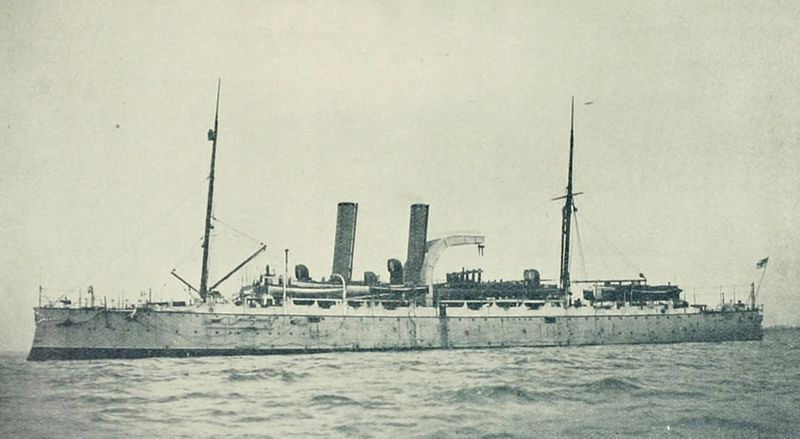
"Britainia's Spartan" by Antoine Vanner is the story of the shakedown cruise of the fictional HMS Leonidas, first of her class. Captain Nicholas Dawlish has earned the honor of being her first commander. We have followed his meteoric career in earlier books, and like all career people, he must struggle to find a balance, and determine if that balance is worth the personal cost. In a similar way a warship must find a balance between speed, firepower, and protection, and do so at an acceptable cost in lives and resources. This is an outline of naval dynamics with respect to protected cruisers in the dawn of the Pre-Dreadnought Era, when hydraulics, electricity, and triple reciprocating steam engines were enhancing the capabilities of warships, but before submarines, destroyers, and airplanes, much less carriers and tenders for them, changed the nature of naval warfare. 
HMS Leonidas - Nicholas Dawlish's command in Britannia's Spartan

HMS Leander, analog to the Leonidas
Armed with ten 6" breechloaders, and carried two 2nd class torpedo boats. 
She became a destroyer depot ship in 1904.
Source : "The Navy and Army Illustrated" Scanned by Steve Johnson.
Downloaded from Steve Johnson's cyber-heritage website : http://www.cyber-heritage.co.uk/vicnavy/
Armored cruisers ( the Russian Navy favored them ) relied on a steel belt for protection, much the same as the battleships. Often a belt included a ram in the bow, a relic of ironclad steamships fighting against wooden ships.  But since weight was the enemy of speed, armored cruisers were little better than battleships at commerce raiding. Not too cost effective. Protected cruisers relied on clever use of curved steel to deflect shells away from, and coal bunkers to protect, the machinery and magazines below water level. It worked well provided you didn't collide with armored ships. The weight savings resulted in greater speed and the range to defend a far-flung empire.

It's always nice to have superior range in a main weapon. That's been true ever since the trebuchet. You can hit the enemy, but they can't hit back. HMS Leonidas had a main battery of all 6" breech loading rifles. A bigger gun could do more damage, but a contemporary  7", 8", 9", or even 10" breach loader wouldn't necessarily have more velocity, accuracy, or effective range ( about 10,000 yards). It would require separate powder charges and shells in the magazine, complicate handling,  adding weight and reducing speed, particularly as a bow chaser, where it would be most advantageous. The alternative solution would have been to develop lighter shells for long range situations, but the trade-off would be reduced impact.
 
Japanese protected cruiser Izumi left elevation plan
The British-built protected cruiser Chilean Esmeralda 1884  (aka IJN Izumi after 1894 ).
A bow ram, 10" chasers, a 6" broadside, and 3 sizes of other guns, 
but no torpedo launchers until the sale and refit. 
Source: Janes Fighting Ships, 1904 edition Sampson, Low, Marston and Co, London
In Nelson's era, sailing ships of the line tended to have lighter weapons as the decks got higher, ranging from 32-pounders to swivel guns. It didn't much matter at "pistol shot range" in the days of sail when rate of fire was the key.  As the range opened up in the Pre-Dreadnought Era, it became difficult to correct the aim because they couldn't differentiate the splashes. The continuous smoke from the rapid-fire weapons never cleared, so they couldn't see well enough to aim anything properly. The innovative “all big gun” design of the HMS Dreadnought solved these issues.

Adding extra "tools" to the armament to anticipate a multitude of situations, such as several small rapid-fire breach loaders of various sizes to defend against torpedo boats, is a design temptation for an independent command. This "Swiss Army knife approach" requires more crew and training, complicates ammunition storage and handling, and versatility comes at the expense of role specialization and refinement.

Torpedoes as we know them were in the early stages, with an effective range limit of only 800 yards, less for a moving target. Lethal, but more of a coup d' grace than a stand-off weapon. HMS Leonidas carried two launchers on each broadside. Pairs of torpedoes are much harder to avoid than solo ones, but crippled ships aren't so nimble. Perhaps it wasn't a very practical addition to the armament.

An alternative arrangement would be for the cruiser to carry a pair of torpedo boats, (like HMS Leander, and the fictional Kiroshima in Britannia’s Spartan) which could be launched for coordinated night attacks. More skill, but more effect. In terms of costs in cash and lives, it takes a lot of torpedo boats to equal a battleship, so they were the emerging threat at the time. France embraced them as part of her “Jeune Ecole” doctrine.  The Americans were developing flywheel powered torpedoes, which had no telltale bubble trails. A pair of torpedo boats carried aft would lift the bow and improve the ship's trim, offer an option against a battleship (when a gun fight was out of the question) , and would enhance blockading a hostile port or protecting a friendly one (more so with the addition of a few sea mines) . They might also come in handy for patrolling, carrying messages, search and rescue, or on convoy duty. They add weight, but would replace some boats and torpedo launchers. 
HMS Vulcan, a torpedo boat depot ship launched in 1889 carried six 16' torpedo boats,
two counter-mining launches, and eight 4.7" guns.
From 'The Royal Navy : a history from the earliest times to the present' Vol 7 by William Laird Clowes, 
published 1903 by Samson.Low, Marston and Co. London.
Available at http://www.archive.org/details/royalnavy07clow, 
Public Domain, File:HMS Vulcan 1889.jpg - Wikimedia Commons
Gatling being fired from a fighting top
Ships retained masts, yards, and sails as backup propulsion and to stretch the coal supply on long voyages, but the sailing rigs had less area and the ships more weight than their predecessors, and weren't practical. In combat, these rigs often became a liability that would obstruct a battery, create splinters, or act as a sea anchor when hit. Radios hadn't been invented yet, so they didn't need an antennae mast. They did still need signal halyard and lookout platforms, and they were good places to mount Gatling guns and search lights to defend against night torpedo boat attacks. An observer or gunner couldn't see much from a mainmast close to the smoke stacks. A foremast and it's supports interfered with the bow chaser and the view from the bridge. It took years for naval architects to sort things out.

The first designated torpedo boat destroyer went into service in 1895. Navies would adopt submarines at the turn of the century, radio 1905, HMS Dreadnought in 1906, and floatplanes circa 1910. In 1912 the effective range of the torpedo was as much as 6,000 yards. By then the value and versatility of the destroyer was proven, and they were replacing torpedo boats. Naval warfare would become "modern". But in the early 1880s, other cruisers, battleships, and torpedo boats were the recognized perils, and how to optimize the new cruisers to fulfil the role of commerce raiders or protectors was the question.


Douglas R. Smith was born in Pennsylvania in 1959, where he developed an interest in history and reading historical fiction. This included Pre-Dreadnought navies, because they established both Japan and the USA as world powers. He worked in agriculture, sales, and insurance. Now he and his wife Karen are in Wisconsin, enjoying their retirement, dining, Disney, and travel.


Britannia's Spartan 


Six-inch breech loading guns represented the cutting edge of naval technology in the early 1880s. In my novel Britannia’s Spartan they are seen in use on both British and Japanese ships. The splendid woodcut below shows Japanese crews managing just such a weapon in the war of 1895 against China. 


Download a free copy of Britannia’s Eventide 


To thank subscribers to the Dawlish Chronicles mailing list, a free, downloadable, copy of a new short story, Britannia's Eventide has been sent to them as an e-mail attachment.

If you have not already subscribed to the mailing list, you can do so by clicking here or on the banner image above

Tuesday, 14 February 2017

Jean Bart – Sea Raider

The French Navy’s record through the centuries never achieved the string of memorable victories won by Britain’s Royal Navy – though one French victory, that of the Virginia Capes in 1781, was decisive in assuring American Independence. One French naval hero was however to achieve a status in his countrymen’s eyes comparable to Nelson in British ones. This was Jean Bart (1650 – 1702), a man whose career was so dramatic, and whose character was so outlandish, that only the most daring of authors would dare create a similar figure in fiction.

The name Dunkirk evokes today images of the almost miraculous evacuation of British and French forces in 1940 from the harbour and nearby beaches of this port on the French side of the English Channel. It played an equally important role in the late seventeenth century, when Britain, France and the Netherlands were locked in a series of wars, as it represented the most northerly French naval base. As such it provided a fortified refuge and source of supply not only for formal naval forces but also for privateers. Its possession was vital for supporting French efforts to control the Channel and the North Sea.

The boyhood of Jean Bart - French chocolate label!
It was here that Jean Bart was born in 1650 to a seafaring family. It may not have been French – there is some evidence that his original name was Jan Baert, indicating a Flemish origin, and that he spoke both languages. (Even today the French/Flemish linguistic boundary lies around a dozen miles north-east of Dunkirk). Details appear scarce but he seems to have first gone to sea in Dutch service, under the illustrious Admiral Michiel de Ruyter in the Second Anglo-Dutch War (1664-67), from which the Dutch emerged victorious.

The price of Louis XIV's glory - French atrocities during invasion of the Netherlands
In 1672 France invaded the Dutch Republic, the so-called United Provinces. The Dutch fought back ferociously, so initiating six-years of warfare in which, surprisingly in view of later history, Britain was to be France’s ally for the first two years. Jean Bart now entered French service, not as a naval officer – a rank not open to those of humble birth – but as a privateer operating out of Dunkirk. Such privateers were privately-owned ships sailing under a “letter of marque”, with government backing, and were frequently funded by syndicates of investors. Bart’s raids on Dutch commerce during the first years of the war were so fruitful that in 1675, at his own expense, he could afford to equip a sloop carrying two guns and 36 men. With this he at once captured a Dutch warship mounting eighteen guns and crewed by 65 men. He continued to take prizes and could now afford to fit out a 10-gun ship, promptly capturing a Dutch 12-gun vessel. He then was given command of five frigates, and on 4th March 1676, captured an 18-gun Dutchman. Shortly afterwards he met eight British merchant ships, escorted by three warships. He promptly captured one of the escorts, drove the others off, and took the merchantmen into Dunkirk. In September of the same year he captured the Neptune, 36-gun frigate, and her entire convoy. During the six years the war lasted he took 49 vessels in total.

French ship under attack by Barbary corsairs, mid-17th Century
With peace restored Bart, irrespective of his birth, was awarded a lieutenant’s commission – a first step in the Royal French Navy that was ultimately to carry him to the rank of admiral. He was now given command of a 14-gun ship and sent to cruise off North Africa against the Barbary corsairs who were to be a scourge of European – and later American – shipping for another century and a half. This resulted in capture of a large armed-xebec which was brought back to Toulon as a prize.

In 1683 France was at war again, this time with Spain. It lasted less than a year but it gave Jean Bart the opportunity to take a Spanish vessel carrying 350 troops, which he sent in to Brest. He followed this up by capturing two warships off Cadiz, receiving a severe thigh-wound in the process.

King Louis XIV’s territorial ambitions were to trigger war again in 1688, a nine-year conflict which was to pitch France against the so-called “Grand Alliance” of the Dutch, British, Holy Roman Empire and several lesser principalities. For Jean Bart this was the start of the most spectacular part of his career. He now commanded a 24-gun frigate, and immediately took a Dutch privateer, but his luck ran out when he ran into met two 50-gun British ships. Taken prisoner, he was brought to Plymouth but was to make a daring escape, stealing a boat and rowing in two and-a-half days across the Channel to near St. Malo on the coast of Brittany. 

The long row home - Jean Bart escaping from Plymouth to St. Malo
Now a national hero, he was promoted to captain and given command of the frigate Alcyon. In her he was to fight under the Count de Tourville on 10th July 1690 at the Battle of Beachy Head in the English Channel – known by the French as the Battle of Béveziers –   a French tactical victory which resulted in British and Dutch losses of eleven ships for no French loss. This gave the French temporary control of the English Channel but de Tourville did not follow up the victory. The battle is unique in that both commanders, British and French, were to lose their commands for their performances.

The Battle of Beachy Head, July 1690, by Nicholas Ozanne
 Jean Bart’s next assignment was escorting merchant shipping from Hamburg to Dunkirk, an activity he combined with successful commerce-raiding in the North Sea. By 1691 however enemy forces had blockaded Dunkirk. Bart escaped with several small vessels, slipped out at night and opened fire on the blockading squadron as he passed. The following evening he captured two British ships, of 40 and of 50 tons respectively, together with merchant ships he took in to neutral Bergen, in Norway. He then now directed his attention to savaging a large Dutch fishing fleet, burning most of them, seizing their escorts and  landing their crews on the English coast, then going on to plunder and burn villages on the Scottish coast.  Again blockaded in Dunkirk, , he once more broke out successfully in October 1693 and at once hurled himself on British shipping, sustaining his record of captures and raiding the English coast near Newcastle, returning with enormous spoils. Sallying out again from Dunkirk with three frigates, he captured more merchant vessels before engaging a convoy escorted by three men-of-war. Two of these he captured but the third, a 54-gun vessel, fought off three attempts to board her. She made her escape, abandoning the convoy to Bart.

The Battle of Texel, June 1694, by Eugene Isabey
The battle that was to earn Jean Bart his title of nobility was fought off the Dutch island of Texel on 29th June 1694 when, with a flotilla of seven ships, he recaptured a French convoy which had earlier that month been taken by the Dutch. He also took three warships of the eight-strong escort.  Greeted with rapture on his return to Dunkirk, he found himself invited to Versailles to receive the personal congratulations of Louis XIV.

Bart’s last triumph in the North Sea was at the Battle of the Dogger Bank on 17th June 1696. It was initiated by his locating a Dutch convoy of 112 merchantmen, escorted by five warships. Speed was essential for a large British squadron under Admiral John Benbow was searching for Bart’s force of seven ships. Bart threw his own ship nevertheless at the Dutch flagship, the Raadhuis van Haarlem, capturing it only after a three-hour battle. Four more Dutch warships surrendered. Bart then burned  
25 merchant ships, making away to the east only as Benbow's squadron hove into sight. A year later the Treaty of Rijswijk brought the war to an end, and with it Bart’s fighting career. He died five years later, still a relatively young man, yet one who had packed more into a single life than the vast majority of men ever dream of.

A lesson in courage - Jean Bart's son tied to the mast during a battle
Jean Bart was to achieve mythic status in death, the embodiment of an “up and at them” tactical commander rather than a strategist. Records indicate that he captured a total of 386 ships, besides sinking or burning many more. Some of the stories told of him may or may not be true, but even the fanciful ones hint at the nature of his character. One tale has him causing outrage among courtiers at Versailles by smoking his pipe in the ante-room while waiting for an audience with Louis XIV. On the king asking him how he broke the blockade at Dunkirk, he is said to have arranged the courtiers present in a line, then attacking them with his fists, knocking them down, as a practical demonstration. In 1697, towards the end of the war, he was tasked with carrying the Prince de Conti (François-Louis de Bourbon), the French candidate for the Polish crown, to Danzig. This demanded slipping six frigates through a tight enemy blockade. When clear of danger, the prince asked Bart if he had not been afraid that the enemy might have captured them. Much to the Prince's horror, Bart informed him that not the slightest danger of such a contingency had existed, as his son had been stationed with a match in the magazine to blow up the ship upon receiving a pre-arranged signal. Another story has him tying his own son to a mast during an action to cure him of fear of death and gunfire.

Jean Bart under attack by aircraft from the USS Ranger, Casablanca, November 1942
Jean Bart’s name has lived on in the French Navy, some 27 ships being named for him since his death. The most famous was France’s last completed battleship, which in November 1942, when only partly completed, was to fire on American warships during the Casablanca landings until silenced by dive bombers from the carrier USS Ranger and five 16-inch hits by the USS Massachusetts. Finally completed after WW2, she was to remain in French service until 1961. The current vessel is an anti-aircraft frigate launched in 1988.

The name of Jean Bart lives on.

                                                        ================

Britannia’s Reach is the second of the Dawlish Chronicles. So what’s it about?

Click image for details
 It’s 1880. On a broad river deep in the heart of South America, a flotilla of paddle steamers thrashes slowly upstream. Laden with troops, horses and artillery, intent on conquest and revenge. 

Ahead lies a commercial empire that was wrested from a British consortium in a bloody revolution. Now the investors are determined to recoup their losses and are funding a vicious war to do so.

Nicholas Dawlish, an ambitious British naval officer, is playing a leading role in the expedition.  But as brutal land and river battles mark its progress upriver, and as both sides inflict and endure ever greater suffering, stalemate threatens.

And Dawlish finds himself forced to make a terrible ethical choice if he is to return to Britain with some shreds of integrity remaining…