Tuesday, 23 February 2016

The Loss of HMS Sceptre 1799

When thinking about war at sea in the Age of Fighting Sail one’s attention is immediately drawn to the ferocity of battle when ships engaged at close quarters. In actuality however combat was relatively rare but wreckage in stormy weather remained a constant – and exhausting – hazard at all times. One is indeed struck by the number of ships – and lives – that were lost without any intervention by the enemy. The Royal Navy was more vulnerable than those of other maritime powers since British strategy rested on keeping at sea – and dominating it – whether on close blockade of hostile coasts or bases, or cruising to destroy enemy commerce, or projecting force anywhere in the world, from the Caribbean to Java, from Egypt to Argentina. 
The nightmare of shipwreck on a lee shore - painting by Francis Danby (1793-1861) 
Keeping at sea did however mean inevitable exposure to extreme weather, in many cases with fatal consequences. For all the professional seamanship of ship’s officers and crews, sailing ships were, by their very nature vulnerable, and never more so than when forced towards a lee-shore. One example – a terrible one – of such a loss was that of HMS Sceptre in 1799.

A third-rate, in this case HMS Bellerophon - Sceptre would have looked generally similar
The Sceptre was a 62-gun third-rate ship of the line which had entered service in 1782, in time to participate in the Battles of Trincomalee and of Culladore, off the Indian coast, the last significant engagements of the Anglo-French was that had grown out of the American War of Independence. She was laid up until 1794 and on recommissioning participated in actions off Haiti and St. Helena. She spent a long time thereafter at Cape Town – captured from the Dutch in 1795 – and was described to have become “weak and leaky” there. Notwithstanding this she was to return to Indian waters in early 1799, escorting a convoy and carrying an entire army regiment – the 84th – herself.  She leaked so badly in during one spell of bad weather that she survived only by pumping. On reaching Bombay she was docked and was strengthened by large timbers, known as riders, which were bolted diagonally to her sides fore and aft. That this should have been necessary for a relatively new ship indicated that the structure was in very poor condition. Now repaired, she set out on her return voyage, reaching Cape Town in late October.
 
Table Bay in the early 19th Century - contemporary illustration
On November 5th, while moored in Table Bay, Cape Town, a strong wind began to blow from the North West – a direction against which the bay offered no shelter. No danger was anticipated however and flags were flown, and a salute fired at noon, to celebrate “Guy Fawkes Day”, commemorating the frustration of the Gunpowder Plot in 1605. By early afternoon however the wind was at gale force and the captain ordered top-masts to be struck (i.e. taken down) and the fore and main yards lowered to reduce drag.  Soon afterwards a mooring cable parted but another anchor was dropped, with two guns attached to increase its holding power. By early evening even this was proving insufficient to hold the ship and a boat was launched to cross to HMS Jupiter, a fourth-rate moored close by, to secure a cable to her. The waves were so violent however that the boat capsized and its crew drowned. The Sceptre was now helpless in a raging sea. No help could reach her from the land and officers who had gone ashore the previous evening could only watch helplessly.
Loss of HMS 'Victory, 4 October 1744' by Peter Monamy (1681 - 1749)
(Not Nelson's Victory, but an earlier ship. The Sceptre, in distress, might have looked like this)
At eight in the evening a new horror manifested itself, a fire below decks, its origin unclear. Dense smoke was rolling from the hatches in such volumes that it was impossible to go below to fight it. Two hours later the helpless ship drove on to a reef, broadside towards the shore and heeling to port towards the sea. The captain ordered the main and mizzen masts to be cut away and this was done – discipline seems to have been well maintained even at this desperate juncture. Lightened by the masts’ fall, the ship lightened and rose free from the reef, moving closer to the shore and giving hope that she might be thrown high enough upon the beach for all to be saved.

HMS Sceptre's destruction as imagined in a 19th Century illustration
 Hope turned to despair as the Sceptre began to break up, the port side collapsing and throwing large numbers of men into the water. The survivors clustered on the starboard side. Several jumped overboard and tried to swim ashore but were borne away on the seething eddies. The entire poop structure wrenched itself free and carried towards the shore, observers there estimating that seventy men or more were clinging to it. It never reached the beach, capsizing as a wave hit it and taking every man on it with it.  Worse was to come. The shattered hull was now heeled towards the shore, men clustered on it, but as a large wave hit it was lifted again, then smashed down, breaking into two sections just before the mainmast. The after section appears to have disintegrated immediately  but the forward part lasted a little longer, with some forty men clinging to it as waves surged over them. Then it too collapsed into separate chunks of wreckage.
 
Guns and wreckage from HMS Sceptre thrown up on the beach
as drawn by a witness, Lady Anne Barnard
The tragedy was played out close the shore, so that the crowds that gathered there – townspeople, soldiers from the garrison – saw the horror unfold but found themselves powerless to help. Fires were lit to guide swimmers but many of them were killed by the churning wreckage as well as by drowning. Only a handful reached the shore alive and the next morning three waggon-loads of dead bodies were gathered for burial. The death toll, which included the captain, was horrific – 349 seamen and marines were killed or drowned. Of the 51 who reached the shore nine were so badly injured as to die there.

One of the survivors of the disaster was “The Indestructible Admiral Nesbit Willoughby”, whose story has been told in an earlier blog (clickhere for details). Then a lieutenant, he was lucky enough to be one of the Sceptre’s officers who were ashore and who were forced to watch from the beach. Thirteen years later this extraordinary man was to survive the horrors of the retreat from Moscow as a prisoner of the French. One cannot wonder whether he was lucky, by surviving these and other adventures, or unlucky in being an apparent magnet for danger!

Britannia’s Shark by Antoine Vanner


Friday, 19 February 2016

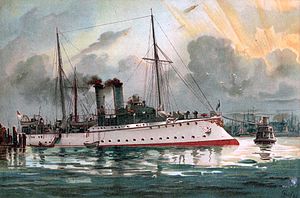
A liner turned hunter: Prinz Eitel Friedrich

In the late 19th and early 20th Century the French and German navies became fixated on the idea of “Cruiser Warfare” – the individual ships operating far from home on the world’s oceans and striking at enemy seaborne trade. Britain, with enormous merchant fleet and the dependence of its economy on overseas trade, was seen as particularly vulnerable. Belief in the concept rested on the success of such operations in the Revolutionary and Napoleonic Wars by both privateers and national navies. As late as the American Civil War, in the 1860s, the Confederate riders Alabama and Florida were to hurt disrupt Union trade far from home waters and necessitate diversion of significant resources to hunt them down. In the 1890s so called “protected cruisers”, which would later evolve into the light-cruiser classification, were seen as especially suited to such tasks. 


The French navy went so far as to build one such cruiser, the Châteaurenault, which was designed to look from a distance like an ocean liner, and so increase its chances of closing with an unsuspecting victim. Several classes of German cruisers of the immediate pre-WW1 period were especially suited to such operations. It was also intended that in time of war civilian vessels would also be commandeered and armed. Unarmoured they might be, but they were intended to capture defenceless merchant shipping and not battle it out with a naval opponent. The Royal Navy, no less than those of other nations, had made provisions for such conversions and subsidies were often provided to shipping companies to build strengthened positions into decks on to which guns could be mounted in wartime. (The RMS Lusitania was one such vessel, though she was not armed at the time of her loss).
Priinz Eitel Friedrich in peacetime - and a candidate for transformation to ocean raider in times of war

The weakness of the cruiser warfare concept was that the conditions that had favoured success in the Napoleonic era no longer applied.  Sailing ships could operate far from base for many months – food and fresh water being the only consumables – but steam vessels were heavily dependent on shore support, not only for fuel supply but for maintenance of boiler and machinery. Britain was well supplied with widely-spread fortified naval bases when war broke out in 1914 but Germany had only a single such base, Tsingtao, on the Chinese coast. German colonial harbours elsewhere were unfortified and were thus easily occupied in the early months of the war. Tsingtao, despite heavy investments in strong fortifications, was to fall to a combined Japanese –British force before the end of 1914. The upshot was that German vessels on overseas deployments could not rely on fuelling and maintenance facilities other than those in Germany itself. Some reliance had been placed on chartered colliers supplying coal from neutral ports and rendezvousing with warships at sea but in the event this source proved of little utility. (Click here to read blog on “Germany’s Naval Nomads”) In practice German raiders were dependent on coal captured from prizes. In practice, transfer of coal from one ship to another on the open sea was a brutally difficult task in all but the calmest weather.

Gunboat SMS Iltis - sister of the Luchs, which gave up her guns to arm the Eitel Friedrich

 It is against this background that the relative success of the German raider SMS Prinz Eitel Friedrich should be seen. A 16,000-ton, 503-foot liner, launched in 1904 was in service for the Norddeutscher Lloyd Company between Germany and China. Designed for long ocean passages, she was capable of a maximum 15 knots. Her peacetime crew was of the order of 400, reflecting the heavy labour demands of a large coal-fired steamship. She was at Shanghai when war broke out in August 1914 and she proceeded immediately to Tsingtao to be fitted out as a raider and to support Admiral von Spee’s East Asia Squadron (Click here for an earlier blog on this squadron’s victory in the Battle of Coronel). The Eitel Friedrich was fitted with four 4-inch (10.5 cm) guns and several smaller weapons from the obsolescent gunboats Luchs and Tiger. She now commissioned as a warship of the Imperial German Navy as SMS Prinz Eitel Friedrich, under the command of Korvettenkapitän Max Therichens, previously of the Luchs. She slipped out of Tsingtao before the Japanese-British blockade of the base became effective and she sailed to join von Spee’s squadron at Pagan, in the Northern Marianas island group, a German colony since 1899, arriving there on 12th August 1914, some two weeks after outbreak of war. Too slow to join von Spee’s cruiser squadron, the Eitel Friedrich was detached for independent action against the merchant shipping of Britain and her allies, initially off Australia.

Stern view of Prinz Eitel Friedrich - gun just visible on the poop
The Eitel Friedrich was to operate in the Pacific for the next three months, hunted, as von Spee’s squadron was separately by Japanese as well as British forces. Britain’s formal alliance with Japan – which was to last until 1923 – was paying off and fulfilling its intended role of releasing British ships from the Pacific area for employment closer to home. No success was scored by the Eitel Friedrich until early December but her second capture was invaluable, a French sailing collier carrying 3500 tons of coal. As this vessel carried no radio it was possible to tow her to the tiny Chilean possession of Easter Island which was not connected to the mainland by either telegraph or radio. The Eitel Friedrich’s presence thus unknown and here the coal could be transferred in sheltered waters and sheep were also taken on board for meat. The collier – the first of eight sailing vessels the Eitel Friedrich would capture – was scuttled after the transfer. The collier’s crew were put ashore though those of subsequent captures were taken on board, accommodation being ample.

By this time the Eitel Friedrich was with one exception – the light cruiser SMS Dresden – the only survivor of van Spee’s squadron, the others having been hunted down and sunk. Her engines and boilers were already showing signs of wear and top speed had fallen, and was likely to fall still further. With no friendly base available there was no option but to head for Germany, inflicting maximum damage on enemy shipping on the way. Accordingly, in January 1915, with enough coal and mutton to last until early April, Captain Therichens brought his ship over into the South Atlantic. Conscious of the risk of British ships patrolling the Cape Horn area, he steered a course far to the south, along the northern fringes of Antarctica.

The William P Frye
Over the next month the Eitel Friedrich was to sink a further eight ships off the South American coast. Aware that he was incapable of outrunning any enemy, Therichens stayed away from the main trade routes and detection of his presence was made all the more difficult by most smaller merchant ships of the period not carrying radio.  His tonnage score was steadily increasing – reaching before operations ended a total of eleven ships of 33,000 Gross Registered Tons.  One of these victims was to prove especially significant, the large (3,374-ton) American sailing vessel William P Frye, detained on 27th January. It should be noted that the United States was still neutral at this stage of the war. The Frye was carrying wheat to Britain and, despite her American registration, Therichens ordered the entire cargo to be thrown overboard before she would be allowed to proceed. This process went slowly – and dangerously, for too-long a stay in any one area increased the risk of interception –  so on the following day Therichens ordered the American crew to be taken on board the Eitel Friedrich and the ship herself to be destroyed by gunfire. This was the first case of a neutral American ship being sunk by the German Navy – actions that were ultimately draw the United States into war with Germany.

The Prinz Eitel Friedrich arriving at Newport News on 12th March 1915
Four further ships – two steamers and two sailing vessels – were captured and destroyed in February but during the following month it was obvious that with supplies running low, engines suffering breakdowns, hull badly fouled and awareness that British patrolling has intensified, the chance of reaching Germany was all but zero. There was nothing for it but to head for a neutral port – in this case Newport News in Virginia, arriving there on 12th January. Therichens seemed to have entertained hopes of being allowed to carry out major repairs, and the American authorities – bizarrely, one must think – allowed the captured crews, now amounting to some 300 men, to be kept on board. Therichens argued, with some success, to be allowed to stay in Newport News for several weeks to effect repairs, but the sinking of the William P Frye had eroded sympathy and the case was in the process of growing into a major diplomatic issue. It was obvious at last however that escape would be impossible, since a British armoured cruiser, HMS Cumberland and a Canadian cruiser HMSCS Niobe, were waiting just outside territorial waters. (The similarity with the plight of the Graf Spee at Montevideo in 1939, when a later HMS Cumberland was also waiting outside, is very marked). Accepting defeat, Therichens surrendered his ship and his crew for internment in America.

The Eitel Friedrich was to remain idle for the next two years but when the United States entered the war she was taken over for use as a troopship and renamed USS DeKalb.  She was to see intense service carrying troops across the Atlantic to Europe and equally intense service carrying them back in 1919. Thereafter she was to be sold to the United American Lines Company and operated on transatlantic service under the name SS Mount Clay.  She was laid up in 1926 and scrapped nine years later.

It was a mundane end for a raider that had evaded capture with skill and determination  for seven months and had inflicted significant loss on enemy shipping at little cost.

Recently published: Britannia’s Spartan

Author Antoine Vanner talks about his latest novel, Britannia’s Spartan, in a short video. Click hereto watch it.

Click below for more details for both paperback and Kindle versions: 

Tuesday, 16 February 2016

Hit and Run at Sea 1876

A blog last month dealt with an 1876 case of a ship “passing by on the other side” and not rendering assistance to a wrecked vessel (click here to read this article). An even more extreme case occurred the same year, one involving “Hit and Run”, with a ship causing a collision that sank another vessel ignoring the plight of her survivors without any significant effort to render assistance.

SS Strathclyde, seen in 1873
On the afternoon of February 17th 1876 a large British trading steamer, the Strathclyde – 1950 tons, 290-feet – was in the English Channel, just off Dover, on the first leg of a voyage to Bombay. She carried a crew of 47 as well as 23 passengers. The weather was fine, “with a fair wind”, visibility good and the sea relatively smooth. Strathclyde was making some nine knots. A generally similar ship was spotted about two miles astern and still further out to sea and it was estimated that courses, if maintained, would cross. The stranger turned out to be the German Franconia, en route for the West Indies, and steaming at higher speed than the Strathclyde. As the faster vessel. the Franconia was expected to take evasive action and on this assumption the Strathclyde held a steady course. A half-hour passed, during which time the Franconia had all but overhauled the Strathclyde and was giving no indication of altering her course – indeed, according to one contemporary account “the Franconia came down upon the Strathclyde as if she had been an enemy’s vessel in time of war.” What seems to have been a panicked order was given at the last moment to avoid collision and the Franconia was swung around, possibly in the hope of crossing the Strathclyde’s wake. The manoeuvre failed and the Franconia smashed into the Strathclyde amidships, tearing a huge rent into which water rushed. She rebounded from the impact, then surged forward again, striking the Strathclyde and gouging a second hole in her side further aft. The Strathclyde began to settle by the stern and was clearly doomed.

A contemporary illustration shows the Franconia reversing from the Strathclyde
The clouds of steam enveloping the latter may have been artistic licence!
The Franconia’s bows had been damaged, but not fatally so, but the over-riding desire of her captain, one Ferdinand Keyn, was to get his ship safely into the nearby harbour of Dover. He was encouraged in this by James Porter, a British pilot taken on board for the transit of the Dover Straits. The Strathclyde’s first mate and four seamen seem to have managed to jump across to the Franconia before the ships separated, reporting later that discipline seemed to have broken down there. They urged Captain Keyn to drop boats for the Strathclyde’s survivors but he was deaf to their appeals. After no more than a few minutes, with feeble attempts at rescue, the Franconia backed off and headed for Dover.

Two of Strathclyde’s lifeboats got away, the first with fifteen of the women passengers but it was quickly swamped, most of the occupants drowning. The second boat got off safely and recovered two living survivors from the water. The ship disappeared in less than ten minutes and took many with her. A fishing lugger from Deal, the Early Morn, arrived on the scene and pulled survivors from the water. The Dover lifeboat had been launched – the whole tragedy had played out so close inshore as to be plainly visible – and was towed towards the stricken vessel by a harbour tug. The final death toll was 38, out of a total 70 crew and passengers. Strathclyde’s captain, J.D. Eaton, stayed with her until the final plunge but he did survive.

The Strathclyde's last moments. Note Franconia on right and heading for Dover
The Franconia reached Dover safely but her Captain Keyn was charged with manslaughter for his unwillingness to render sufficient assistance. Considerable opprobrium was also heaped on the British pilot on board, of whom it was written at the time “Let us hand James Porter’s name down in infamy; let us blush to think that he could call himself an Englishman!” 

Keyn’s trail, at London’s Central Criminal Court, was to have implications beyond the immediate case. He was convicted as charged, but the verdict was quashed on appeal.  The grounds for this rested on the argument that English Law was not applicable to foreign vessels in English waters. Sufficient feeling was however aroused by the case that soon thereafter Britain adopted International Territorial Waters provisions which were already in use by several other countries. These defined such waters as extending three miles from the shoreline, this distance reflecting the contemporary range of coastal artillery.  As for the owners of the Strathclyde, they brought and action against the Franconia’s owners in the Admiralty Court and were awarded £45,000. It seems a very paltry sum in view of the loss of life.

Britannia’s Spartan


Six-inch breech loading guns represented the cutting edge of naval technology in the early 1880s. In my novel Britannia’s Spartan they are seen in use on both British and Japanese ships. The splendid Japanese woodcut below shows Japanese crews managing just such a weapon in the war of 1895 against China. Click here for further details.


Friday, 12 February 2016

HMS Hector 1782 – an epic of leadership

Inman in his later years
In a recent blog (click here) we met Captain Henry Inman (1762 –1809), a noted frigate commander who was in overall command of operations off Dunkirk in 1800 in which the French frigate Désirée was captured in dramatic circumstances. This ship was commissioned into the Royal Navy and Inman was to command her at the Battle of Copenhagen in the following year. A man of great ability, Inman’s career was to be dogged by ill health and he died before achieving his full potential. His most impressive achievement was however in his youth – he was only twenty years old at the time – and it was characterised by leadership and seamanlike skills of the highest order. Without him well over 200 lives might well have been lost. 

                                         The Battle of the Saintes, April 1782

Promoted to lieutenant in 1780, after surviving two separate shipwrecks, Inman, on shore duty in the West Indies, missed participation in the large fleet action, The Battle of the Saintes, off Dominica in April 1782. This had culminated in a crushing British victory over the French. In the course of this engagement the French “74” line-of-battle ship Hector was captured. Though badly damaged in the action she was commissioned into the Royal Navy as HMS Hector. Under the command of Captain John Bourchier (approx. 1755 – 1819) she was ordered to return to Britain. Henry Inman joined her as First Lieutenant. Getting the battered Hector seaworthy for the Atlantic crossing involved removal of 22 of her guns and replacement of her masts with shorter ones, presumably so as not to over-strain her hull. Her crew was significantly short-handed, some 300 men, many of whom were invalids. In normal circumstances a ship of this size would carry a crew of 500 to 700 men and it is therefore obvious that her fighting ability was very seriously impaired. She sailed in late August, none on board suspecting that she would have to survive a violent hurricane that was to spell doom for other survivors of the Saintes Battle and killing over 3500 men.

Before the unanticipated hurricane another enemy had to be confronted. On the evening of September 5th the Hector was found by two 40-gun French frigates, L’Aigle and Gloire. These fresh, undamaged vessels quickly perceived Hector’s decrepitude and one placed herself on her beam, and the other on her quarter and began to pour fire into her. Poorly manoeuvrable, Hector was badly placed to avoid several rakings but she returned fire sufficiently to damage both attackers. It was a very creditable performance for a ship so weakly manned and armed. Even so, had the French vessels continued the bombardment from a distance they might have sunk Hector. Instead they made the mistake of attempting to board and their efforts were bloodily repulsed. The action was broken off after six hours and both French ships bore off. (They were to be captured by a British force off the Delaware coast a week later – the damage sustained in the conflict with the Hector quite possibly a contributory factor).

Hector’s survival had been dearly bought. 46 of her crew had been killed or wounded, an especially serious concern when so many of her complement were already invalids. Captain Bourchier had been so badly wounded as to be incapacitated and effective command now passed to the twenty-year old Henry Inman. The ship herself had been weakened yet further – the hull had sustained more injury, as had the masts, rigging and sails.
The "74" HMS Theseus surviving a hurricane in 1804
The Hector's plight would have been even worse as she had lost both masts and rudder
"All Hands to the Pumps" 1889
by Henry Scott Tuke
It was in this state that the Hector was to encounter the massive hurricane that swept through the Central Atlantic on September 17th. Battered by high seas, she lost her rudder and all the masts. Leaks were sprung and incoming water reached a level at which a major portion of the provisions and fresh water was spoiled. Survival now became a matter of continuous pumping, a labour that demanded physical exertion on an open wind and spray-lashed deck which would have been severe for a fit and healthy crew, but almost impossible for one so debilitated.

The pumping ordeal was to last two weeks, with Inman – himself driven to the limits of exhaustion – needing at times to resort to the threat of his pistols to keep men at the task. Many appear to have died from fatigue while those who had finished their turns had no energy to do other than lie, washed over by surging water, in the scuppers. Despite these efforts the water level was still rising inside the stricken hulk. Men already sick were dying daily and in the last four days of these two weeks the ship was without drinking water even as the hull structure began to disintegrate.

It was at this extremity, when hope was all but abandoned, that a sail was spotted.   This was the tiny snow Hawke, of Dartmouth, Devon, under the command of a Captain John Hill. Though the seas were still high Hill brought her alongside Hector, remained with her through the night, and in the morning commenced transfer of the survivors, now only some 200 in total, including the wounded Captain Bourchier. Henry Inman remained on Hector until the last man had left. She sank ten minutes after he reached the Hawke.
A naval snow, 1759, by Charles Brooking
The figures on deck give an idea of just how small a craft such a vessel was
The situation was now only slightly less desperate. The Hawke was small – it is unlikely that she would have been longer than 100 feet – and to make room for Hector’s survivors necessitated dumping much of her cargo overboard. Even at that she was so grossly overcrowded, and the extra weight taken on gave concern for stability, that Hill and Inman had to enforce orders regarding how many men could be on deck at any one time. Food was quickly depleted, despite rationing, and the water allowance was only a half pint per man per day. Despite this caution only a single cask of fresh water remained when land was sighted close to St. John’s, Newfoundland.

Inman and Hill were – deservedly – the heroes of the hour and were carried in triumph through the streets of St. John’s. Without the skill and bloody-minded determination of both men, the death toll would have undoubtedly been higher. With his health badly impaired by his ordeal Inman was put on half-pay on his return to Britain and it was to until 1790 that he was again assigned a command. Further adventures lay ahead – and we’ll return to them in a future blog. 

 Britannia’s Reach by Antoine Vanner

 Historic naval fiction moves on into the age of Fighting Steam. Click here for more details of this story of desperate riverine combat.


Tuesday, 9 February 2016

Guest Blog: “SO WHY PIRATES?” by Helen Hollick

Today’s blog is from a guest, Helen Hollick, whose novels range from Arthurian Britain, via Saxon England, to sea adventures which she says are “not meant to be taken seriously”. Invariably witty and entertaining, exuding energy and joie-de-vivre, Helen’s website and blog are a source of delight (see links at end of article). Her “Sea Witch Voyages” series, set in the so-called Golden Age of Piracy, are unique in the nautical fiction genre. I’m very grateful therefore that she should contribute some entertaining musings on society’s continuing fascination with pirates. Over to Helen…

 SO WHY PIRATES? Helen Hollick

So why write about pirates? Why read about pirates? Even more bizarre, why dress up as pirates? What exactly is the exotic lure of pirates in the realm of entertainment?

Let’s be honest here, real pirates were not (are not!) nice people. The most active period of piracy is called the ‘Golden Age’, a few short years in the early 1700s. What is
‘Golden’ about outright ruffians who steal things, frighten and torture their victims? Who murder, destroy, blow things (and people) up? Pirates were the terrorist hooligans of the eighteenth century – yet we love novels and movies about them. We have pirate festivals and pirate fun days; pirate costumes are among the highest choice for fancy-dress parties, there is even an annual ‘Talk Like A Pirate Day’ every September 19th.

Why?

Very possibly three answers. Romanticism. Escapism. The thrill of safe danger. Johnny Depp’s creation of Jack Sparrow (at least for the first movie, the others were not so good) re-kindled that spark of interest in nautical adventure where belief is suspended in favour of a darn good sailor’s yarn. Safe escapism to that other world where bad things look like they happen, but actually they don’t. It’s all enjoyable make-believe.

In reality there is nothing romantic about a ship being boarded by dozens of drunken cut-throat louts bellowing at the top of their voices, ‘Death! Death! Death!’, all eager to torture, rape, murder, plunder and loot, and then destroy the evidence by setting the ship on fire.

But fictional pirates are very different. They are rogues, yes; they would as soon cut your throat as cut your money-pouch from your belt, but there is a rugged charm associated with these scallywags. Pirate tales are a grand adventure romp, usually with barely any historical accuracy whatsoever. You know that the hero will survive the storm and subsequent shipwreck, recover from a near-fatal wound, dodge the gallows, find the treasure and get the girl in the end. We all enjoy the adventures of a loveable rogue because – well, he isn’t real. The danger he gets into or creates makes our hearts race – the thrill of the chase or the fight, the within-an-inch-of-his-life death-defying scenes. The ability to keep on fighting/running/bedroom antics even though shot/wounded/kicked in an ‘ouch’ vulnerable place where real men would be curled up on the floor clutching their nether regions, howling in agony. You know these heroes are in trouble. You also know they are going to get out of it – the thrill, the excitement, is not knowing how they do so.


The secret of a good pirate novel (or any novel come to that!) is the pace, action, larger than life characters and how believable it all is. Even fantasy has to be believable – which is one of the reasons Game Of Thrones is so successful. I was halfway through Series One of GoT before I figured it was fantasy-based, not historical-adventure. (The dragons gave it away, I guess.)

It is not just our thrill-seeking generation to be enamoured by these bad-boy characters. Back in the eighteenth century the Big Entertainment (the equivalent of going to a Celeb-packed Premier Opening Night) was the spectacle of the Gallows. A good hanging drew the crowds, the more famous the criminal, the bigger the audience. To some, the prospect of seeing a man hanged was the highlight of the year. A hanging was a party atmosphere with pie-sellers and souvenirs. Dancing, revelry, and then, Top of the Bill you get to see a man taking twenty minutes or so to be strangled to death along with all the other unpleasantries that happen to the slowly expiring body. That long drop with a short stop was not in use in the early 1700s; to hang meant standing on a barrel, or cart, which was rapidly removed leaving the poor soul to kick and squirm as the noose around his  (or her) neck choked him to death. No quick broken-neck death. Captain Kidd, poor chap, was pushed off once at the Gallows at Wapping, London – and the rope broke. They picked him up, tied a new noose, stood him on the barrel, kicked it away… and the rope broke again. Had it happened a third time he would have been set free. Alas for him, someone obviously had the bright idea to get a different rope…

Another chap did survive, but I’m not sure it was a good thing. If the corpse was not paid for and collected by relatives (who often grabbed hold of the strangling body in the hope that the extra weight would kill quicker – literally, ‘hangers on’) then it was sent to the local medical school for dissection. This poor bloke was hanged, sent for dissection but was not actually dead. He regained consciousness as he lay there, naked, on the table about to be cut open!

Nope. Hanging? Not my type of entertainment. I’ll stick to drama on TV thank you.

But that’s where the ‘safe danger’ comes into play isn’t it? A hanging, or a horror movie, a murder-mystery or a thrills and spills adventure where the ‘baddies’ get killed with no remorse from the one doing the killing – usually the hero who ends up with the cute busty blonde -   sets our heart racing, our eyes popping, and in no danger whatsoever apart from a nightmare or two.

My pirate novels, the Sea Witch Voyages are adult adventures not meant to be taken seriously. I write them for fun, they are meant to be read as tongue-in-cheek Errol Flynn / Jack Sparrow romps. They are entertainment… even if the real pirates were far from entertaining to the poor souls who met a boat-load of them somewhere on the open ocean!


Links:

Twitter: @HelenHollick

My Author Page on an Amazon near you : viewAuthor.at/HelenHollick

And Thanks to Helen for a most entertaining guest blog! I look forward to welcomng her back again in the future - Antoine Vanner

Friday, 5 February 2016

The Captains’ War: Bulgaria and Serbia 1885

There is something intensely sad when reading about forgotten conflicts, often fought over issues that were trivial even at the time, and which were memorable only to the families whose happiness was wrecked by loss of loved ones.  War may be “Last Argument of Kings” – as was inscribed on his cannons by Louis XIV – but the true price is paid by much humbler people. One such forgotten conflict was that between the Balkan nations of Serbia and Bulgaria in 1885. Military operations lasted only two weeks but they resulted in a decisive victory for one of the parties.

The Price of Glory - A Bulgarian hospital at the war's end

Bulgaria as a nation had only been born seven years previously, following its liberation from Ottoman-Turkish (mis)rule in the brutal Russo-Turkish War of 1877-78. This had been triggered by Turkish massacres of Christian Bulgarians in 1876 in what was still then a Turkish province. Russia, traditionally the protector of Eastern Christians, used this as a pretext for a declaration of war on Turkey, with the ultimate objective of capturing Istanbul (Constantinople) and  thereby securing an outlet on the Mediterranean. The war was to be bloody in the extreme – other than the Franco-Prussian War of 1870-71 the largest in Europe between Waterloo and World War 1. It was characterised by excess on both sides and further massacres. The Russian Armies smashed their way to the very outskirts of Istanbul and had Britain not threatened to intervene on Turkey’s behalf would have done so.  (This war provides the background to my novel Britannia’s Wolf, in which the action plays out in the last, brutal months of fighting - see link at end of article).


The final outcome was decided at the Congress of Berlin in 1878 when the major European powers agreed revised borders. This involved creation of Bulgaria as an independent principality, but with a large enclave within it, known as Eastern Rumelia, which remained under nominal Ottoman control. The challenge was now to find a ruler for the new principality and the solution usually adopted in such cases in the nineteenth century was resorted to. This was to find some under-employed member of a minor royal or semi-royal house, usually German.

Prince Alexander
In this case the lucky man was to be Prince Alexander of Battenberg (1857 – 1893), then serving as a lieutenant in the Prussian Life-Guards in Berlin. Why this was considered a suitable qualification for a head-of-state role, even for a constitutional monarchy, as Bulgaria was to be, is somewhat of a mystery. In the event however Alexander was not to do badly.  His older brother, Prince Louis (1854-1921, was already serving in Britain’s Royal Navy and in due course would rise the office of First Sea Lord. Despite a distinguished career and unquestioned loyalty to Britain, this unfortunate man was hounded from office in 1914 because of this German name, which he thereafter changed from Battenberg to Montbatten. Lord Louis Montbatten (1900-1979), uncle of the present Duke of Edinburgh, and last Viceroy of India, was his son.

Alexander, now a constitutional monarch was Prince of Bulgaria, was to find himself caught between the machinations of the Russians, who wanted him as a puppet, on the one hand and of Bulgarian politicians on the other. Frustrated, he lost patience on 1881 and, with the connivance of Russia, suspended the constitution and assumed absolute power.   For the next two years the real power was in the hands of two Russian generals, Sobolev and Kaulbars, sent by the Czar, much to the anger of many Bulgarians. In 1883 Alexander restored the constitution – with broad support from the Bulgarian political classes –an action that enraged the Czar and led to the withdrawal of senior Russians who had been training the Bulgarian army.

Throughout this period Eastern Rumelia had remained under nominal Turkish control but a revolution there in 1885 gave Alexander the opportunity to annex it and create a single Bulgarian state. This step was popular throughout Bulgaria but the possibility existed that Turkey would strike back. Bulgarian forces were accordingly sent south-east to defend the border against any Turkish offensive.

Milan I
Serbia, Bulgaria’s western neighbour, saw this situation as an opportunity for an easy seizure of a small area of disputed territory on the border between the two countries (see map). In November 1885 Serbian forces, 60,000 strong, crossed the frontier under the command of King Milan I (1854-1901). Eager for personal glory, and confident of an easy victory, he did not appoint experienced generals to key positions. Though well-armed with modern Mauser rifles the Serbian troops were poorly trained in their use. Recently-ordered modern artillery had not yet arrived. Morale seems to have been poor, not least because the troops seem to have been told initially that they going to the aid of the Bulgarians in a war against Turkey. That they were now to fight the Bulgarians instead caused considerable confusion and lack of trust.

Given that Bulgarian forces were massed to the south-east, to face a Turkish threat, the Serbian advance in the north-west should have proved  a walkover. In the event however Alexander and the Bulgarian high-command took the risk of assuming that the Turks would not attack – an assumption that proved correct – and worked somewhat of a miracle in shifting the bulk of their forces to meet the Serbians.  Doing so was dependent on a limited-capacity railroad as well as very impressive feats of marching. One infantry regiment marched some 60 miles in 32 hours, and indication of the high level of Bulgarian morale. The Bulgarian weakness was in senior officers since the Russians occupying these positions had been withdrawn and the burden of command fell on middle-ranking Bulgarians (causing the conflict to be known afterwards in Bulgaria as "The War of the Captains"). Armed with poorer rifles than the Serbians, the Bulgarians did however have the advantage of modern breech-loading artillery.

Alexander on his way to the Front
The weak screen of Bulgarian forces in the mountainous terrain on the border succeeded in delaying  the Serbian advance while reinforcements arrived from the south-east. These occupied previously prepared defensive position at Slivnitsa, where the decisive battle was to take place. Some two and a half miles of trenches and artillery redoubts ran along a ridge in front of Slivnitsa village and the flanks were protected by steep mountainous terrain on the right and hilly country to the left. Experience in the later stages of the American Civil War and in the Russo-Turkish Was had shown that frontal assaults on entrenched positions were unlikely to succeed, and in the years since both these conflicts significant improvement had been made as regards range, effect and accuracy of both small-arms and artillery.

Alexander in command at the Battle of Slivnitsa
By November 16th Prince Alexander – personally commanding the Bulgarian forces – had some 25,000 troops in place, with 15,000 more arriving over the next two days. The Serbian attack commenced on November 17th and continued through the 18th and 19th. An attack on the Bulgarian centre was – not surprisingly – thrown back, artillery fire proving especially effective, while an attempted Serbian flanking attack on the Bulgarian left on the 19th proved equally abortive. The Serbians were now forced to retreat, followed over the frontier by the victorious Bulgarians.  An attempt by the Serbians to dig in to resist the Bulgarian onslaught failed under a determined flank attack. By November 27th the Serbs were back at Nish and at this point the Austro-Hungarian Empire demanded that the Bulgarians accept a cease-fire or face reinforcement of the Serbs by Austro-Hungarian troops. This was accepted, although peace negotiations were to last until March of the following year.

Serbian troops surrendering
The 1886 Treaty of Bucharest that ended the war was to result in no adjustments to the Serbo-Bulgarian border. The butcher’s bill for achieving this return to the status quo ante involved each side suffering  700-800 dead  and some 4500 wounded. Bulgaria was justifiably proud of its military victory but a residue of bitterness was to remain between both countries which was to have dreadful consequences three decades later in World War 1.  Outside both countries the only popular memory of the conflict – and a fading one today at that – was George Bernard Shaw’s cynical comedy “Arms and the Man.” Set in the war’s immediate aftermath, this was, quite bizarrely, made into an operetta  entitled “The Chocolate Soldier” (Der Praliné-Soldat) by Oskar Strauss in 1908.

Alexander's forced abdication - one wonders if the revolvers were artistic licence
In the circumstances Prince Alexander had acquitted himself admirably.  He was not however to enjoy his enhanced reputation for long. Many Bulgarian officers considered themselves inadequately rewarded for their part in the victory and in August 1896, a mere nine months after his victory, he was forced to abdicate, possibly at gun-point. An attempt at a come-back failed and he finally left Bulgaria the following month. He was to live only seven years more, mainly in Austria, where he held a military command. The reduction in status and dignity must have been hard to endure and one cannot but feel that he deserved better. He died in 1893.

And the Bulgarian monarchy? Yet another member of a minor German princely house was found to fill the vacancy. But that’s a separate story!

Britannia’s Wolf


The first book in the Dawlish Chronicles Series

1877: Russian forces drive deep into the corrupt Ottoman-Turkish Empire.  In the depths of a savage winter, as the Turks face defeat on all fronts, a British officer is enmeshed and finds himself confronting enemy ironclads, Cossack lances and merciless Kurdish irregulars. And in the midst of this chaos, while he himself is a pawn in the rivalry of the Sultan’s half-brothers for control of the collapsing empire, he is unwillingly and unexpectedly drawn to a woman whom he believes he should not love.

Britannia’s Wolf is available in hard-copy and Kindle format – click here for details.

Britannia's Wolf It is also available as an audio book read by the distinguished American actor David Doersch. If you haven't previously ordered an audio-book from audible.com you can download it without cost as part of a 30-Day Free Trial. You can listen on your Smart Phone, Tablet or MP3 Player.


Tuesday, 2 February 2016

The Loss of HMS Dædalus, 1813

We have met Captain Murray Maxwell (1775 –1831) on this blog in an article dealing with his adventures in the frigate HMS Alceste in the Far East and her subsequent shipwreck in the East Indies in 1817. On this latter occasion Murray’s superb leadership was to ensure survival of his entire crew on a despite shortage of provisions and attack by pirates. (Click here for a link to the earlier article). Alceste had been captured from the French in 1806 and Maxwell was to command her with notable success and distinction through much of her service in the Royal Navy. The Alceste was not however the first frigate to be wrecked under Maxwell’s command and that event was also to occur in Eastern waters.
Murray Maxwell - honoured by a Korean stamp for his survey work on the Korean coast
Maxwell had command of the frigate HMS Dædalus, a Venetian-built ship captured in the Adriatic in 1811, for a mere eleven months. In her he left Britain in January 1813, escorting an East India Company convoy to Ceylon (now Sri Lanka).  The voyage was uneventful and by sunset on 1st July the convoy had passed the island’s most southerly point. During the hours of darkness it sailed east by north to give any coastal shoals adequate clearance and on the following morning it headed north, parallel to the coast, towards its destination of Trincomalee. This was a period when charts were less than adequate and when heavy reliance was placed on pilots familiar with coastal waters. No chances were being taken on the Daedalus – her course was some seven or eight miles off the land and good look-outs were being  kept both from the deck and mast-head for rocks and breakers. It was reported that “the atmosphere was so clear that a ripple might have been seen upon the water for miles around”. Nothing appeared to indicate danger and the master was pointing out to Captain Maxwell her position on the chart, when they felt the hull touch ground somewhere close to her stern. The shock was almost imperceptible and many on board were not aware of it. Signals were immediately made to warn the convoy of their danger, but before the signals could be answered, the Dædalus swung off into deep water. All sail was set, and hopes were entertained that she was not materially injured. Perhaps due to her Venetian construction, and originally designed for service in the relatively calm waters of the Mediterranean, Dædalus  proved  too slight to sustain any shock without damage. Gentle as the grounding had been the lower part of the stern-post had given way, causing a massive leak. The pumps were instantly manned but it was impossible to keep pace with the ingress of water.
The French frigate Clorinde - HMS Daedalus would have been very similar
A signal was made for the convoy to stand by and to send all their carpenters on board Dædalus, but their combined efforts were to be unavailing. The rudder was detached from the broken part of the stern-post and guns and anchors were thrown overboard. A patch was fashioned from canvas, oakum and tar. It was dropped over the stern and pulled into position along the keel to block the leak. This was only briefly successful however and hopes that had been briefly raised that the ship might yet reach Trincomalee were dashed. After eight hours continuous pumping the exhausted crew saw the water rising to the level of the lower deck.

Captain Maxwell now recognised that he had so chance of saving his ship and that she must be abandoned as soon as possible if lives were to be saved.  The process was disciplined in the extreme. The boys, “idlers”, and two divisions of seamen and marines were ordered into the boats which were alongside, while the remaining men were employed at the pumps to keep the ship afloat. The good order and discipline which prevailed during this scene are beyond all praise. In Maxwell’s words “The men behaved as if they were moving from one ship to another in any of the king's ports.'
 The sinking of HMS Pandora on August 30, 1791
(she was carrying captured mutineers from HMS Bounty)
The last moments of HMS Daedalus must have looked very similar
Dædalus was settling fast, when the boats returned to carry away the remainder of the officers and men, they left the pumps and embarked in the boats, taking with them the hammocks and clothes belonging to the ship's company. Maxwell was the last man to leave. Five minutes later the ship lurched, fell on her beam ends and lay on them for a minute, then righted again and slipped gently from sight.

In the court-martial that followed blame was laid on the master, Arthur Webster, for having failed to take constant depth soundings. He was severely reprimanded. To modern eyes it seems strange that it should be the master rather than the captain who would suffer but Maxwell’s reputation did not seem to be damaged and his career was not impeded. He was soon to be in command of Alceste again and three years later he was heading to China and the events for which he is best remembered.

And for these it’s best to refer to the earlier article.


Britannia's Wolf: Audiobook available as part of a 30-Day Free Trial


Britannia's Wolf, the first in the Dawlish Chronicles series of naval adventure novels set in the Victorian period, is now available as an audio-book. It's been read by the distinguished American actor David Doersch. If you haven't previously ordered an audio-book from audible.com you can download it without cost as part of a 30-Day Free Trial. You can listen on your Smart Phone, Tablet or MP3 Player.

Click here for details (UK) 

If you have already read it you may like to hear a world of battle by land and sea, palace intrigue and refugee flight during a savage winter brought to life. And if you haven't yet read, it this may be your introduction to a resolute but often self-doubting Royal Navy Captain and the woman he hesitates to recognise as the love of his life.

Britannia’s Spartan


Six-inch breech loading guns represented the cutting edge of naval technology in the early 1880s. In my novel Britannia’s Spartan they are seen in use on both British and Japanese ships. The splendid Japanese woodcut below shows Japanese crews managing just such a weapon in the war of 1895 against China. Click on the image below for further details.